The kitchen is the most renovated room in American homes — and for good reason. According to the National Kitchen and Bath Association, kitchen remodels consistently deliver some of the highest returns on investment of any home improvement project. At the center of nearly every kitchen renovation sits one defining decision: the cabinets. Kitchen cabinets consume anywhere from 30% to 50% of a total kitchen remodel budget, making them the single most impactful choice you’ll make.
And yet, most homeowners walk into that decision underprepared. They know they want something that looks good. They have a vague sense of their budget. But the gap between what they imagine and what they actually understand about cabinet construction, materials, and design can cost them thousands of dollars — or worse, years of regret staring at a choice they can’t easily undo.
This guide exists to close that gap. Whether you’re gutting a 1970s galley kitchen or refreshing a builder-grade space that never felt like yours, what follows is everything you genuinely need to know — written by someone who has spent years helping homeowners navigate these decisions without the sales pressure of a showroom floor.
Understanding the Three Cabinet Categories That Define Your Budget
Before you fall in love with a finish or a door style, you need to understand the structural framework of the cabinet market. Every kitchen cabinet sold in the United States falls into one of three categories: stock, semi-custom, or custom. This distinction shapes your cost, your timeline, and your design flexibility more than any other single factor.
Stock Cabinets
Stock cabinets are pre-built in standard sizes and stored in warehouses, ready to ship within days. You’ll find them at big-box retailers like Home Depot and IKEA, typically priced between $60 and $200 per linear foot installed. The trade-off is limited sizing — they come in fixed width increments, usually every 3 inches — which means filler strips often become necessary to close gaps in your layout.
For budget-conscious renovators or rental property owners, stock cabinets make practical sense. The quality varies enormously by brand, so inspecting the box construction (more on that shortly) matters more than the door style.
Semi-Custom Cabinets
Semi-custom cabinets offer a middle ground that most design professionals recommend for primary residences. Manufacturers build them to order within a defined range of sizes, finishes, and configurations. Pricing typically runs $150 to $650 per linear foot installed, and lead times range from 4 to 8 weeks depending on the manufacturer.
This category gives you meaningful flexibility — pull-out shelves, specific interior configurations, a wider finish palette — without the open-ended cost of going fully custom. Brands like KraftMaid, Merillat, and Waypoint operate in this space and offer solid quality at mid-range price points.
Custom Cabinets
Custom cabinets are built from scratch by a cabinetmaker to your exact specifications. There are no standard sizes, no catalog limitations, and no compromises on layout. Pricing starts around $500 per linear foot installed and can climb well past $1,500 for high-end woodworking shops using premium materials.
The lead time for custom work typically runs 8 to 16 weeks, sometimes longer for small independent shops. If you have an unusual kitchen layout, ceiling heights above 9 feet, or specific design requirements that off-the-shelf products can’t meet, custom is often the only path that delivers a result you’ll be genuinely satisfied with.
Kitchen Cabinet Materials: What’s Actually Inside the Box
The door is what you see. The box is what you live with. This distinction matters enormously, and it’s one that showroom salespeople rarely volunteer.
Plywood vs. Particleboard Cabinet Boxes
The interior box of a cabinet — the carcass — is typically built from one of two materials: plywood or particleboard (also called MDF-core or furniture board). Plywood boxes cost more to manufacture, which is why budget cabinet lines default to particleboard. But the performance difference over time is significant.
Plywood handles moisture better, holds screws more securely, and resists warping under the stress of heavy dishes and daily use. Particleboard is heavier, more susceptible to swelling when exposed to humidity, and tends to fail at screw joints over time — particularly around hinges and drawer slides. If a cabinet manufacturer doesn’t prominently advertise plywood box construction, assume particleboard.
Solid Wood vs. Wood Veneer vs. MDF Doors
Cabinet doors are a separate conversation from the box. Solid wood doors offer natural beauty and the ability to be refinished multiple times, but they expand and contract with seasonal humidity changes — which can cause cracking in painted finishes if not properly engineered.
Wood veneer doors apply a thin layer of real wood over an engineered core, offering dimensional stability with a natural wood appearance. MDF (medium-density fiberboard) doors are the preferred substrate for painted finishes because they don’t expand and contract, resulting in a smoother, more durable painted surface. Many high-end painted cabinet lines use MDF doors specifically for this reason.
Dovetail Drawers and Soft-Close Hardware
Two construction details separate quality cabinets from budget ones more reliably than almost anything else: dovetail drawer joints and soft-close hinges and slides. Dovetail joints interlock mechanically, creating a drawer box that won’t pull apart under years of use. Soft-close hardware — now standard in most mid-range and above cabinets — prevents slamming and extends the life of both the hardware and the cabinet face.
If you’re evaluating cabinets in a showroom, open and close every drawer. Pull it out fully and push it back. The quality of that motion tells you more than the finish ever will.
Kitchen Cabinet Design Styles That Actually Stand the Test of Time
Trends in kitchen cabinet design move faster than most homeowners expect. What felt fresh and modern five years ago can feel dated today. The smartest approach is understanding which styles have genuine longevity and which are purely trend-driven.
Shaker Cabinets: The Enduring Standard
Shaker-style doors — defined by a flat recessed center panel framed by a simple rail-and-stile border — have dominated American kitchen design for over two decades. Their staying power comes from versatility. A shaker door reads as traditional in a farmhouse kitchen, transitional in a suburban home, and even contemporary when paired with the right hardware and finish.
If you’re renovating a home you plan to sell within 10 years, shaker cabinets are the lowest-risk aesthetic choice you can make. Buyers recognize them, real estate agents recommend them, and they photograph well — which matters more than ever in an era where buyers preview homes online before scheduling a showing.
Flat-Front (Slab) Cabinets
Flat-front or slab cabinet doors have no frame, no panel, no ornamentation — just a single flat surface. They’re the defining element of contemporary and modern kitchen design, and they’ve grown significantly in popularity over the past decade as open-plan living spaces became the norm.
The challenge with slab doors is that they’re unforgiving. Any warping, any inconsistency in the finish, any misalignment in the reveal between doors becomes immediately visible. They require higher-quality construction and more precise installation than shaker doors. Done well, they’re stunning. Done poorly, they look cheap in a way that’s hard to ignore.
Inset vs. Overlay Doors
Beyond door style, the relationship between the door and the cabinet frame defines the overall look in a fundamental way. Overlay doors — where the door sits in front of the face frame — are the most common configuration in American kitchens. Full overlay doors cover nearly the entire face frame, creating a sleek, furniture-like appearance. Partial overlay leaves a visible border of the frame, which reads as more traditional.
Inset doors sit flush inside the face frame, like a piece of fine furniture. They require precise craftsmanship and cost significantly more than overlay configurations, but the result is a kitchen that looks genuinely custom regardless of the cabinet line you choose.
Kitchen Cabinet Ideas for Every Style and Space
The best kitchen cabinet ideas don’t come from a single source — they emerge from understanding how design elements interact with your specific space, your lifestyle, and your long-term goals.
Two-Tone Cabinets
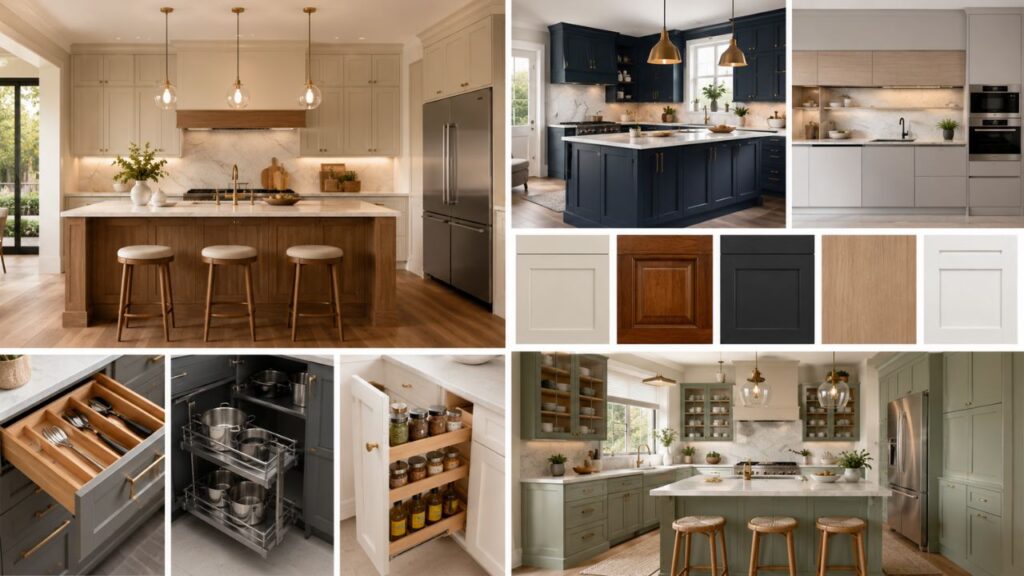
One of the most impactful kitchen cabinet ideas of the past several years is the two-tone approach: upper cabinets in one color or finish, lower cabinets in another. The most common execution pairs white or light upper cabinets with a deeper color — navy, forest green, charcoal — on the lowers. This grounds the kitchen visually, adds depth, and breaks up the monotony of a single-color scheme.
The key to making two-tone work is maintaining consistency in door style and hardware. Mixing finishes while keeping everything else unified creates intentional contrast rather than visual chaos.
Open Shelving as a Design Element
Open shelving has been both celebrated and criticized in kitchen design circles, and the reality is more nuanced than either camp admits. Replacing a few upper cabinet runs with open shelves creates breathing room in a kitchen that might otherwise feel heavy or closed-in. It also forces a level of organization that some homeowners find genuinely motivating.
The practical concern is real: open shelves collect grease and dust faster than closed cabinets, and they require consistent styling to look intentional rather than cluttered. A hybrid approach — open shelving in one or two strategic locations, closed cabinets everywhere else — tends to deliver the aesthetic benefit without the maintenance burden.
Glass-Front Cabinets
Glass-front cabinet doors offer a middle ground between fully open shelving and solid doors. They create visual depth, allow you to display curated dishware or glassware, and make a kitchen feel larger by breaking up solid surfaces. Seeded glass, reeded glass, and clear glass each create a different effect — seeded and reeded options obscure the interior slightly, which is forgiving if your shelves aren’t perfectly styled.
How Much Do Kitchen Cabinets Actually Cost?
Cost is where most renovation planning goes sideways, because the numbers people find online rarely reflect the full picture. The cabinet price you see advertised is almost never the price you pay.
Breaking Down the Real Numbers
For a typical 10×10 kitchen — the industry standard measurement used for comparison — here’s what you can realistically expect:
- Stock cabinets: $2,000 to $5,000 for cabinets only; $4,000 to $9,000 installed
- Semi-custom cabinets: $5,000 to $15,000 for cabinets only; $10,000 to $25,000 installed
- Custom cabinets: $15,000 to $30,000+ for cabinets only; $25,000 to $60,000+ installed
These ranges account for significant variation in material quality, regional labor costs, and kitchen complexity. A kitchen with an island, tall ceilings, or complex corner configurations will push costs toward the higher end of each range.
Hidden Costs Most Homeowners Miss
The cabinet price is just the beginning. Hardware — pulls, knobs, and hinges — adds $200 to $2,000 depending on quality and quantity. Interior accessories like pull-out trash cans, lazy Susans, drawer organizers, and pull-out shelves add $500 to $3,000. Delivery, installation, and any necessary modifications to plumbing or electrical to accommodate the new layout add further costs that vary significantly by region.
A realistic rule of thumb: budget 20% above your cabinet quote for the full installed cost including hardware and accessories.
Kitchen Cabinet Designs That Maximize Storage and Function
Beautiful kitchen cabinet designs that don’t function well become frustrating within months. The most successful kitchen renovations treat storage planning as seriously as aesthetics.
The Work Triangle and Cabinet Placement
The classic kitchen work triangle — the relationship between the sink, stove, and refrigerator — still provides a useful framework for cabinet placement. Base cabinets adjacent to the sink need to accommodate cleaning supplies and dish storage. Cabinets near the stove should prioritize cookware and spice storage. The refrigerator zone benefits from pantry-style tall cabinets for dry goods.
Understanding how you actually use your kitchen — not how you imagine you’ll use it — should drive these decisions. If you bake regularly, a dedicated baking station with deep drawers for sheet pans and a pull-out mixer shelf makes a meaningful difference. If you rarely cook, maximizing counter space and minimizing upper cabinets might serve you better.
Corner Cabinet Solutions
Corner cabinets are the most problematic storage spaces in any kitchen. The traditional blind corner cabinet wastes significant space and makes stored items genuinely difficult to access. Several solutions have emerged that dramatically improve corner functionality.
Lazy Susans — rotating shelves that bring items to you — remain the most common solution and work well for most households. Pull-out corner systems, sometimes called magic corners or Le Mans units, extend outward when the door opens, providing full access to the entire corner space. These systems cost more but deliver meaningfully better functionality for kitchens where storage is at a premium.
Drawer vs. Door Base Cabinets
One of the most impactful kitchen cabinet design decisions you can make is replacing door-style base cabinets with deep drawer stacks. Drawers provide dramatically better access to stored items than doors — you can see and reach everything without crouching or reaching into the back of a dark cabinet. Most kitchen designers now recommend drawer-style base cabinets for pots, pans, and dry goods wherever the layout allows.
Choosing the Right Kitchen Cabinet Color
Color is where personal preference and resale strategy sometimes collide, and navigating that tension requires honest self-assessment about your goals.
White and Off-White: The Perennial Safe Choice
White kitchen cabinets have dominated American kitchen design for decades, and their popularity shows no signs of fading. They make spaces feel larger, photograph well, and appeal to the broadest range of buyers. The practical downside is maintenance — white cabinets show fingerprints, grease, and wear more visibly than darker finishes, which matters more in households with young children or heavy cooking.
Off-white and cream tones offer a warmer alternative that reads as clean without the starkness of pure white. Benjamin Moore’s White Dove and Sherwin-Williams’ Alabaster are two of the most commonly specified cabinet colors in the industry, and for good reason — they work across a wide range of countertop and flooring combinations.
The Case for Color
Deeper cabinet colors — navy, sage green, charcoal, forest green — have moved from trend to mainstream over the past five years. Done well, they create a kitchen with genuine character and a sense of permanence that white kitchens sometimes lack. The risk is that color preferences are personal, and a deeply colored kitchen can feel polarizing to future buyers.
A practical middle ground: use color on the island or lower cabinets while keeping uppers neutral. This approach delivers visual interest without committing the entire kitchen to a color that might feel dated in a decade.
Frequently Asked Questions
What is the most durable material for kitchen cabinets?
Plywood-box cabinets with solid wood or MDF doors consistently outperform particleboard alternatives in long-term durability. Plywood resists moisture and holds hardware screws more securely over time, while MDF doors provide a smoother, more stable surface for painted finishes. For the highest durability, look for cabinets that specify plywood construction throughout — not just in the doors — and pair them with quality soft-close hardware that reduces daily wear on joints and hinges.
How do I know if my kitchen cabinets are worth refacing instead of replacing?
Cabinet refacing makes financial sense when the existing box structure is sound — no water damage, no warping, no failing joints — and you’re primarily unhappy with the appearance rather than the layout. Refacing typically costs 40% to 60% less than full replacement and can be completed in a fraction of the time. However, if you want to change your kitchen’s layout, add an island, or significantly reconfigure storage, refacing won’t solve those problems — replacement is the only path forward.
What is the standard depth of base and upper kitchen cabinets?
Standard base cabinets are 24 inches deep and 34.5 inches tall before countertop installation, bringing the finished counter height to approximately 36 inches — the ergonomic standard for most adults. Upper cabinets are typically 12 inches deep and come in heights of 30, 36, or 42 inches depending on ceiling height and design preference. Deeper upper cabinets (15 inches) are available and provide meaningfully more storage, though they can make a kitchen feel heavier if the ceiling height doesn’t accommodate them well.
How long does a kitchen cabinet installation typically take?
For a standard kitchen, professional cabinet installation takes 1 to 3 days for the cabinet boxes themselves. However, the full kitchen renovation timeline — including countertop templating and installation, backsplash, plumbing reconnection, and appliance reinstallation — typically runs 2 to 4 weeks from cabinet delivery. Semi-custom and custom cabinets add 4 to 16 weeks of lead time before installation even begins, which is the most common source of timeline surprises for homeowners who don’t plan for it.
Can I paint my existing kitchen cabinets instead of replacing them?
Painting existing cabinets is a legitimate option that can dramatically transform a kitchen at a fraction of replacement cost, but the quality of the result depends heavily on preparation and execution. Professional cabinet painters — who spray rather than brush, and who properly clean, sand, and prime before painting — deliver results that can last 8 to 10 years. DIY painting without proper preparation tends to chip and peel within 2 to 3 years, particularly on high-traffic areas like door edges and around hardware.
What hardware finish works best with white kitchen cabinets?
Matte black hardware has become the dominant pairing for white cabinets over the past several years, offering strong contrast and a contemporary edge. Brushed brass and unlacquered brass provide a warmer, more traditional alternative that has grown significantly in popularity. Brushed nickel remains a safe, versatile choice that reads as neither trendy nor dated. The key is consistency — mixing hardware finishes within a single kitchen rarely works unless done with deliberate intention and a clear design rationale.
How do kitchen cabinets affect home resale value?
Updated kitchen cabinets consistently rank among the highest-return renovation investments in annual cost-versus-value studies. A mid-range kitchen remodel — which includes cabinet replacement — returns approximately 70% to 80% of its cost at resale in most U.S. markets, according to Remodeling Magazine’s annual Cost vs. Value Report. More importantly, dated or damaged cabinets actively suppress buyer interest and can cause homes to sit on the market longer, making cabinet updates one of the most strategically sound pre-sale investments a homeowner can make.
What questions should I ask before hiring a cabinet installer?
Ask specifically whether they handle the full scope — delivery coordination, installation, and any necessary adjustments — or whether they subcontract portions of the work. Request references from projects completed within the past 12 months and ask to see photos of finished installations. Confirm that their quote includes scribing to walls (filling gaps between cabinets and uneven walls), leveling, and hardware installation. Installers who can’t answer these questions specifically are often less experienced than their pricing suggests.
Why do some kitchen cabinets warp or swell over time?
Warping and swelling almost always trace back to moisture exposure combined with low-quality box construction. Particleboard is particularly vulnerable — it absorbs moisture from dishwasher steam, under-sink leaks, and high-humidity environments, causing it to swell and eventually delaminate. Cabinets installed near dishwashers or under sinks deserve extra scrutiny during selection. Plywood construction, proper sealing of all exposed edges during installation, and prompt repair of any plumbing leaks are the most effective preventive measures.
What is the difference between face-frame and frameless cabinet construction?
Face-frame cabinets — the traditional American style — attach a solid wood frame to the front of the cabinet box, which provides structural rigidity and a surface for door hinges. Frameless cabinets, also called European-style, have no front frame — the doors attach directly to the box sides using concealed hinges. Frameless construction provides slightly more interior access and a cleaner, more contemporary appearance, but requires more precise installation since there’s no frame to hide minor alignment issues. Both styles are available across all quality tiers; the choice is primarily aesthetic and functional rather than a quality indicator.
Wrapping Up: Making a Decision You’ll Be Happy With for Years
Choosing kitchen cabinets is one of those decisions that rewards patience and punishes impulse. The homeowners who end up most satisfied with their kitchens are almost never the ones who moved fastest — they’re the ones who spent time understanding the difference between what looks good in a showroom and what holds up to a decade of daily use.
The material inside the box, the quality of the drawer slides, the precision of the installation — these are the details that determine whether your kitchen feels like a genuine upgrade five years from now or a source of quiet frustration. Kitchen cabinets are too central to your home’s function and value to evaluate on aesthetics alone.
Whatever direction you choose — stock, semi-custom, or custom; shaker or slab; white or something bolder — make that choice with full information and a clear sense of your priorities. A kitchen that works beautifully for how you actually live will always outperform one that simply photographs well.