There’s a moment almost every home cook knows — standing over a gas burner, waving smoke away from a screaming fire alarm, wondering if there’s a smarter way to cook. For millions of American households, the answer has been sitting in appliance showrooms for years, largely overlooked. The induction stove is quietly changing the way people cook, and once you understand how it works, it’s hard to go back to anything else.
Induction cooking has surged in popularity over the last few years, and for good reason. According to the Association of Home Appliance Manufacturers, induction appliance sales in the U.S. grew by double digits throughout the early 2020s, accelerated in part by new state rebate programs and a broader shift away from gas. Yet plenty of buyers still feel uncertain — about cost, compatibility, and whether the technology actually delivers on its promises.
This guide is written for exactly that person. Whether you’re remodeling a kitchen, replacing a broken range, or simply curious whether all the hype is justified, you’ll find real, experience-based answers here. We’ll cover how induction works, how it compares to electric stoves and gas, which models are worth your money, and what nobody tells you before you buy.
How an Induction Stove Actually Works
Most people understand gas and electric cooking intuitively — one burns fuel, the other heats a coil. Induction is different in a way that takes a few seconds to grasp but makes perfect sense once it clicks.
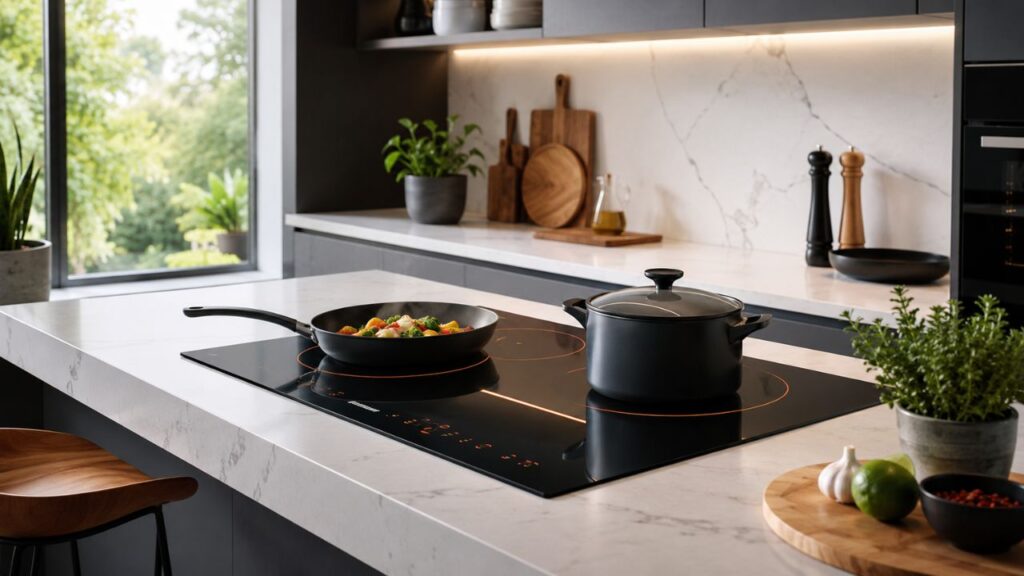
An induction stove uses electromagnetic energy to generate heat directly inside your cookware. Beneath each cooking zone sits a copper coil. When you turn the burner on, an alternating electric current passes through that coil, creating a magnetic field. If you place a ferromagnetic pot or pan on top, that magnetic field induces an electrical current inside the metal of the cookware itself — and that current generates heat.
The cooktop surface never actually heats up on its own. The heat you feel on the glass comes from the pan radiating it back downward. That’s not a minor detail — it’s the reason induction cooking is faster, safer, and more efficient than the alternatives.
What Is Induction Cooking, Really?
What is induction cooking at its core? It’s a method of transferring energy electromagnetically rather than thermally. Instead of creating heat and then transferring it to your pan (the way gas and electric stoves work), induction creates heat inside the pan directly. The result is an almost immediate response when you turn the heat up or down — far more precise than an electric coil and comparable to, or faster than, high-end gas.
This is why professional chefs who switch to induction often describe it as the best of both worlds: the control of gas with cleanup that’s genuinely easy.
Induction Stove vs. Electric Stove: What’s the Real Difference?
If you’ve been cooking on a standard electric stove — the kind with coil burners or a flat radiant glass-top — you might assume an induction range is just a fancier version of the same thing. It isn’t.
A conventional electric stove heats a metal coil or a radiant element beneath the glass surface. That element glows red, radiates heat upward, and eventually heats your pan from the outside in. The process is slow to respond, slow to cool, and wastes a significant amount of energy heating the air and glass around your cookware.
An induction range, by contrast, converts roughly 85–90% of its energy into useful cooking heat, compared to about 70–75% for smooth-top electric and around 40–55% for gas. That efficiency gap is real and measurable — you’ll likely see it in your electricity bill over time, particularly if you cook frequently.
There are practical differences in daily use, too. An electric stove’s surface stays dangerously hot long after you remove the pan. An induction surface cools quickly because it was never independently generating heat. Spills don’t bake onto the glass the same way. Cleanup is dramatically easier.
The One Catch: Cookware Compatibility
The biggest adjustment for people switching to induction cooking is cookware. Because the system depends on magnetic induction, your pots and pans must be made of a ferromagnetic material — cast iron, most stainless steel, and enameled cast iron all work. Aluminum, copper, and most glass cookware do not, unless they have a magnetic base added.
The quick test: hold a magnet to the bottom of your pan. If it sticks firmly, you’re good to go. Many households find their existing cast iron and a good portion of their stainless steel pans work without any issue. It’s rarely a full overhaul — but it’s worth checking before you buy.
Understanding What an Induction Cooktop Offers Day to Day
What is induction cooktop living like in a real kitchen? Faster and quieter than you’d expect. Water boils noticeably quicker than on gas or electric — some high-end models bring a full pot of water to a boil in under four minutes. Temperature control is responsive enough that you can hold a chocolate sauce at a gentle simmer without constant attention.
The surface is also remarkably easy to clean. Since the glass doesn’t get hot enough to bake on spills, most messes wipe off with a damp cloth. That alone converts a lot of people after years of scrubbing coil burners.
There’s also a safety dimension worth taking seriously, especially in homes with young children or older adults. Because the cooking surface itself doesn’t produce heat independently, touching it while a pan is removed won’t burn you the way a gas or electric burner would. Some models include pan-detection features that won’t activate a zone unless a compatible pot is present.
Induction Ranges Worth Knowing: The Bosch Induction Range and Beyond
The appliance market for induction has matured considerably. You’ll find solid options at nearly every price point, from budget-friendly portable units to full professional-style ranges.
The Bosch induction range consistently earns strong marks from both industry reviewers and everyday users. Bosch’s 800 Series and Benchmark Series models are frequently cited for their precise temperature control, responsive burners, and well-designed interfaces. The brand also tends to build quieter cooling fans than some competitors — a detail that matters more than you’d think in open-concept kitchens.
At the mid-range level, Samsung and LG both produce capable induction ranges with features like Air Fry modes and flexible cooking zones that can merge two burners into one large surface for griddles or oversized pans. These tend to offer more technology at a somewhat lower price than the premium German brands.
For budget-conscious shoppers, GE and Frigidaire have both introduced competitively priced induction ranges in recent years. They may lack some of the precision of higher-end models, but for most home cooks, the performance difference is minimal.
What About Portable Hot Plates?
Not everyone wants — or can afford — a full range replacement. A hot plate style induction unit is a single or double burner countertop appliance that plugs into a standard outlet and offers the same electromagnetic cooking technology at a fraction of the cost.
These are popular with college students, apartment renters, RV travelers, and anyone adding a secondary cooking surface to a kitchen. Brands like Duxtop, NuWave, and Cuisinart make well-reviewed single-burner units that run between $40 and $150. For supplemental cooking or testing induction before committing to a full range, a portable unit is a smart, low-risk entry point.
The Real Cost of Switching to Induction
The upfront cost of an induction stove is higher than a basic electric or gas range. Entry-level freestanding induction ranges start around $900–$1,100. Mid-range models with better build quality and more features typically run $1,500–$2,500. Premium models like the Bosch Benchmark or Thermador ranges can exceed $4,000.
That said, the economics shift when you factor in operating costs, available rebates, and cookware upgrades. The federal Inflation Reduction Act includes a tax credit of up to $840 for induction range purchases through qualifying programs, and many states have added their own incentives on top of that. Depending on your local utility rates and cooking habits, energy savings can meaningfully offset the higher purchase price over several years.
Installation is straightforward if you’re replacing an existing electric range — you need a 240-volt outlet, which most kitchens already have. Converting from gas requires more work: you’ll need an electrician to run a dedicated 240V circuit, which typically costs $200–$600 depending on your home’s electrical panel and the distance involved.
Induction Stove Performance: What Cooking Is Actually Like
Numbers and specs only go so far. What does it feel like to cook on an induction stove every day?
The honest answer is: impressive at first, then just normal. The speed becomes something you take for granted quickly. What sticks around as a genuine quality-of-life improvement is the control — particularly at low heat. Maintaining a true, steady simmer is notoriously difficult on gas and nearly impossible on a coil electric burner. On induction, you dial it in and it stays there.
Searing proteins is another area where induction performs well. A heavy cast iron skillet heats evenly across its entire base (something that’s less consistent on gas, where heat concentrates in the center), and the rapid heat response means you can pull back quickly if the pan gets too hot.
Baking-adjacent stovetop tasks — candy making, caramel, tempering chocolate — benefit enormously from precise temperature control. These are areas where even experienced cooks can struggle on conventional burners.
The one performance limitation worth noting: induction works best with flat-bottomed cookware. Wok cooking in the traditional sense — with a round-bottomed wok over high flame — doesn’t translate well, though flat-bottomed woks and dedicated induction wok elements exist as workarounds.
Frequently Asked Questions
Do I need special cookware for an induction stove?
Yes — but most kitchens already have at least some compatible cookware. Induction cooking requires pots and pans with a ferromagnetic base, meaning cast iron, carbon steel, and most stainless steel work well. You can test any pan with a refrigerator magnet: if it sticks to the bottom, the pan will work. Aluminum, pure copper, and glass cookware without a magnetic layer will not.
Is an induction range more expensive to run than gas?
It depends on your local utility rates, but in many U.S. markets, induction cooking costs less to run than gas despite using electricity. Induction converts roughly 85–90% of energy into cooking heat, compared to 40–55% for gas. When you calculate energy wasted rather than used, electricity often wins — especially as natural gas prices have increased in recent years.
How long does an induction cooktop last?
Most induction cooktops and ranges are built to last 10–15 years with normal use, which is comparable to other range types. The glass ceramic surface is durable but can crack if heavy objects are dropped on it. The electromagnetic components themselves tend to be reliable and are less prone to mechanical failure than gas valve systems.
Can children accidentally turn on an induction stove?
Many induction stoves include child lock features that prevent accidental activation. Beyond that, the pan-detection systems on most models mean the cooktop won’t generate meaningful heat without compatible cookware placed on the surface. This makes induction considerably safer around children than gas or conventional electric stoves.
Will an induction stove work during a power outage?
No. Induction stoves require electricity to operate — there’s no workaround for this. If power outages are a concern in your area, a gas range or a backup propane camp stove would be the appropriate supplement. Some households keep a portable propane burner specifically for this reason.
Is the Bosch induction range worth the price premium?
For buyers who prioritize quiet operation, precise control, and build quality, Bosch models consistently justify the premium. The 800 Series in particular earns strong long-term satisfaction ratings. That said, buyers on a tighter budget will find that mid-range models from Samsung or LG perform very well for everyday home cooking without the additional cost.
Can I use cast iron on an induction cooktop?
Cast iron is actually one of the best materials for induction cooking. It’s naturally magnetic, heats very evenly, and retains heat well. The main caution is weight — dragging heavy cast iron across the glass surface can scratch it over time. Lifting rather than sliding is the right habit to develop.
Do induction stoves make noise?
Most induction cooktops produce a faint hum or buzz, particularly at certain power levels, due to the electromagnetic activity. You may also hear the cooling fan that protects the internal components. These sounds are typically quiet and inoffensive, but they’re worth being aware of — particularly in open-plan kitchens where noise carries. Bosch and a few other premium brands are notably quieter than budget models.
Is induction cooking safe for people with pacemakers?
This is a reasonable concern. The electromagnetic fields generated by induction cooktops are localized close to the cooking surface, and in normal cooking posture, exposure is minimal. However, anyone with a pacemaker or other implanted electronic medical device should consult their cardiologist and the device manufacturer before using an induction stove regularly. Most modern pacemakers are designed to minimize interference from household appliances, but individual advice from a medical professional is always appropriate here.
Final Thoughts
The induction stove has earned its reputation. It’s faster than gas, cleaner than electric, more energy-efficient than either, and — once you’ve lived with one — genuinely enjoyable to cook on. The barrier to entry has never been lower, with federal incentives reducing real costs and a much wider range of models available at every price point than existed even five years ago.
If you’re hesitating because the technology feels unfamiliar, start small. A single-burner induction hot plate for $50 will let you experience the responsiveness and cleanup ease firsthand before committing to a full range replacement. Most people who try it become converts quickly.
The kitchen is where a lot of daily life happens, and the tools you cook with shape that experience more than we usually acknowledge. Switching to induction cooking isn’t about chasing trends — it’s about making that daily experience a little faster, a little safer, and a lot more pleasant.