
You can usually tell within thirty seconds of walking into a home whether the layout was planned or just happened. An open concept kitchen living room that’s been thought through feels easy — you move from cooking to chatting to relaxing without a single awkward corner getting in the way.
Get it wrong, though, and the same idea turns into a noisy, cluttered mess where you can smell dinner from the couch for the rest of the night. So what separates the layouts that work from the ones that don’t?
This guide pulls apart everything worth knowing about an open concept kitchen living room — from floor plan basics to small-space tricks, plus how a living room dining room combo fits into the same picture. Whether you’re renovating, building, or just rearranging furniture, there’s something here you can use today.
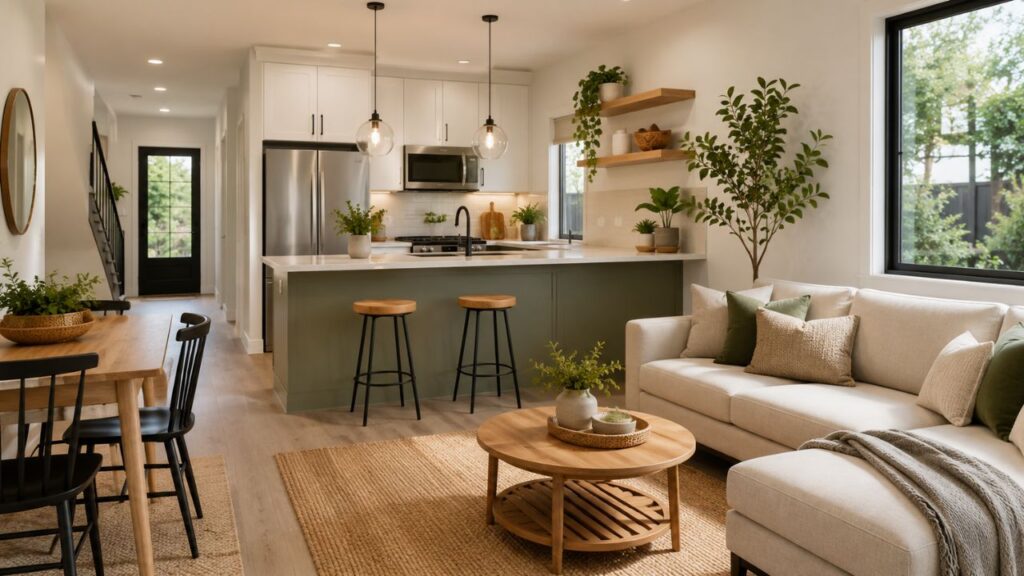
Why People Keep Choosing Open Concept Layouts
Walls used to mean privacy and structure. Now, for a lot of households, walls just mean wasted square footage.
The shift toward open concept living didn’t happen by accident. A few practical reasons keep showing up:
- Better natural light — fewer walls means light travels further through the home.
- Easier supervision — parents can cook while watching kids in the next room.
- More flexible entertaining — guests spread out naturally instead of crowding one room.
- A bigger feeling space — even modest square footage feels roomier without partition walls.
That said, open concept isn’t automatically better. It works brilliantly for some households and creates real headaches for others — noise travels everywhere, cooking smells linger in the sofa cushions, and there’s nowhere to hide the mess before guests arrive.
Who Open Concept Actually Suits
Ask yourself honestly: do you entertain often? Do you have young kids you want to keep an eye on while cooking? Does clutter stress you out, or do you not mind a lived-in look?
If most of your answers lean toward “yes, often,” an open concept layout is probably a good match. If you crave quiet separation after a long day, a more closed floor plan might suit your life better.
Open Concept Kitchen Living Room: Getting the Basics Right
At its core, an open concept kitchen living room removes the wall (or walls) that traditionally separated cooking space from lounging space. But “removing a wall” is the easy part — making the resulting space feel intentional is where the real design work happens.
The Three Zones That Matter
Even without walls, a well-designed open concept kitchen living room still has clear zones:
- Cooking zone — counters, appliances, and prep space.
- Lounging zone — sofas, coffee table, TV or fireplace focal point.
- Transition zone — often a kitchen island or rug that marks where one area ends and the next begins.
Skip this zoning, and the room reads as one giant blob of furniture with no visual logic. Add it back in, and suddenly the same square footage feels organized and calm.
A Quick Real-World Example
A couple I know gutted their 1990s house, knocking down the wall between a cramped galley kitchen and a separate sitting room. The result was a genuinely useful open concept kitchen living room — but only after they added a kitchen island as a soft boundary. Without it, the first version of the space felt like one room trying to do three jobs badly. The island fixed that almost overnight.
Long Open Plan Kitchen Living Room Floor Plan: Working With an Awkward Shape
Not every home gets a perfectly square open space. Plenty of houses, especially older row homes and narrow lots, end up with a long open plan kitchen living room floor plan that stretches front to back instead of side to side.
This shape comes with its own challenges:
- Furniture can feel scattered along a “bowling lane”
- Sightlines get long and narrow instead of wide and open
- Lighting often needs to be layered rather than centralized
Tips for a Long Open Plan Kitchen Living Room Floor Plan
- Break the length visually. Use a rug, a change in flooring material, or a half-wall to mark zones along the length.
- Run lighting in sections. A single central fixture won’t reach both ends — use pendant lights over the kitchen and a separate fixture over the seating area.
- Angle furniture inward. Facing sofas toward each other (instead of all pointing one direction) breaks the “hallway” feeling.
- Use a runner rug strategically between zones rather than one giant rug trying to cover the whole stretch.
A well-handled long open plan kitchen living room floor plan can actually be a strength — it gives you distinct activity zones without ever closing off the sightline between them. Homeowners dealing with a long open plan kitchen living room floor plan for the first time often assume the length is a flaw, when really it’s just an opportunity to plan for more zones than a square room would ever allow.
Open Kitchen Living Room Ideas Worth Stealing
Looking for inspiration rather than rules? Here are a handful of open kitchen living room ideas that consistently work across different home styles.
Idea 1: The Island as the Anchor
A kitchen island isn’t just for prep work. In most open kitchen living room ideas, the island doubles as a visual anchor, a casual dining spot, and the unofficial boundary between cooking and lounging.
Idea 2: Matching (Not Identical) Finishes
You don’t need the same cabinet color as your sofa fabric, but tying the spaces together with a shared accent color, similar wood tones, or matching trim keeps the open concept kitchen living room feeling cohesive rather than like two separate rooms awkwardly fused together.
Idea 3: Ceiling Treatments as Zoning Tools
Without walls, the ceiling becomes a powerful zoning tool. A change in ceiling height, a beam, or even a different paint color overhead can subtly tell your eye “this is the kitchen” versus “this is the living room” — one of the more underrated open kitchen living room ideas out there.
Idea 4: Statement Lighting Over Each Zone
Distinct lighting fixtures over the kitchen island and the seating area do double duty — they look good, and they reinforce the sense that each area has its own purpose.
Idea 5: Borrowing Color From One Zone to the Other
One of the simplest open kitchen living room ideas is letting a single accent color show up in both spaces — a teal backsplash echoed in a throw pillow, for instance. It’s a small detail, but it quietly tells the eye that both halves of the room belong together. Designers working through countless open kitchen living room ideas for client homes often say this trick does more visual heavy lifting than any single piece of furniture.
Very Small Open Plan Kitchen Living Room Ideas
Small homes face a different set of challenges. When square footage is tight, very small open plan kitchen living room ideas need to work twice as hard — every inch has to earn its place.
Tricks That Actually Help in Tiny Spaces
- Go vertical. Tall, narrow cabinets and shelving free up floor space.
- Choose multi-purpose furniture. A storage ottoman, a fold-down table, or a bench with hidden storage all pull double duty.
- Stick to a light, consistent color palette. Dark, busy colors make a small open space feel boxed in.
- Skip the oversized island. In genuinely tight layouts, a slim peninsula or rolling cart often works better than a full island.
- Mirror strategically. A mirror placed to reflect a window can make a cramped open layout feel noticeably bigger.
Among the most useful very small open plan kitchen living room ideas, scale is everything. Oversized furniture is the single biggest mistake people make in small open spaces — a sofa that would look perfectly normal in a bigger room can swallow a tiny one whole.
Case Study: A 600-Square-Foot Apartment
A young couple renting a 600-square-foot apartment turned their cramped layout around using exactly this approach. They swapped a bulky sectional for a smaller loveseat and two slim chairs, added a slim rolling kitchen cart instead of a fixed island, and painted the whole space one soft, consistent color. The apartment didn’t get any bigger — it just stopped fighting itself. That’s the real lesson behind most very small open plan kitchen living room ideas: the goal isn’t more stuff, it’s smarter stuff. And once you start applying very small open plan kitchen living room ideas like these consistently, the space stops feeling like a compromise and starts feeling like a deliberate choice.
Open Concept Living Room: Making the Lounging Side Work
The kitchen tends to get most of the design attention, but the open concept living room side of the equation deserves just as much thought.
What Makes an Open Concept Living Room Feel Settled
- A clear focal point — TV, fireplace, or a striking piece of art that anchors the seating arrangement
- Furniture that doesn’t block flow — leave clear walking paths between the kitchen and the seating area
- Soft textiles — rugs, curtains, and cushions help absorb sound, which matters more in open layouts than closed ones
- A defined edge — even without a wall, a rug or furniture arrangement should clearly mark where the living room “starts”
Sound is genuinely underrated here. An open concept living room without any soft surfaces can turn surprisingly loud — every clattering pan and dishwasher cycle echoes straight into your movie night.
Lighting layers matter too. A single overhead fixture rarely flatters an open concept living room the way a mix of floor lamps, table lamps, and dimmable overhead lights does. Layered lighting lets you shift the mood from bright and functional during the day to soft and relaxed once dinner’s done.
Living Room Dining Room Combo: The Other Half of the Equation
Plenty of homes don’t stop at kitchen and living room — they fold in a third zone too. A living room dining room combo is incredibly common in open-plan homes, and it brings its own balancing act.
Making a Living Room Dining Room Combo Work
- Use the dining table as a transition point between the kitchen and the seating area, rather than shoving it against a wall.
- Keep the dining area lit separately with a pendant or chandelier, so it reads as its own space even without walls.
- Avoid identical seating styles. A dining chair doesn’t need to match the sofa — contrast actually helps define the zones.
- Leave breathing room. A common mistake in a living room dining room combo is cramming the table too close to the sofa, which kills the walking path between zones.
Done well, a living room dining room combo lets a household host a full dinner party and still flop onto the couch ten feet away without ever feeling like they’re in the wrong room.
Small House Open Concept Kitchen and Living Room: Special Considerations
Open concept living isn’t just for sprawling new builds. A surprising number of people are tackling small house open concept kitchen and living room renovations specifically because removing walls is one of the few ways to make a modest footprint feel larger.
What’s Different About Small Homes
- Storage has to be built in, not added later. Built-in benches, under-stair cabinets, and floor-to-ceiling shelving matter more here than in larger homes.
- Every appliance choice counts. A smaller fridge or a two-burner cooktop can free up real visual space in a tight small house open concept kitchen and living room layout.
- Sightlines matter more than square footage. A small home with a clear, unobstructed view from the front door to the back window will feel bigger than a slightly larger home chopped up by furniture.
A Realistic Example
A family renovating a 950-square-foot bungalow knocked down a load-bearing wall (with proper engineering support, of course) between their tiny kitchen and equally tiny living room. The combined space wasn’t any bigger on paper, but it felt completely different — what used to be two cramped rooms became one functional, breathable space. That’s the quiet appeal behind most small house open concept kitchen and living room projects: the square footage doesn’t change, but the experience of living in it does. Anyone weighing a similar small house open concept kitchen and living room renovation should budget extra time for permits if a load-bearing wall is involved — it’s the one step people most often underestimate.
Open Floor Plan Ideas Beyond the Kitchen and Living Room
It’s worth zooming out for a second. Open floor plan ideas don’t have to stop at the kitchen-living room boundary — plenty of homes extend the same logic into entryways, home offices, and even bedrooms.
A few open floor plan ideas worth considering for the rest of the house:
- A home office nook tucked into a living room corner instead of a separate closed room
- An open staircase landing that doubles as a reading area
- A mudroom that flows directly into the kitchen rather than sitting behind a closed door
Not every space needs to be open, of course. Bedrooms and bathrooms almost always benefit from staying closed off. But borrowing a few open floor plan ideas for secondary spaces can extend the same airy feeling throughout a whole home, not just the main living area.
It’s also worth noting that open floor plan ideas don’t require a full renovation to test out. Even temporarily rearranging furniture to remove a visual barrier, or swapping a solid door for a glass one, can give you a sense of whether you’d actually enjoy living with less separation before committing to anything structural.
Common Mistakes to Avoid in Open Concept Spaces
Even with good intentions, certain mistakes show up again and again in open-plan renovations:
- No zoning at all. Removing walls without replacing them with any visual structure leaves the space feeling unfinished.
- Ignoring acoustics. Hard floors, bare windows, and no soft furniture make every open space loud.
- Skipping ventilation upgrades. Cooking smells travel much further in an open layout — a strong range hood isn’t optional anymore.
- One light fixture for the whole space. Different zones need different lighting; one central light rarely does the job.
- Forgetting storage. Walls used to hide a lot of clutter. Open layouts need more intentional storage solutions to compensate.
Quick FAQ: Open Concept Living, Answered Honestly
Is an open concept kitchen living room actually good for resale value? In most markets, yes. Real estate agents commonly report that an open concept kitchen living room is one of the more requested features among buyers, particularly in mid-range family homes. It’s not universal — some buyers in older or historic homes prefer original layouts — but broadly, this layout tends to help rather than hurt resale appeal.
What’s the difference between open concept and an open floor plan? Honestly, not much — most people use open concept and “open floor plan” interchangeably. The phrase “open floor plan ideas” usually shows up in broader searches covering the whole house, while open concept more often refers specifically to the kitchen-living area. Either way, anyone researching open floor plan ideas for a renovation will end up reading about the same core principles regardless of which term they typed into the search bar.
Can a very small home really pull off an open layout? Yes, with the right approach. The best very small open plan kitchen living room ideas focus on scale and storage rather than trying to cram in more furniture. Done right, a tiny home with an open concept living room can feel far more spacious than a slightly bigger home chopped into separate rooms. The same goes for a long, narrow open concept living room built around a long open plan kitchen living room floor plan — scale and zoning matter more than raw square footage either way.
Do I need a kitchen island for an open concept kitchen living room to work? Not strictly, but it helps. An island (or even a peninsula) gives an open concept kitchen living room a natural boundary without needing an actual wall. Without some kind of anchor, the space can feel a little directionless.
How do I add a living room dining room combo without making the space feel cramped? Keep pathways clear and let lighting do the zoning. A living room dining room combo works best when the dining area has its own light source and enough breathing room around the table — usually at least three feet of clearance on each side for chairs to pull out comfortably.
Final Thoughts: Build the Layout Around How You Actually Live
There’s a reason so many homeowners gravitate toward an open concept kitchen living room: it mirrors how most households actually spend their time — cooking, chatting, and relaxing all within earshot of each other, instead of scattered behind closed doors.
But the layout only works when it’s planned with intention. Zoning, lighting, storage, and scale all matter more in an open space than in a traditional one, precisely because there are no walls to quietly cover for design mistakes.
Whether you’re working with a sprawling long open plan kitchen living room floor plan or tackling a small house open concept kitchen and living room renovation on a tight budget, the same principle holds: define your zones first, then decorate. The walls might be gone, but the structure still needs to exist — it just lives in furniture placement, lighting, and flooring instead of drywall.
Action step: Before you move a single piece of furniture or knock down a wall, sketch your space on paper and mark three zones — cooking, dining, and lounging. If you can draw a clear, unobstructed path between all three without furniture blocking the way, you’re already most of the way to a layout that works.