
Walk into almost any furniture showroom, scroll through any home renovation account, or flip through any shelter magazine right now, and you’ll spot it within seconds: a walnut credenza with tapered legs, a sunburst clock, a low-slung sofa that somehow looks both relaxed and architecturally serious. That’s midcentury modern, and it’s not a trend that came back — it never really left.
If you’ve typed “mid century modern” into a search bar recently, you’re probably trying to figure out one of a few things: what the style actually is, how to spot real mid century modern furniture versus a knockoff, how to put together a mid century living room that doesn’t feel like a showroom display, or maybe you’re hunting for a specific piece for an MCM house you just bought. This guide is built to answer all of that, in the order you’d actually need it.
I’ve spent years buying, restoring, and writing about furniture from this period — chasing down dovetail joints at estate sales, arguing with sellers about whether a chair is “Eames style” or an actual Eames, and slowly furnishing my own house the hard, patient way. So this isn’t a surface-level definition post. It’s the stuff I wish someone had told me before I spent money on the wrong pieces.
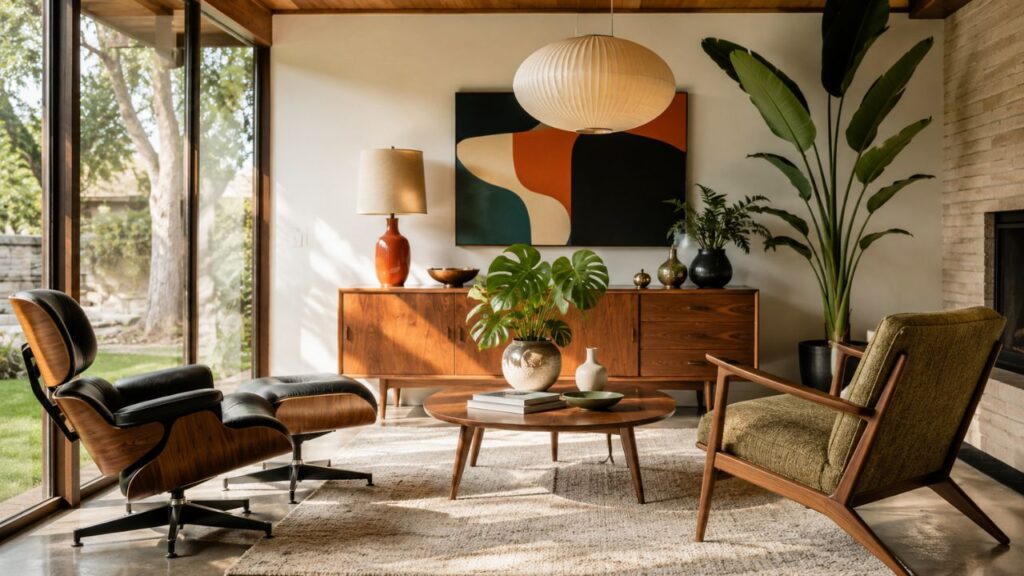
What “Midcentury Modern” Actually Means
The term midcentury modern describes a design movement in architecture, furniture, and graphic design that ran roughly from the mid-1930s through the late 1960s, with its real peak between 1947 and 1957. The phrase itself wasn’t even coined until decades later — design historian Cara Greenberg popularized it in her 1984 book about the furniture from that era, and the label stuck.
So when someone says mid century modern, they’re talking about a specific historical window, not just “anything retro.” That distinction matters because it’s the difference between buying an authentic piece with real provenance and buying a modern reproduction styled to look like one. Both can be valid choices — but you should know which one you’re getting.
The mid century modern years were shaped by a unique mix of forces:
- Postwar prosperity and a housing boom across the US and parts of Europe
- New industrial materials — molded plywood, fiberglass, plastic resin, aluminum — that became available for civilian use
- A cultural shift toward open living, casual entertaining, and indoor-outdoor connection
- Influence from the Bauhaus movement, which pushed “form follows function” into mainstream homes
That combination is why mid century modern design still feels so coherent today. It wasn’t decoration layered onto a house. It was a complete way of thinking about how people should live.
Mid Century Modern Architecture: The Bones of the Style
Before furniture, there’s the house itself. Mid century modern architecture is built around a handful of consistent principles, and once you know them, you’ll start noticing them everywhere — including in houses that were never marketed as “MCM” but clearly borrowed the playbook.
Core Architectural Features
- Low-slung rooflines, often flat or with a gentle slope
- Walls of glass, especially facing a backyard or garden, to blur the line between indoors and outdoors
- Open floor plans with few interior walls separating kitchen, dining, and living spaces
- Post-and-beam construction, which let architects remove load-bearing walls and open up sightlines
- Natural materials like exposed wood, stone, and brick, often left unfinished or lightly treated
- Integration with the landscape — houses built to follow the slope of a lot rather than fight it
Architects like Richard Neutra, Joseph Eichler (as a developer working with several architects), and the team behind the Case Study House Program in Southern California turned these ideas into thousands of real homes. If you’ve ever heard someone mention an “Eichler” in a real estate listing, that’s a direct descendant of this movement — and those houses now sell at a premium specifically because buyers want the genuine architectural pedigree, not just the look.
What Makes an MCM House Different From a Regular Ranch House
This is where a lot of confusion happens. A 1950s ranch house and a true mid century modern house can look superficially similar from the street, but the differences show up in the details:
| Feature | Standard 1950s Ranch | True MCM House |
|---|---|---|
| Roofline | Gabled, traditional pitch | Flat or low-slope, often with deep overhangs |
| Window placement | Smaller, evenly spaced | Floor-to-ceiling glass panels |
| Layout | Segmented rooms | Open-plan living areas |
| Material use | Painted siding | Exposed wood, stone, brick |
| Connection to outdoors | Minimal | Central design goal — patios, atriums |
If you’re house hunting and a listing uses “MCM” loosely, walk through with this checklist. A real mcm house earns the label structurally, not just through staging.
Mid Century Modern Furniture: What to Actually Look For
This is probably the section you came for, so let’s get specific. Mid century modern furniture isn’t one look — it’s a family of related styles from different designers and countries, all working with similar materials and similar restraint.
The Defining Traits of Authentic MCM Furniture
- Tapered, splayed legs — usually wood, often angled outward
- Organic curves mixed with clean geometric lines
- Minimal ornamentation — no carved details, no excess hardware
- Mixed materials — wood paired with metal, glass, or molded plastic
- Function-first joinery — exposed joints as a design feature, not something to hide
When people search for the best mid century modern furniture, what they usually mean is pieces that combine all of the above with genuine craftsmanship — solid wood construction, dovetail or finger joints, and hardware that’s held up for sixty-plus years without falling apart.
Iconic Names You’ll Run Into
You don’t need to memorize design history, but recognizing a few names will save you from overpaying for generic pieces marketed as something they’re not:
- Charles and Ray Eames — molded plywood and fiberglass chairs, the Eames Lounge Chair and Ottoman
- George Nelson — the Marshmallow Sofa, ball clocks, modular storage
- Hans Wegner — Danish craftsmanship, the Wishbone Chair
- Arne Jacobsen — the Egg Chair and Swan Chair
- Eero Saarinen — the Tulip Chair and Womb Chair
- Florence Knoll — clean-lined sofas and case goods through Knoll
- Paul McCobb — accessible, modular case furniture that’s easier to find affordably
These designers represent iconic mid-century work that’s now studied in design schools and sold in museum gift shops — but their original pieces also command serious resale prices. That’s exactly why the reproduction market is so large, and why knowing the difference matters before you buy.
Finding Unique Mid Century Modern Furniture Without Overpaying
If you’re after unique mid century modern furniture rather than mass-market reproductions, here’s where experienced buyers actually look:
- Estate sales — often the best source for solid, original pieces at fair prices
- Regional auction houses — less competition than big-name auctions, real provenance
- Specialty dealers — pricier, but they’ve already done the authentication work
- Scandinavian and Brazilian imports — countries with strong MCM traditions outside the US, often overlooked by buyers focused only on American pieces
- Estate liquidators in postwar suburban neighborhoods — literally the houses these pieces were bought for originally
A quick gut check before buying: flip the piece over. Original construction usually shows solid wood, dovetail joinery, and manufacturer stamps or paper labels. Reproductions often use veneer over particleboard and skip the labeling entirely.
Mid Century Modern Style Furniture vs. Mass-Market “MCM-Inspired” Pieces
There’s an entire industry now built around mid century modern style furniture that isn’t vintage at all — new furniture designed to evoke the era without claiming to be from it. This isn’t automatically a bad option. Budget, sustainability concerns, and simple availability make new pieces the right call for plenty of people.
When New “MCM-Inspired” Furniture Makes Sense
- You want a consistent, matched look across an entire room
- You’re not interested in restoration or sourcing hunts
- You need furniture that meets current safety and flammability standards
- You’re furnishing a rental or temporary space
When Original Pieces Are Worth the Hunt
- You’re restoring a genuine MCM house and want furniture that matches its era
- You care about craftsmanship that’s already proven itself for decades
- You’re building a collection with resale or heirloom value in mind
- You want pieces with a documented design and manufacturing history
The honest answer is that most well-furnished mid century modern rooms mix both — a few investment pieces (an original lounge chair, a vintage credenza) paired with newer, more affordable supporting furniture. That’s not a compromise; it’s how most experienced collectors actually furnish a house.
Designing a Mid Century Living Room That Feels Lived-In, Not Staged
This is where a lot of attempts at the style go wrong. People chase the mcm living room look from a magazine spread and end up with something that feels like a furniture catalog rather than a home. Here’s how to avoid that.
Building a Warm Mid Century Modern Living Room
A warm mid century modern living room depends on a few specific choices working together:
- Wood tone consistency — pick one dominant wood tone (walnut, teak, or oak) and stay close to it across your major pieces
- Layered textures — pair smooth wood and leather with something soft, like a wool throw or a shag-adjacent area rug, to avoid a cold, showroom feel
- Warm color accents — burnt orange, mustard, avocado green, and deep teal were genuine period colors, not just nostalgic clichés
- Low-profile seating — sofas and chairs sitting closer to the ground than modern furniture, which changes how a whole room reads
- Functional lighting — sculptural floor lamps and pendant lights, not recessed can lighting, which didn’t exist in this design language
A Retro Vintage Mid Century Living Room, Without the Theme-Park Effect
If you want a genuinely retro vintage mid century living room rather than a modern room with a few MCM accents thrown in, prioritize:
- One real vintage anchor piece (a sideboard, a credenza, or a lounge chair)
- A rug with a geometric or abstract pattern from the period’s color palette
- Wall art that’s actually from or inspired by the era — abstract expressionism, atomic-age motifs, or simple line art
- Restraint — period rooms were not cluttered. Open floor space was part of the design philosophy, not an afterthought
1950s Mid Century Modern House Interior Cues Worth Borrowing
A genuine 1950’s mid century modern house interior wasn’t trying to look busy or maximalist. It relied on a few load-bearing design choices:
- Exposed wood ceilings or wood paneling on a single accent wall, not every wall
- Built-in shelving and room dividers instead of freestanding furniture walls
- Conversation pits or grouped seating arrangements that faced each other, not a TV
- Minimal window treatments — sheer curtains or none at all, letting the architecture’s glass do the work
Common Mistakes People Make Chasing the MCM Look
I’ve made most of these myself, so consider this the shortcut version of learning the hard way.
Mistake 1: Buying everything from one matched set. Original mid century rooms were assembled over years from different sources. A room built entirely from one catalog collection often looks flat and themed rather than collected.
Mistake 2: Ignoring scale. A lot of original MCM furniture was built for smaller postwar homes. A genuine vintage sofa can be narrower and lower than you expect — measure before you buy, especially online.
Mistake 3: Over-restoring. Stripping every piece of patina off original wood erases part of what makes it valuable and visually interesting. A little wear is part of the story, not a flaw to eliminate.
Mistake 4: Treating “MCM” as one single look. Danish, American, Brazilian, and Italian mid century design all have distinct characteristics. Mixing them without intention can create visual noise instead of cohesion.
Mid Century Modern Design Beyond Furniture and Architecture
The movement reached well past houses and chairs. Mid century modern design shaped:
- Graphic design and advertising — clean sans-serif type, bold flat color blocks, geometric layouts
- Product design — radios, telephones, kitchen appliances built with the same restraint as the furniture
- Textiles — abstract, atomic-inspired prints from designers like Alexander Girard
- Ceramics and tableware — brands like Heath Ceramics and Russel Wright dinnerware
Understanding this wider context helps explain why the style feels so complete when it’s done right — it was never just about furniture. It was an entire visual language applied consistently across a household.
Frequently Asked Questions
What does MCM mean in furniture and design? MCM stands for midcentury modern, the design movement spanning roughly the 1930s through the late 1960s, with its peak years in the late 1940s through the 1950s.
How do I tell if furniture is real mid century modern or a reproduction? Check construction first — solid wood, dovetail or finger joinery, and manufacturer labels or stamps usually indicate originality. Reproductions often use veneer over composite wood and lack period hardware or labeling.
What colors work best in a mid century modern living room? Warm, earthy tones read most authentically: walnut and teak wood tones, mustard, burnt orange, avocado green, and deep teal, balanced against neutral walls.
Is mid century modern the same as Scandinavian design? They overlap but aren’t identical. Scandinavian design is a regional movement within the broader mid century period, generally lighter in wood tone and more minimal than American MCM, which often used darker walnut and bolder accent colors.
Are mid century modern houses a good investment? Genuine MCM houses, especially architect-designed or developer-built examples like Eichler homes, have held strong resale value in many markets because of growing buyer demand and limited original supply.
Can I mix mid century modern furniture with other styles? Yes, and most well-designed rooms do. MCM pairs naturally with minimalist, Scandinavian, and even some industrial pieces, as long as wood tones and proportions stay consistent across the room.