
Most people treat the closet door like an afterthought. You move into a house, the builder-grade bifold doors are already hanging there, and you just… live with them. For years.
Then one day you’re standing in your bedroom, the door is half off its track again, and you realize this flimsy slab of hollow-core wood has been quietly making your room look smaller and your storage less functional the entire time.
I’ve spent a good chunk of the last several years helping homeowners rethink builder-grade fixtures, and closet doors come up constantly. They’re one of the cheapest upgrades with the biggest visual payoff in a home. A $40 swap or a $400 custom build can completely change how a bedroom, hallway, or bathroom feels.
This guide walks through closet door ideas for nearly every situation — tight hallways, awkward bathroom nooks, walk-in closets that deserve better, kids’ rooms, and budget-conscious renters who can’t drill into walls. By the end, you’ll know exactly which direction fits your space, your budget, and your style.
Quick Answer: The Most Popular Closet Door Options Right Now
If you’re short on time, here’s the fast version. The most common closet door options in 2026 are:
- Sliding (barn-style) doors — best for modern homes and tight floor space
- Bifold doors — budget-friendly, classic, decent for standard closets
- Bypass/sliding mirrored doors — great for small bedrooms needing extra light and reflection
- Pocket doors — disappear into the wall, ideal when floor space is at a premium
- Curtains or fabric panels — the cheapest closet door alternatives, perfect for renters
- French doors — elegant, best for walk-in closets and dressing rooms
- Louvered or slatted doors — allow airflow, popular for linen and utility closets
Now let’s get into the details, because the right pick really does depend on your specific room.
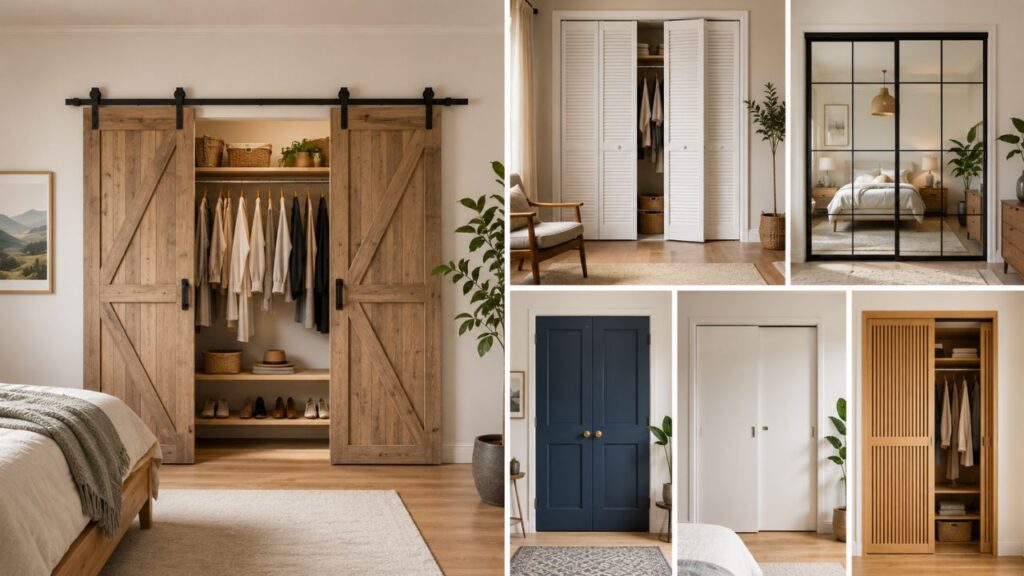
How to Choose Closet Doors: 5 Questions to Ask First
Before falling in love with a Pinterest photo, walk through these questions. They’ll save you from buying doors that look great online but don’t fit your actual hallway.
1. How much floor space can you spare?
Swinging doors need clearance. If your hallway is narrow or there’s furniture nearby, a swinging door will constantly bump into something. This is where space saving closet doors — sliding, bifold, or pocket styles — earn their keep.
2. What’s your budget?
Custom closet doors can run anywhere from $300 to $2,000+ per opening depending on material and hardware. Off-the-shelf bifold or sliding doors from a home improvement store typically land between $80 and $300.
3. Is this a rental?
If you can’t make permanent changes, you need closet door alternatives that don’t involve removing the existing door or drilling extra holes — think curtains, removable contact paper, or temporary sliding track kits.
4. What’s the room’s function?
A bathroom closet door deals with humidity and needs to handle moisture better than a bedroom door. A linen closet might benefit from louvered doors for ventilation. A walk-in closet door might not even need a traditional door at all.
5. What’s your existing decor style?
Modern closet door ideas (think matte black hardware, flat panels, minimal trim) clash badly with a traditional farmhouse bedroom. Matching your door style to the room’s existing language matters more than people expect.
Closet Door Ideas by Room
Bedroom Closet Door Ideas
The bedroom is where most people spend the most time deciding on closet doors, and for good reason — it’s a large surface area that affects the whole room’s mood.
Mirrored sliding doors remain one of the most requested bedroom closet doors ideas, especially in smaller rooms. They do double duty: you get a full-length mirror without sacrificing wall space, and the reflective surface visually doubles the room.
Wood-paneled bifolds with updated hardware are an underrated bedroom closet door idea. You don’t need to replace the door itself — sometimes swapping plain knobs for brushed brass pulls and adding a coat of paint is enough to make tired bifolds look intentional again.
Statement color doors have become one of the more interesting closet door color ideas trending in design circles. Instead of matching the door to the wall, homeowners are painting closet doors in deep forest green, navy, or even terracotta to create a focal point. This works particularly well in bedrooms with otherwise neutral palettes.
For a primary bedroom with a deep reach-in closet, a single sliding barn door mounted on exposed black hardware gives a boutique-hotel feel without the cost of a full walk-in renovation.
Small Closet Door Ideas
Small spaces need smart thinking, not just smaller furniture.
For tight quarters, bypass doors (two or three panels that slide past each other on a track) are among the most practical small closet door ideas because they require zero swing clearance. Accordion-style folding doors work similarly and cost less, though they’re less durable long-term.
If the closet itself is shallow and narrow, consider ditching the door altogether. An open closet with a curtain on a tension rod is one of the simplest closet door solutions for tight spaces — it’s reversible, costs under $30, and instantly makes a cramped room feel less boxed in.
Another option worth mentioning: pocket doors. They require some carpentry work (the wall needs a cavity), but for a small bedroom where every inch of swing space counts, a pocket door is the single most space-efficient choice among all types of closet doors.
Bathroom Closet Door Ideas
Bathrooms come with their own rulebook because of moisture, humidity, and ventilation needs.
Louvered (slatted door) designs are a longtime favorite for bathroom closet doors ideas because the angled slats allow air circulation, which helps prevent mildew buildup inside linen closets. A slated door is also visually lighter than a solid panel, which suits smaller bathrooms.
For a more modern bathroom, frosted glass sliding doors let light pass through while keeping the contents private — a popular pick among bathroom closet door ideas for spa-style primary bathrooms.
If your bathroom closet is more of a narrow linen nook, a simple pocket door or a slim bifold keeps the space from feeling cramped every time you open it.
Walk-In Closet Door Ideas
A walk-in closet door is a different conversation entirely, because the closet itself is essentially a small room.
Many homeowners are skipping the door altogether and using an open archway, sometimes with a decorative curtain for privacy. Others go the opposite direction with French doors — two hinged panels, often with glass inserts, that turn the closet entrance into a dressing room door design moment rather than a purely functional opening.
For walk-in closets attached to a primary suite, a single wide sliding door (sometimes called a “barn door” even when it’s not rustic in style) is currently one of the most requested custom closet doors styles, largely because it doubles as a design statement visible from the bed.
Comparison Table: Types of Closet Doors at a Glance
| Door Type | Best For | Approx. Cost Range | Space Needed | Maintenance |
|---|---|---|---|---|
| Bifold | Standard reach-in closets | $80–$250 | Minimal swing | Low |
| Sliding/Bypass | Small rooms, modern decor | $150–$500 | None (slides on track) | Low |
| Tight hallways, minimalist look | $400–$1,200 (incl. install) | None once installed | Moderate (track can jam) | |
| French | Walk-in closets, dressing rooms | $500–$2,000+ | Full swing clearance | Low |
| Louvered | Linen/utility closets, bathrooms | $100–$350 | Minimal swing | Low |
| Curtain/Fabric | Renters, kids’ rooms, budget fixes | $15–$80 | None | Very low |
| Mirrored Sliding | Small bedrooms needing light | $200–$600 | None | Low |
This table covers the core closet door options most homeowners compare before making a decision, but your final pick should weigh style and household needs alongside cost.
Unique and Modern Closet Door Ideas Worth Stealing
If you want something beyond the standard catalog options, here are a few unique closet doors ideas that designers have been leaning into lately.
- Fluted wood panel doors — vertical grooved wood paneling adds texture without pattern, a popular modern closet door idea for minimalist bedrooms.
- Rattan or cane inserts — woven panels set into a wood frame bring a warm, textured look, especially popular in coastal and boho interiors.
- Chalkboard-painted doors — genuinely useful in a kids’ room or mudroom closet for notes and lists, and it doubles as cool closet doors for family homes.
- Wallpapered panel doors — applying removable wallpaper to a flat door panel turns a boring slab into a statement piece for almost no cost.
- Mixed-material sliding doors — combining glass and wood, or metal and wood, in a single sliding panel for an industrial-modern look.
- Color-blocked bifolds — painting just the top or bottom half of a bifold door a contrasting shade for a playful, design-forward touch.
These ideas work especially well as a closet door replacement project when you’re not ready for a full closet door replacement budget but want something that doesn’t look like everyone else’s.
How to Build a Closet Door (DIY Overview)
If you’re handy and want to skip the retail markup, building your own door is more achievable than most people assume. Here’s a simplified rundown of how to build a closet door using a basic plank-and-batten style, one of the more beginner-friendly DIY builds:
- Measure the opening precisely — width and height, accounting for any track hardware you plan to use.
- Choose your panel material — plywood, MDF, or shiplap boards are common, budget-friendly choices.
- Cut and assemble the panel to match your opening, leaving a small gap for hardware clearance.
- Add battens or trim for a board-and-batten or shaker-style look, which also adds rigidity.
- Sand, prime, and paint or stain according to your room’s palette.
- Install hardware — sliding track, bifold hinges, or standard door hinges depending on your chosen style.
- Test the swing or slide before final mounting to confirm clearance.
A weekend project like this typically costs a fraction of a custom closet doors quote from a contractor, though it does require basic tools (circular saw, drill, level) and some patience on the first attempt.
Closet Door Color Ideas That Actually Work
Color is one of the easiest and cheapest ways to upgrade an existing door without replacing it. A few closet door color ideas that consistently work well in real homes:
- Matte black — pairs with almost any wall color and reads as modern instantly
- Soft sage or olive green — calming, works in bedrooms and nurseries alike
- Warm terracotta — adds warmth to neutral or beige-heavy rooms
- Deep navy — classic, slightly formal, pairs beautifully with brass hardware
- Same-as-wall (color-drenched) — painting the door the exact shade as the surrounding wall to make it disappear, often used in hallway closet openings to reduce visual clutter
A general rule from years of seeing this play out in real homes: lighter colors recede and make a room feel calmer, while darker colors create a focal point. Decide which effect you actually want before grabbing a paint chip.
Closet Door Alternatives for Renters and Budget Projects
Not everyone wants or can commit to a permanent door swap. Here are practical closet door alternatives that don’t involve major construction:
- Tension-rod curtains — the fastest, cheapest fix, and fully reversible
- Removable wallpaper on existing doors — changes the look without touching the door itself
- Beaded curtains or macrame panels — a more bohemian alternative for open closets
- Temporary sliding track kits — some brands now sell tension-mounted tracks that don’t require drilling into the wall studs
- Folding screens — a freestanding option placed in front of an open closet, popular in studio apartments
These options solve the same core problem as permanent doors — concealing storage — without the commitment, which matters a lot if you’re renting or testing out a design direction before investing in something custom.
Pull Open vs. Sliding vs. Folding: Which Mechanism Should You Pick?
This is where a lot of people get stuck, because the door style (look) and the door mechanism (how it opens) are two separate decisions.
Pull open closet doors (standard hinged doors that swing outward) work best when you have generous floor clearance and want a traditional look. They seal better against drafts and dust than sliding options, which matters in colder climates.
Sliding doors are the go-to when floor space is tight, but they only cover roughly half the closet opening at any given time — something to keep in mind if you need full access to both sides of a wide closet simultaneously.
Folding (bifold/accordion) doors offer a middle ground: more access than sliding doors, less swing clearance than full hinged doors, but with more moving parts that can wear out or come off track over time.
If you’re torn, picture your actual daily routine. Are you usually grabbing one outfit, or rifling through the entire closet? That single habit usually points to the right mechanism faster than any style guide can.
Custom Closet Doors: When It’s Worth the Investment
Custom closet doors make the most sense when:
- Your closet opening is a non-standard size (common in older homes)
- You want matching wood species or finish across multiple rooms
- You’re doing a full walk-in closet renovation and want doors that match built-in shelving
- You want specific hardware (recessed pulls, oversized barn door hardware, glass inserts) that off-the-shelf options don’t offer
A custom shop will typically measure your opening, walk through material and finish options, and quote a lead time of two to six weeks depending on complexity. It costs more than a big-box bifold, but for an odd-sized opening, it often ends up cheaper than trying to retrofit a standard door with shims and trim.
Interior Closet Door Trends to Watch
A few patterns have been showing up repeatedly in recent home renovation projects and design publications:
- Frosted or reeded glass panels replacing solid wood in modern builds, letting light move between rooms
- Oversized single sliding doors replacing double bifolds for a cleaner, less cluttered look
- Matte black hardware continuing to dominate over polished brass and chrome
- No-door open shelving in walk-in closets, treating the closet like a boutique display rather than hidden storage
- Mixed wood tones — closet doors intentionally not matching the room’s other trim for a layered, collected look
None of these are required, but they’re useful context if you want your project to feel current rather than dated in five years.
Frequently Asked Questions
What are the most popular closet door ideas for small bedrooms? Sliding or bypass doors and mirrored panels tend to work best in small bedrooms because they don’t require swing clearance and can visually expand the room through reflection.
What’s the cheapest closet door alternative? A curtain on a tension rod is the cheapest option, usually costing under $30, and it requires no tools or wall damage, making it ideal for renters.
Are sliding closet doors better than bifold doors? It depends on the space. Sliding doors need no floor clearance but only expose half the closet at once. Bifold doors give more access but need some swing room and have more moving parts that can wear out.
Can I replace closet doors myself? Yes, for standard-sized openings, swapping bifold or sliding doors is a manageable DIY project with basic tools. Custom or pocket door installations usually benefit from a professional due to the carpentry involved.
What type of closet door is best for a bathroom? Louvered or slatted doors are popular for bathroom closets because they allow airflow and reduce moisture buildup, which helps prevent mildew in linen storage.
How much does it cost to replace a closet door? Standard bifold or sliding doors typically run $80 to $300 installed, while custom closet doors can range from $500 to $2,000 or more depending on size, material, and hardware.
Do walk-in closets need doors at all? Not always. Many walk-in closets now use open archways or curtains instead of traditional doors, especially when the closet functions like a small dressing room.