If you’ve ever toured a house listing and stopped cold at the phrase “Jack and Jill bathroom,” you’re not alone. It’s one of those real estate terms that gets thrown around constantly, yet almost nobody explains it in plain language. Buyers nod along in open houses, pretending they know exactly what it means, while quietly wondering if it’s a good thing or a red flag.
Here’s the short answer before we go deeper: a Jack and Jill bathroom is a shared bathroom sandwiched between two bedrooms, with a door leading into each room. No hallway. No fumbling around in socks at 2 a.m. Just a direct, private connection between two rooms that share one wash space.
But that one-line definition barely scratches the surface. Once you start asking about jack and jill sinks, jack and jill shower setups, or how to handle a small jack and jill bathroom layout without it feeling cramped, the topic gets a lot more interesting — and a lot more useful if you’re building, buying, or remodeling.
I’ve spent years working alongside contractors, real estate agents, and homeowners tackling exactly this kind of layout, and I’m going to walk you through everything: the definition, the history, the modern variations, the design tricks that actually work, and the mistakes people make when they remodel one badly.
What Is a Jack and Jill Bathroom?
Let’s nail down the jack and jill bathroom meaning first, because there’s genuine confusion out there — some people think it refers to a bathroom with two toilets, others assume it’s just a fancy term for “shared bathroom.”
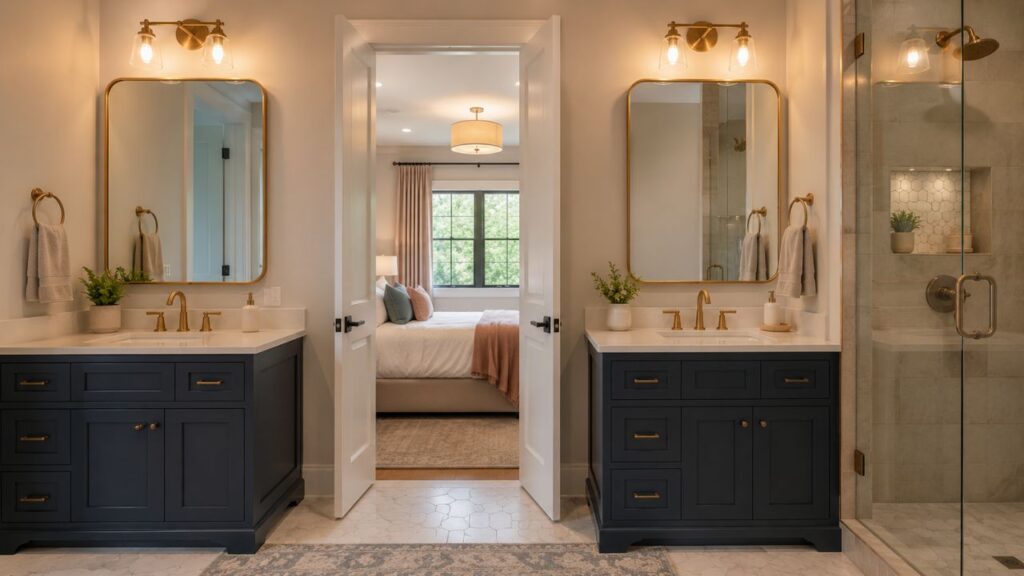
A Jack and Jill bathroom is a single bathroom positioned between two separate bedrooms, accessible directly from each room through its own door. Instead of walking out into a hallway to reach a communal bathroom, each bedroom connects straight into the shared space. It’s essentially a private, semi-en-suite arrangement built for two rooms instead of one.
So what’s a jack and jill bathroom in practical terms? Picture two kids’ bedrooms on either side of a single bathroom. Each child has their own door leading into it, they share the tub, shower, and often the sink area, but neither has to cross a public hallway to brush their teeth. That’s the whole idea in a nutshell.
You’ll also see the term written slightly differently online — jack in jill bathroom and jack n jill bathroom layout are common misspellings of the same concept, so if you searched either of those, you landed in the right place.
Where the Name Comes From
The nursery rhyme “Jack and Jill went up the hill” gets credit for the name, likely because it evokes a boy-and-girl pairing sharing something together. Historically, builders used the term specifically for a layout designed to let a brother and sister — or two siblings of any gender combination — share a bathroom while keeping their bedrooms private. Over time, the term stuck for any two-bedroom, shared-bath configuration, regardless of who’s living in the rooms.
Jack and Jill Bathroom Definition, Simplified
If you need the cleanest jack and jill bathroom definition for a listing description or a quick explanation to a client, use this: a bathroom with two doors, each opening into a different bedroom, allowing both rooms to share one bathroom without using a hallway.
That’s it. No toilets counted, no fixture requirement, no size minimum. The doors and the direct bedroom access are what qualify a bathroom for the label.
Is There Another Name for a Jack and Jill Bathroom?
Yes, actually. If you’re searching for another name for jack and jill bathroom, real estate professionals sometimes call it a “connecting bathroom,” a “shared dual-entry bathroom,” or simply a “buddy bath.” None of those terms are as catchy, which is probably why “Jack and Jill” won out and became the industry standard. Appraisers and builders will occasionally use “double-entry bathroom” in blueprints and permit documents, too.
Jack and Jill Bathroom vs. Other Bathroom Types
It helps to see how this layout stacks up against the alternatives homeowners usually compare it to.
| Bathroom Type | Access Point | Privacy Level | Best For |
|---|---|---|---|
| Jack and Jill bathroom | Two doors, one per bedroom | Moderate — shared, but no hallway | Siblings, kids’ rooms, guest suites |
| En-suite bathroom | One door, from one bedroom | High — private to one room | Primary bedrooms |
| Hall bathroom | One door, from a hallway | Low — accessible to whole household | Guests, general family use |
| Powder room | One door, hallway or common area | Low — no shower/tub | Guests, main floor convenience |
This comparison matters because a lot of buyers assume Jack and Jill automatically means “less private” in a bad way. In reality, it’s a smart middle ground — more private than a hall bath, more practical for two rooms than building two separate en-suites.
What Is a Jack and Jill Bedroom?
Since the two terms get mixed up constantly, let’s clear up what is a jack and jill bedroom. This isn’t a separate concept — it’s just the informal way people describe one of the two bedrooms connected to a Jack and Jill bathroom. So if someone says “the kids have Jack and Jill bedrooms,” they mean each kid has a bedroom that opens into the same shared bathroom. The bedroom itself doesn’t have special features; it’s defined entirely by its connection to that shared bath.
How a Jack and Jill Layout Actually Works
Now for the part most people actually care about: the mechanics. A functional jack and jill bath setup usually includes a few core elements, though the exact configuration varies by home size and budget.
Doors and Locks
Each bedroom has its own door into the bathroom, and both doors typically lock from the inside. This is the detail that makes the whole system work — without functioning locks, you get awkward walk-ins and zero privacy, which defeats the purpose entirely.
Jack and Jill Sinks
One of the most searched details is the jack and jill sinks setup, and for good reason — it’s usually where the real design decision happens. Most modern layouts include double vanities, meaning jack and jill sink counts of two rather than one, so both users can get ready at the same time without waiting. In older or smaller homes, a single sink is still common, especially where square footage is tight.
If you’re planning a remodel, upgrading to two sinks is consistently rated by contractors as the highest-value change you can make to this layout, because it removes the single biggest bottleneck — the morning rush.
Jack and Jill Shower and Toilet Arrangements
The shower and toilet setup is where privacy really gets tested. A well-designed jack and jill shower area is separated from the sink zone by a door or partition wall, so one person can shower while the other brushes their teeth or gets dressed at the vanity.
Some homes take this further with a jack and jill shower room — a fully enclosed wet area with its own door, separate from both the sink zone and the toilet. This is the gold standard for privacy in a shared bathroom, though it does require more square footage.
For the toilet, many buyers specifically look for a jack and jill toilet enclosed in its own small room or behind a partition, separate from the sink and shower. Layouts described as jack and jill bathroom with separate toilets solve the single biggest complaint people have about shared bathrooms: needing full privacy for one function while someone else uses the sink or shower.
Small Jack and Jill Bathroom Layout Ideas
Not every home has the luxury of extra square footage, and a small jack and jill bathroom layout comes with its own set of challenges. Here’s what actually works in tight spaces, based on what designers repeat over and over:
- Pocket doors instead of swing doors. Swing doors eat up floor space that a pocket door simply reclaims. In a tight footprint, this alone can free up room for a second sink.
- A single, wider sink with two faucets. If two full vanities won’t fit, one long counter with two faucet sets gives both people elbow room without doubling the plumbing footprint.
- Vertical storage. Tall, narrow cabinets and recessed medicine cabinets keep countertops clear, which makes a small space feel noticeably bigger.
- Light, cohesive tile. Large-format tile in a light tone, run continuously across the floor, visually stretches a cramped layout small jack and jill bathroom ideas search often turns up — and it genuinely works.
- Frameless glass instead of a curtain. A glass shower panel takes up almost no visual space compared to a full curtain, which matters a lot in a room under 60 square feet.
Even a small jack and jill bathroom layout with a single sink and a combo tub-shower can function well if the doors, storage, and lighting are handled thoughtfully. The size of the room matters less than how deliberately it’s zoned.
Modern Jack and Jill Bathroom Ideas
If you’re not working with space constraints and want something that feels current, here’s where modern jack and jill bathroom ideas tend to land in 2026 remodels:
- Matte black or brushed brass fixtures paired with white or warm-toned tile for contrast without going cold.
- Floating double vanities that make the floor visible underneath, which reads as more spacious and modern than boxed-in cabinetry.
- Zero-threshold showers — no curb to step over, which is both a modern aesthetic and a practical safety upgrade for households with kids.
- Smart mirrors with built-in lighting on each side of a shared vanity, giving each user their own well-lit space without needing separate light fixtures.
- A neutral, warm palette rather than stark white, since designers have shifted toward tones that feel lived-in rather than clinical.
A modern jack and jill bathroom layout doesn’t need to abandon the shared structure to feel current — most of the visual upgrade comes from fixtures, lighting, and finishes rather than a totally different floor plan.
Jack and Jill Bathroom Designs Worth Studying
Some of the best jack and jill bathroom designs I’ve seen in real homes follow a consistent pattern: they treat the sink zone as communal and everything else as private. That means:
- Shared vanity area with two sinks, open to both bedrooms.
- A separate compartment for the toilet, with its own door.
- A separate shower or tub compartment, also with its own door.
This “three-zone” approach shows up constantly in jack and jill bathroom plans drawn up by architects, and it’s popular precisely because it solves the privacy problem without requiring a full second bathroom. Builders sometimes call this the “split bath” configuration, even when the family used the term Jack and Jill to request it.
Planning a Jack and Jill Bathroom Remodel
A jack and jill bathroom remodel is a different animal from a standard bathroom update, mainly because you’re balancing the needs of two rooms and, often, two different people with different routines. Here’s a realistic breakdown of what to prioritize.
Budget Reality Check
According to cost data tracked by the National Association of Home Builders and repeated across contractor estimates, a mid-range bathroom remodel typically runs higher when plumbing has to move — and Jack and Jill remodels frequently involve exactly that, since adding a second sink means adding a second water line and drain.
Expect a straightforward cosmetic refresh (new tile, fixtures, paint, vanity swap) to cost meaningfully less than a full jack and jill bathroom remodel ideas project that involves adding a second sink, relocating the toilet into its own compartment, or expanding the shower.
Sequencing the Work
- Address plumbing and electrical first, especially if you’re adding a sink or moving the toilet.
- Handle waterproofing and tile in shower or wet zones next.
- Install cabinetry and vanities.
- Finish with fixtures, mirrors, and lighting.
Skipping ahead — installing a vanity before confirming plumbing locations, for instance — is the single most common (and expensive) mistake homeowners make on this kind of project.
Questions to Ask Your Contractor
- Can the existing plumbing support two sinks, or does it need rerouting?
- Is there enough square footage to separate the toilet into its own compartment?
- What’s the realistic timeline given that two bedrooms lose bathroom access during the remodel?
- Are the door locks being upgraded as part of the job?
Pros and Cons of a Jack and Jill Bathroom
Pros:
- No hallway walk required between bedroom and bathroom
- Often more space-efficient than building two separate en-suites
- Encourages kids to share responsibility for keeping a space clean
- Adds resale appeal for buyers with multiple children
Cons:
- Scheduling conflicts during busy mornings if there’s only one sink
- Renovation costs can climb quickly if you’re separating zones
- Noise travels between bedrooms through the shared bathroom
- Less privacy than two fully separate en-suite bathrooms
Who Actually Benefits Most From This Layout?
In my experience looking at floor plans with families, three groups get the most value from this setup:
- Parents of young children, who want kids close by without a full en-suite bathroom for each room.
- Multi-generational households, where two family members share a wing of the house and want private bedroom access to a bathroom without going through common areas.
- Guest suites in larger homes, where two guest rooms rarely get used at the same time, making the shared bathroom a non-issue most of the year.
Frequently Asked Questions
What is a Jack and Jill bathroom? It’s a bathroom positioned between two bedrooms with a separate door leading into each room, allowing both rooms to share the bathroom without walking through a hallway.
Is a Jack and Jill bathroom the same as an en-suite? No. An en-suite connects to only one bedroom, while a Jack and Jill bathroom connects to two.
Do Jack and Jill bathrooms have two sinks? Not always, but many modern layouts include two sinks specifically to avoid morning bottlenecks. Older or smaller homes often have just one.
Can you add separate toilets to a Jack and Jill bathroom? Yes. A jack and jill bathroom with separate toilets is a common upgrade during remodels, usually done by enclosing the toilet in its own small compartment with a door.
Does a Jack and Jill bathroom hurt resale value? Generally no — many buyers with kids specifically look for this layout. It can occasionally raise questions from buyers without children, but it’s rarely viewed as a dealbreaker.
How much does a Jack and Jill bathroom remodel cost? It depends heavily on whether plumbing needs to move. A cosmetic refresh costs far less than a remodel that adds a sink or separates the toilet and shower into their own compartments.
What’s the difference between a Jack and Jill bathroom and a shared hall bathroom? A hall bathroom is accessed from a common hallway and is available to the whole household. A Jack and Jill bathroom is accessed only from the two connected bedrooms.
Final Thoughts
A Jack and Jill bathroom isn’t complicated once you see it laid out, but the details — sink count, toilet separation, door placement — make a real difference in daily livability. If you’re buying a home with one, ask how the zones are separated. If you’re remodeling one, prioritize plumbing decisions early, and don’t underestimate how much a second sink or a separated toilet compartment can change the way two people share a morning routine.