I’ve moved four times in the last nine years, and three of those apartments would generously be called “cozy” by a real estate listing. The smallest was 410 square feet in a converted brownstone with a radiator that took up a fifth of the living room. So when I talk about small apartment decorating, I’m not working from a mood board I found online. I’m working from experience — including the mistakes, like the velvet sectional I bought for a room that could barely fit a loveseat.
This guide pulls together what actually holds up once you live with it for a year, not just what photographs well for a single afternoon. We’ll go room by room: living room, bedroom, studio layouts, balconies, and furniture choices that earn their square footage. Along the way I’ll flag the things most articles skip, because “just add a mirror” only gets you so far.
Start Here: Reading Your Space Before You Buy Anything
Before you touch a paint swatch or add anything to cart, walk your apartment with a notepad and actually measure it. Most small apartment ideas fail not because the ideas are bad, but because they were designed for a different footprint than the one you’re standing in.
A few questions worth answering first:
- Where does natural light enter, and at what time of day?
- Which walls are load-bearing or shared with a noisy neighbor?
- What’s your actual walking path from door to kitchen to bed?
- Do you need this room to do one job, or three?
If you’re wondering how to style a small apartment without it looking cramped or, worse, empty and cold, the answer usually comes down to hierarchy. Pick one wall, one piece of furniture, or one color to be the visual anchor, and let everything else support it quietly. Apartments that feel chaotic usually have five things all competing to be the star.
One trick interior designers use that rarely gets mentioned: stand in the doorway of each room and note the first three things your eye lands on. If none of those three things is intentional — if you’re staring at a cable box or a laundry basket — that’s your starting point, not the color of your throw pillows.
Apartment Living Room Ideas That Actually Hold Up
The living room carries the most pressure in a small home because it’s usually doing double or triple duty — lounging, working, hosting, sometimes even sleeping a guest on a pull-out. Good apartment living room ideas start with function, not furniture shopping.
Furniture Placement Over Furniture Quantity
Small living room ideas for apartments almost always come down to arrangement before acquisition. Floating a sofa a few inches off the wall, angling a chair toward a window instead of the TV, or replacing a coffee table with two nesting tables can change how a room reads without spending a dollar.
A pattern I see constantly: people push every piece of furniture against the wall, thinking it opens up the middle. In practice, this makes a room feel like a waiting room. Pulling the sofa slightly forward and letting a rug define a seating zone usually reads as more spacious, even though technically less floor is “open.”
Vertical Space Is Underused Real Estate
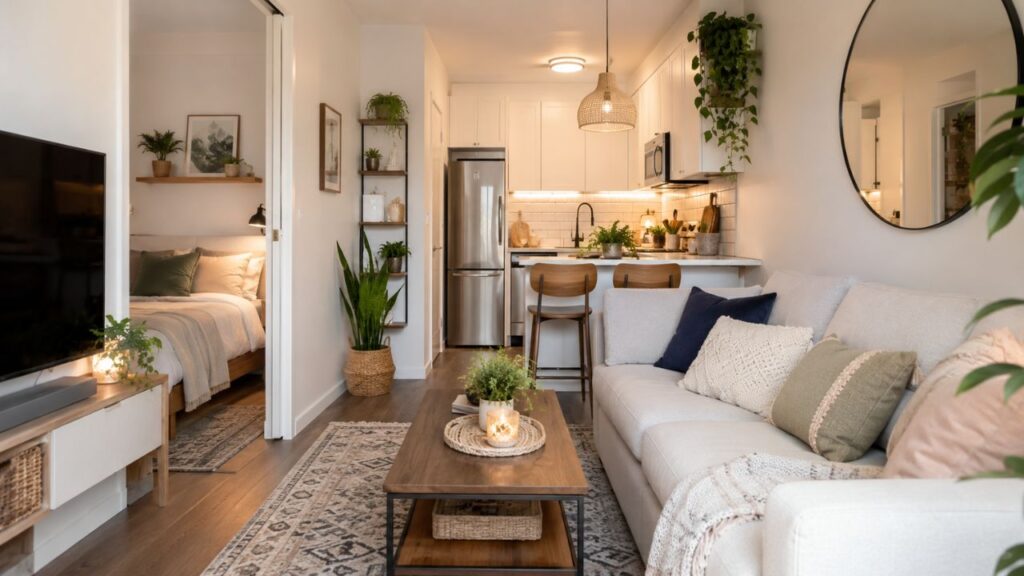
Apartment small living room ideas that focus only on the floor plan miss half the opportunity. Bookshelves that go to the ceiling, art hung slightly higher than eye level, and curtains mounted close to the ceiling line rather than the window frame all pull the eye upward, which makes the room register as taller and less boxed in.
Modern Small Living Room Ideas Without the Showroom Feel
Modern small living room ideas tend to lean on a few repeatable moves: a neutral base (white, warm gray, greige), one bold textural element like a woven rug or a leather chair, and lighting that’s layered rather than a single overhead fixture. A floor lamp in the corner, a table lamp near the sofa, and one accent light do more for ambiance than any overhead can manage alone.
If you rent, a lot of apartment decorating ideas assume you can paint or install shelving, which isn’t always true. Look into tension rods, adhesive hooks rated for real weight, and furniture-grade command strips before assuming you’re stuck with bare walls.
Apartment Bedroom Ideas for Actual Rest, Not Just Looks
Bedrooms in small units get treated like an afterthought, but they matter more than almost any other room for how you feel day to day. Apartment bedroom ideas should start from sleep quality, then move to aesthetics.
Bedroom Design That Respects the Room’s Job
Good bedroom design in a small footprint usually removes things rather than adding them. A nightstand that’s actually a small stool. A headboard that doubles as storage. Blackout curtains instead of a decorative valance that does nothing for light control. The goal isn’t a magazine spread — it’s a room your body recognizes as a place to wind down.
Bedrooms that feel calm tend to share a few traits: lower light temperature in the evening (2700K bulbs, not the blue-white ones from the kitchen), minimal visual clutter on flat surfaces, and a color palette that skews muted rather than saturated. Bright red or neon accent walls might look striking online, but they’re a genuinely poor choice for a room meant to help you fall asleep.
Making a Small Bedroom Function Like a Bigger One
If your bedroom barely fits the bed, consider a platform frame with built-in drawers instead of a bed frame plus a separate dresser. Under-bed storage bins solve the “where do off-season clothes go” problem without needing a closet you don’t have. Wall-mounted sconces instead of table lamps free up nightstand space for the things you actually need within reach.
Studio Apartment Ideas: Making One Room Do Everything
Studios are their own category, and most studio apartment ideas floating around online were clearly written by someone who’s never actually lived in 350 square feet with a kitchenette bolted to one wall. Here’s what holds up in practice.
Very Small Studio Apartment Layout Basics
A very small studio apartment layout works best when you define zones before you define decor. Sleeping, working, and living areas need visual separation even without walls. A bookshelf, a rug boundary, or even a curtain track can signal “this is the bedroom zone” without sacrificing the open feel that makes a studio livable.
For a very small studio apartment, furniture that folds, nests, or converts earns its keep fast. A murphy bed frees an entire third of the room during the day. A drop-leaf table seats four when needed and disappears against the wall the rest of the time. These aren’t gimmicks — they’re the difference between a studio that feels like a real home and one that feels like a dorm room you never left.
Studio Apartment Layout Ideas by Room Shape
Studio apartment layout ideas change quite a bit depending on whether you’re working with a long rectangle, an L-shape, or a square footprint:
- Long rectangle: Split it into thirds — sleep, live, kitchen/dine — using furniture as the dividers rather than adding anything structural.
- L-shape: Use the shorter leg of the L for sleeping, since it naturally reads as more enclosed and private.
- Square: Anchor the bed in a corner rather than the center of a wall, which frees up more usable floor for a seating area.
Ideas for small studio apartments almost always benefit from a defined “front door zone” too — even a narrow console table or a set of hooks by the entry keeps shoes and bags from sprawling into the living space, which is often the first thing that makes a studio feel messy.
Cozy Small Studio Apartment Without the Clutter
A cozy small studio apartment isn’t about adding more stuff — it’s about texture and warmth done in restraint. Layered lighting again does a lot of the work here: string lights are overused and can look juvenile, but a couple of warm-toned lamps at different heights make a huge difference. Add one substantial textile (a chunky throw, a real wool rug) rather than five decorative pillows competing for space.
Studio Apartment Decorating Ideas and How to Decorate a Studio Apartment Step by Step
If you’re asking how to decorate a studio apartment from scratch, work in this order:
- Map your zones first (sleep, work, live, cook) before buying a single item.
- Choose a consistent color story across the whole space — studios read smaller when each “zone” has a wildly different palette.
- Invest in one or two multi-function furniture pieces before anything decorative.
- Add lighting layers.
- Only then, bring in art, textiles, and personal objects.
Studio apartment decorating ideas that skip straight to step five usually end up looking cluttered within a month, because the bones of the space were never actually solved.
Studio Room Design and Flat Decoration Ideas for Renters
Studio room design shares a lot of DNA with what’s often called flat decoration ideas in the UK, Australia, and much of Europe — the terminology differs, but the underlying challenge (one open room, limited storage, often a shared wall or two) is identical. Renters in particular benefit from removable wallpaper, over-the-door storage, and furniture on casters that can be reconfigured without a drill.
Best Furniture for Small Apartments
Furniture shopping for a small space is genuinely different from furnishing a house, and treating it the same way is the most common — and most expensive — mistake people make.
| Furniture Type | Why It Works in Small Spaces | Watch Out For |
|---|---|---|
| Sleeper sofa with slim arms | Doubles as guest bed without eating floor space | Cheap mattresses inside fold-outs; check reviews on comfort |
| Nesting or drop-leaf tables | Expand only when needed | Can wobble if not solid wood or well-braced |
| Wall-mounted or floating shelves | Storage without floor footprint | Weight limits; use proper anchors, not just adhesive |
| Storage ottomans | Seating plus hidden storage | Look for sturdy frames, not just fabric-covered foam |
| Murphy beds or wall beds | Reclaims entire floor area during the day | Installation cost and wall compatibility |
| Mirrored or glass-top furniture | Visually lighter, bounces light | Shows fingerprints and dust more than solid pieces |
The best furniture for small apartments tends to share three traits: it’s scaled correctly (measure twice, always), it does more than one job, and it doesn’t visually compete with everything else in the room. A single oversized statement chair often works better than three mismatched smaller ones.
Apartment Balcony Ideas That Don’t Waste the Space
If you’re lucky enough to have outdoor space at all, even a narrow one, it’s worth treating as a real room rather than a storage overflow zone for bikes and boxes.
Apartment balcony ideas that consistently work in tight footprints:
- Railing planters instead of floor pots — they free up walking space and add greenery at eye level.
- A single folding bistro chair and small table rather than a full patio set that blocks the door.
- Vertical herb walls using stacked planters, which give you an actual kitchen garden in two square feet.
- Outdoor-rated string lighting on a timer, which makes a tiny balcony usable well past sunset.
- A weatherproof storage bench that doubles as seating and hides cushions, tools, or off-season items.
Even a Juliet balcony with no real floor space benefits from a well-placed planter box and a small hanging light — it’s about signaling that the space is cared for, not necessarily about fitting furniture on it.
Modern Apartment Decor: What’s Actually Trending vs. What’s Just a Fad
Modern apartment decor right now leans toward warm minimalism rather than the stark, cold minimalism that dominated a decade ago. Think warm wood tones, curved furniture silhouettes, and a return to tactile materials like linen, boucle, and unlacquered brass. Apartments decor trends move fast, but the ones with staying power tend to prioritize comfort alongside aesthetics rather than choosing one over the other.
A few things I’d genuinely recommend over trend-chasing when it comes to apartment decor:
- Buy your sofa and bed frame for comfort and durability first — these are the pieces you’ll live with the longest.
- Spend more on lighting than most people expect to; it does more visual work per dollar than almost anything else.
- Treat trendy colors as accent pieces (a vase, a throw, a lampshade) rather than permanent commitments like a painted wall or a sectional.
Apartment Decorating Ideas on a Real Budget
Not every apartment decorating idea requires a renovation budget. Some of the highest-impact, lowest-cost moves I’ve made or watched work well for others:
- Swap out builder-grade light fixtures for something with character — many rentals allow this if you keep the original fixture for move-out.
- Use peel-and-stick tile on a kitchen backsplash for an afternoon project with outsized visual return.
- Reupholster a single thrifted chair instead of buying new — fabric and foam cost far less than furniture.
- Add a large mirror opposite your main window to double the sense of natural light.
- Group existing art and objects into intentional clusters instead of scattering them thinly across every wall.
Small apartment ideas don’t need to be expensive to be effective. Some of the best transformations I’ve seen cost under $200 and took a single weekend.
Common Mistakes That Undercut Good Apartment Decorating Ideas
A few patterns show up again and again in small spaces that otherwise have good bones:
- Rugs that are too small. A rug that only fits under a coffee table makes the whole room look smaller. Size up more than feels intuitive.
- Curtains hung at window width instead of wall width. Extending curtain rods a few inches beyond the frame and hanging them higher makes ceilings feel taller.
- Too many small pieces of art. A handful of large, confident pieces reads better than a dozen tiny ones scattered without a plan.
- Ignoring scale. A giant sectional in a small living room, or oversized art in a narrow hallway, throws off the whole balance of a space no matter how nice each piece is individually.
Why Small-Space Living Has Changed the Furniture Industry
This isn’t just a personal-taste trend. Housing data in most major U.S. cities has shown a steady climb in the share of new apartment construction dedicated to studios and one-bedrooms over the past decade, driven largely by cost. Furniture brands have responded directly — modular sofas, expandable dining tables, and murphy-bed systems that used to be niche, custom-order items are now sold at mainstream retailers like IKEA, West Elm, and CB2 as standard product lines.
That shift matters for anyone decorating a small apartment right now, because it means the “no good options exist at my size” problem that plagued renters a generation ago is mostly solved. The challenge today isn’t availability — it’s knowing which category of furniture actually fits your layout before you buy, which is exactly why measuring first and decorating second makes such a difference.
There’s also a psychological angle worth mentioning, since it comes up constantly in design research: cluttered, poorly zoned small spaces measurably increase reported stress compared to organized ones of the same square footage. It isn’t really about the size of the apartment — it’s about whether the space has a visible sense of order. A 400-square-foot studio with clear zones and thoughtful storage will feel calmer to live in than a 900-square-foot two-bedroom where every surface is covered in loose items.
A Real Case Study: Turning a 480-Square-Foot Studio Around
A friend of mine moved into a 480-square-foot studio in a converted factory building — exposed brick, one long wall of windows, and a kitchenette crammed into a corner. Her first instinct was to buy everything new and matching. Six months in, the apartment still felt like storage with a bed in it.
What actually fixed it wasn’t more furniture — it was less, arranged with intent. She pulled the bed away from the window wall and into a shallow alcove near the closet, added a floor-length curtain on a ceiling track to visually close off the sleeping zone at night, and replaced a bulky sectional with a slim loveseat plus two folding chairs that live against the wall when not in use. The kitchenette got a single floating shelf instead of a freestanding cart that had been blocking the walkway.
None of these changes cost much. The curtain track was the single biggest expense at around $80. But the apartment went from feeling like one crowded room to feeling like three distinct, functional spaces — which is really the entire goal behind good studio apartment ideas. The lesson generalizes well beyond her specific layout: subtraction and zoning usually beat addition and matching sets.
Seasonal and Rotational Decorating for Small Spaces
One thing rarely mentioned in apartment decorating ideas articles: small spaces actually benefit more from seasonal rotation than large homes do, because you can’t display everything you own at once anyway. Rather than storing decorative items away entirely, try swapping out a handful of pieces every few months — a heavier throw and warmer-toned pillow covers in winter, lighter linen and a few plants brought in from the balcony in summer.
This does two things. First, it keeps the space feeling intentional rather than static, which matters more for mood than people expect. Second, it forces a kind of ongoing edit — if you haven’t missed an object during its months in storage, that’s often a sign it doesn’t need to come back out at all.
Frequently Asked Questions
What colors make a small apartment look bigger? Light, warm neutrals reflect the most available light and create a sense of continuity from room to room. That said, one deeper accent wall or a moody bedroom color doesn’t shrink a space the way people fear — it’s more about contrast and consistency than sticking strictly to white.
How do I decorate a studio apartment without making it feel cluttered? Define your zones first, invest in multi-function furniture before decorative pieces, and keep your color palette consistent across the whole room rather than treating each “area” as its own separate style.
What’s the best furniture for a very small studio apartment? Pieces that fold, nest, or convert — murphy beds, drop-leaf tables, and storage ottomans — tend to deliver the most usable square footage per dollar spent.
Are dark colors ever a good idea in a small bedroom? Yes, particularly for sleep quality. A muted, deeper wall color paired with good lighting can feel more cocooning than clinical, and bedrooms don’t carry the same “make it look bigger” pressure that living rooms do.
How much should I spend furnishing a small apartment? Prioritize the sofa, bed, and lighting first, since those get the most daily use. Secondary items — side tables, decorative objects, art — can be sourced secondhand or added over time without hurting the overall look.
Do apartment balconies need furniture to feel finished? Not always. A single planter and a well-placed light can make a small balcony feel intentional without needing a full furniture set that blocks the doorway.