A few years ago, if you brought up a spanish kitchen to a designer, you’d probably get a shrug and a mental image of orange terracotta floors and wrought iron light fixtures nobody asked for. That’s changed. Walk into any kitchen showroom or scroll through a design magazine right now, and you’ll see plaster hoods, arched niches, and hand-painted tile showing up everywhere, often without anyone even calling it “Spanish.”
That’s the thing about this style. It never really left — it just went quiet for a while. Homes across the American Southwest, Florida, and California have carried Spanish colonial bones for a century, and a lot of the current interest in warm, textured kitchens is really people rediscovering what was already sitting under their roofs.
I’ve worked with homeowners who inherited a 1920s Spanish colonial bungalow and had no idea what to do with the arched doorway leading into the kitchen. I’ve also worked with clients building brand new homes who wanted that same warmth without the house actually being old. Both groups end up asking the same question: how do you do this well, instead of doing it like a restaurant theme?
This guide covers what actually works, what to skip, and how to adapt the look whether you want something rustic and lived-in or sharp and contemporary.
What Actually Defines a Spanish Style Kitchen
Before picking tile or paint, it helps to understand where this look comes from. Spanish design in homes traces back to Moorish influence in southern Spain — think Andalusia, Seville, and the intricate tilework you’ll find around the Alhambra in Granada. When Spanish colonizers brought building traditions to the Americas, those elements mixed with local materials and climates, eventually becoming what we now call Spanish Colonial Revival architecture, especially popular across California and Florida in the 1910s and 1920s.
A genuine spanish kitchen pulls from a handful of consistent elements:
- Warm, earthy color palettes rather than stark white
- Handmade or hand-painted tile, often with visible imperfections
- Natural materials — wood beams, plaster, wrought iron, terracotta
- Arched openings or niches
- A sense of age, even in new construction
None of these need to be extreme. You don’t need a full arched doorway and exposed beams to get the feeling across. Sometimes it’s just one strong material choice doing most of the work.
Modern Spanish Kitchen: Keeping the Warmth, Losing the Clutter
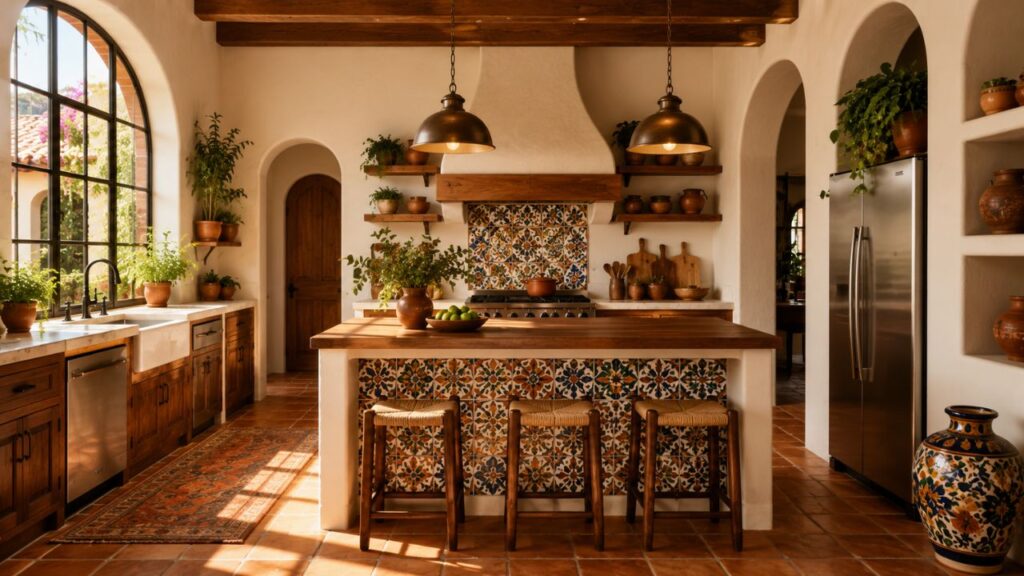
If the traditional version feels too heavy for your taste, a modern spanish kitchen strips things down without losing what makes the style recognizable. This is probably the most requested version right now, and it’s easy to see why — it photographs well, it’s livable, and it doesn’t fight with contemporary appliances.
A modern spanish style kitchen usually keeps two or three signature elements — say, an arched range hood and handmade zellige-style tile — and pairs them with flat-panel cabinetry, simple hardware, and a neutral wall color. The arches stay. The heavy dark wood cabinetry usually goes.
Here’s what tends to separate a well-done modern take from one that feels like it’s trying too hard:
- One statement material, not five. Pick either the tile, the hood shape, or the flooring as your hero element. Let everything else calm down around it.
- Warm neutrals over stark white. Think unbleached linen, warm greige, or soft clay rather than bright white cabinetry, which tends to fight with the earthy materials.
- Simple lighting with character. A single sculptural pendant does more than five matching fixtures.
I worked on a renovation last year where the client wanted a modern spanish kitchen but was nervous about it looking dated in ten years. We used a plain arched hood in smooth plaster, kept the cabinets a flat oak-toned wood, and added one wall of hand-glazed tile behind the range. It reads current, not costume-y, and it’ll likely age better than a kitchen chasing a trend cycle.
Spanish Revival Kitchen: Bringing Back the Original Details
There’s a difference between “Spanish style” as a broad aesthetic and a true spanish revival kitchen, which specifically references the architectural movement popular in the early twentieth century. If your home was actually built during that period, or you’re renovating in a neighborhood with strong Spanish Colonial Revival bones, this distinction matters more than people expect.
A proper spanish revival kitchen typically restores or references:
- Barrel-vaulted or beamed ceilings
- Deep-set windows, sometimes with iron grilles
- Plaster walls with a slightly uneven, hand-troweled finish
- Cabinetry with simple, chunky profiles rather than ornate carving
- Reclaimed or reclaimed-look wood for open shelving and beams
One mistake I see constantly: homeowners restoring a Spanish Revival house go straight to “old world Tuscan” inspiration boards, which is a different design language entirely — heavier, more ornate, more Italian countryside than Andalusian courtyard. The Spanish Revival palette is generally simpler and more architectural, relying on form (the arch, the vault, the niche) rather than decoration to do the work.
If you’re restoring an original kitchen, it’s worth having a preservation-minded contractor or architect walk through before demo. A lot of original plaster, tile, and ironwork can be repaired rather than replaced, and it’s almost always cheaper and more authentic than sourcing reproductions.
Terracotta Spanish Style Kitchen: The Floor and Wall Question
Few materials say “Spanish” louder than terracotta, and a terracotta spanish style kitchen is still one of the most requested looks in this category, particularly among people who grew up around it or spent time in Spain, Mexico, or the American Southwest.
Terracotta shows up in a few places:
- Flooring — the classic application, often laid in a running bond or basket weave pattern
- Backsplash tile — smaller format, sometimes paired with hand-painted accent tiles
- Planters and accessories — a lower-commitment way to bring in the tone without a full renovation
The honest downside of terracotta flooring is maintenance. Unsealed or under-sealed terracotta stains easily, and it can feel cold underfoot in winter unless you’re adding radiant heating underneath. Sealed properly, though, it develops a patina over time that a lot of homeowners genuinely prefer to a “fresh out of the box” tile floor.
If full terracotta flooring feels like too much of a commitment, a terracotta spanish style kitchen can be achieved through wall color alone — a warm burnt-orange or clay-toned paint on a single wall, paired with white oak cabinetry and black iron hardware, gets you 80% of the emotional effect for a fraction of the cost and none of the sealing maintenance.
Mediterranean Spanish Style Kitchen: Where the Overlap Gets Confusing
This is where a lot of homeowners get stuck, because “Mediterranean” and “Spanish” get used almost interchangeably online, and it causes real confusion when you’re trying to source materials. A mediterranean spanish style kitchen blends Spanish elements with broader coastal Mediterranean influences — think Greek and Italian coastal design layered in alongside the Moorish-Spanish base.
The practical difference shows up in color and material choice:
| Element | Spanish-Leaning | Mediterranean-Leaning |
|---|---|---|
| Color palette | Terracotta, ochre, deep blue accents | Whitewashed walls, blue and white |
| Tile style | Hand-painted geometric or floral | Blue-and-white or coastal motifs |
| Wood tone | Dark, heavy wood beams | Lighter, weathered driftwood tones |
| Metal accents | Black wrought iron | Aged brass or unlacquered brass |
| Overall feel | Warm, earthy, courtyard-inspired | Airy, coastal, sun-bleached |
A mediterranean spanish style kitchen works particularly well in coastal homes where a fully saturated Spanish palette might feel too heavy against ocean light. Pulling back the terracotta and leaning into whitewashed plaster with blue accent tile keeps the Spanish bones — the arches, the handmade tile texture — while adapting to a brighter, breezier setting.
Rustic Spanish Style Kitchen: Leaning Into Imperfection
If the modern version is about restraint, a rustic spanish style kitchen goes the opposite direction — leaning hard into texture, age, and visible craftsmanship. This is the version with exposed wood beams overhead, hand-forged iron light fixtures, and cabinetry that looks like it was built by a carpenter rather than pulled from a catalog.
Key elements of a rustic spanish style kitchen:
- Reclaimed or distressed wood cabinetry, often with simple plank-style doors
- Exposed ceiling beams, ideally rough-hewn rather than perfectly milled
- Hand-forged iron hardware and light fixtures with visible hammer marks
- Thick, uneven plaster walls
- Open shelving displaying ceramics, olive oil bottles, and copper cookware
This style rewards asymmetry. Perfectly matched cabinet doors or evenly spaced tile actually work against the aesthetic here — a slightly irregular hand-laid tile pattern reads as authentic, while a perfectly gridded version of the same tile can look almost sterile by comparison.
A practical note from experience: rustic doesn’t mean “unfinished.” The best rustic Spanish kitchens I’ve seen still have modern function underneath — soft-close drawers, proper ventilation, good task lighting — hidden behind that weathered exterior. The goal is old-world appearance with new-world usability.
Color Palettes That Actually Work
Across all these variations, a few color families keep showing up, and understanding why helps you make better choices than just picking whatever’s trending on a mood board.
Warm neutrals as the base. Unbleached linen, warm white, sand, and soft greige give you a canvas that won’t compete with tile or wood.
Terracotta and ochre as accents. Whether it’s a full terracotta floor or a single ochre-painted niche, these tones carry most of the emotional warmth.
Deep blue or teal in small doses. A blue tile backsplash or a single painted door adds contrast without overwhelming the warm base.
Black iron as the connector. Cabinet hardware, light fixtures, and window grilles in matte black or hand-forged iron tie every other element together.
I generally tell clients to pick their hero warm tone first — terracotta, ochre, or a specific tile color — and build everything else as support. Trying to balance three or four bold colors at once is usually what pushes a kitchen from “warm and layered” into “busy.”
Materials and Textures Worth Sourcing Properly
A few materials genuinely make or break this style, and they’re worth spending more on if your budget allows:
- Zellige or Talavera-style tile — the slight variation in glaze and shape from piece to piece is what gives handmade tile its character. Machine-perfect reproductions rarely fool anyone up close.
- Real plaster or limewash finishes — these catch light differently than flat paint and develop subtle texture over time.
- Wrought iron fixtures — even a few pieces (a pot rack, a pendant light, cabinet pulls) go further than people expect.
- Natural wood with visible grain — white oak, walnut, or reclaimed wood reads more authentic than painted MDF trying to mimic wood grain.
None of these require a full renovation budget. A single tiled accent wall, one iron pendant, and cabinet hardware swapped to black iron can shift the whole feel of an existing kitchen for a relatively modest cost.
Common Mistakes to Avoid
Going too matchy with tile. Uniform, perfectly aligned tile in a “Spanish” pattern often looks like a hotel lobby rather than a real courtyard. Slight variation is the point.
Skipping ventilation planning around arched hoods. Arched range hoods are beautiful but require careful planning with your ventilation contractor — the shape changes airflow calculations compared to a standard rectangular hood.
Overdoing dark wood everywhere. Heavy dark cabinetry throughout a small kitchen can make the space feel like a cave rather than warm and inviting. Balance dark wood with light walls and plenty of natural light.
Confusing Spanish with Tuscan or Moroccan. These are genuinely different design traditions with different color logic and detailing. Pulling reference images from all three at once tends to produce a muddled result.
Forgetting function for form. Beautiful hand-painted tile is porous and needs proper sealing behind a range. Talk to your fabricator about sealant schedules before installation, not after the grout’s already stained.
Budget Considerations
A full renovation chasing this look, including custom tile work, plaster hoods, and reclaimed wood beams, can run well into six figures depending on your market and kitchen size. But the look scales down without losing its identity:
- Lower budget: Paint one wall a warm terracotta tone, swap hardware to black iron, add a single hand-painted tile backsplash section.
- Mid budget: Full tile backsplash, a plaster-finished range hood, warm wood open shelving.
- Higher budget: Custom cabinetry, full terracotta or hand-laid tile flooring, exposed reclaimed beams, arched openings.
Tile is usually the single biggest cost lever, since hand-painted or handmade tile can run several times the price of mass-produced ceramic. A good compromise a lot of my clients land on: handmade tile as a smaller accent (behind the range, on a kitchen island end panel) paired with a simpler, less expensive tile for the bulk of the backsplash.
Frequently Asked Questions
What makes a kitchen “Spanish style” versus just Mediterranean? Spanish style leans on Moorish-influenced details — arches, hand-painted geometric tile, wrought iron, and deep earth tones like terracotta and ochre. Mediterranean design is broader and often incorporates lighter, coastal Greek and Italian influences alongside those Spanish elements.
Is a Spanish style kitchen expensive to achieve? Not necessarily. A few well-chosen elements — a tile accent, black iron hardware, a warm paint color — can suggest the style convincingly without a full gut renovation.
Does terracotta flooring need special maintenance? Yes. Unsealed terracotta stains and chips easily. Proper sealing, and resealing every few years depending on foot traffic, keeps it looking good and functional in a kitchen environment.
Can I do a Spanish style kitchen in a newly built home? Absolutely. Many current builds intentionally reference Spanish Colonial Revival details through arched openings, plaster hoods, and handmade tile, even without any of the original architecture.
What’s the biggest mistake people make with this style? Overdoing it in one direction — either too much heavy dark wood and ornamentation, or so minimal it loses any real character. The best examples restrain themselves to two or three strong material choices.
How do I keep a Spanish kitchen from feeling dated? Favor simpler forms (clean arches, plain plaster, unadorned iron) over ornate detailing, and pair them with a neutral, contemporary cabinet style. Trend-heavy tile patterns tend to age faster than simple, timeless ones.