I’ve rearranged enough living rooms for friends and family to know one truth: the end table is the piece everyone underestimates. People spend weeks picking a sofa, agonize over paint swatches, then grab whatever table is closest to the door at the furniture store. Then they wonder why their coffee cup doesn’t quite reach, or why the room feels a little off even though nothing is technically wrong.
An end table isn’t a filler item. It’s the piece that decides whether your seating area actually functions — whether you can set down a drink, plug in a lamp, or stack the books you’re pretending you’ll finish this month. Get the height wrong, the size wrong, or the style wrong, and the whole arrangement feels clumsy, even if you can’t quite say why.
This guide walks through everything that actually matters: end table height, end table dimensions, materials, placement, and the small measuring trick that professional stagers use so a table never looks like an afterthought. By the end, you’ll know exactly how to choose an end table for your specific sofa, your specific room, and your specific habits — not just a generic size chart.
What Counts as an End Table, Exactly?
An end table (also called a side table) is a small table placed beside a sofa, chair, or bed, typically used to hold a lamp, drink, remote, or a stack of magazines. It’s a cousin of the coffee table, but shorter in footprint and taller relative to seat height, because it needs to sit close to arm level rather than knee level.
People use “end table” and “side table” interchangeably, and for most living room purposes, that’s fine. In design circles, “side table” sometimes gets used more broadly to include occasional tables placed anywhere in a room, not just next to a sofa. But if you’re shopping online and searching for a side table or an end table, you’ll find the same category of furniture either way.
How Tall Should an End Table Be? The Real Answer
This is the question I get asked most often, and the honest answer is: it depends on your sofa, not on a fixed number. That said, there’s a reliable rule of thumb designers use.
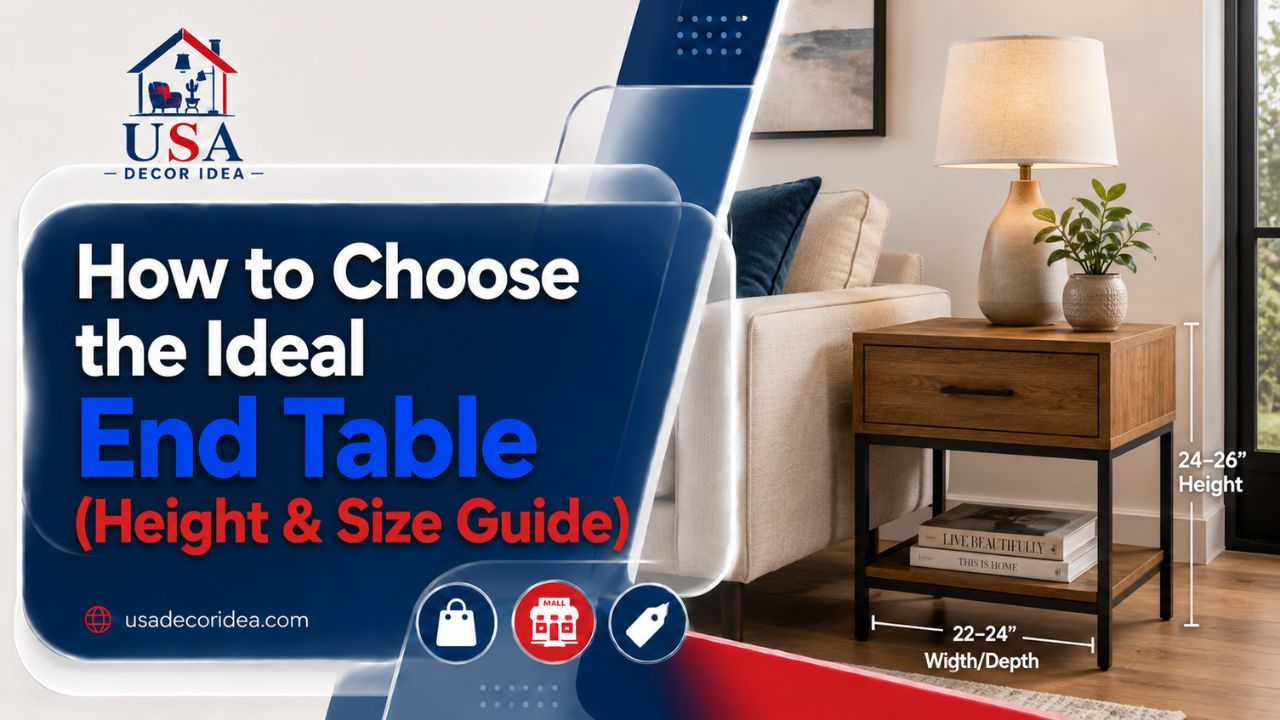
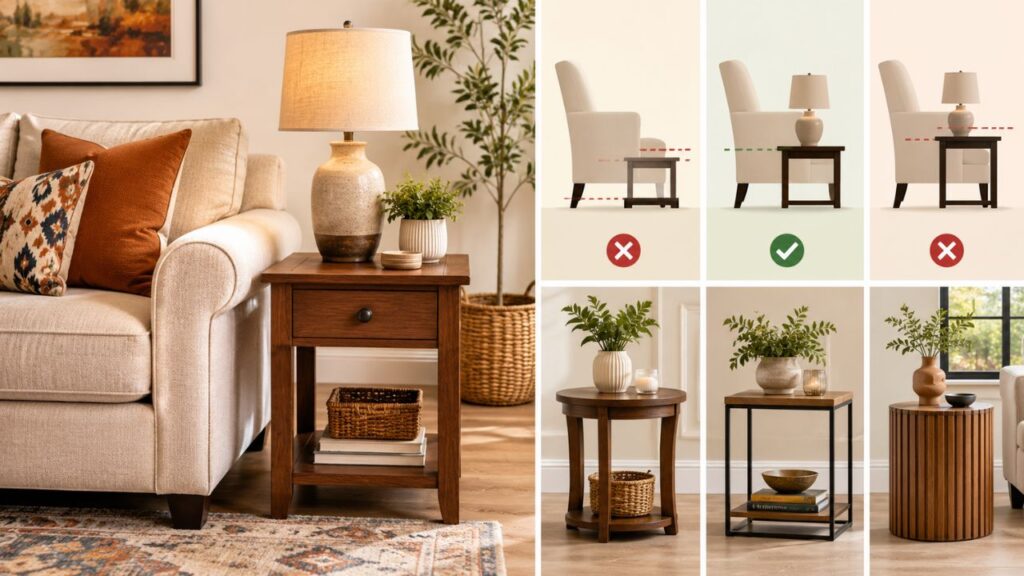
The standard guideline: an end table should sit within two inches of your sofa or chair arm height — either slightly above or level with it. Most sofa arms sit between 24 and 26 inches off the floor, which is why most end tables on the market land in that same range.
So when someone asks how high should an end table be, the practical answer is: measure your sofa arm first, then shop for a table within an inch or two of that number, plus or minus. A table that’s noticeably shorter than your armrest forces you to lean down every time you reach for your coffee. A table that towers over the armrest blocks the sightline across the room and looks top-heavy next to lower seating.
If you’re wondering how tall should an end table be for a specific type of chair, like a recliner or an armless accent chair, the arm-height rule still applies — you’re matching the table to where your hand naturally rests, not to the floor.
End Table Height Standard by Furniture Type
| Furniture Paired With | Typical Arm/Seat Height | Ideal End Table Height |
|---|---|---|
| Standard sofa | 24–26 inches | 24–28 inches |
| Low-profile or Scandinavian-style sofa | 20–23 inches | 20–24 inches |
| Recliner | 22–25 inches | 22–26 inches |
| Accent chair (armless) | 17–19 inches seat height | 20–24 inches |
| Sectional with chaise | 24–27 inches | 24–28 inches |
I’ve seen people obsess over matching the end table height standard down to the exact inch, but a one-inch difference either way rarely bothers anyone in daily use. What actually causes problems is a six-inch mismatch — that’s when the table either disappears visually or sticks up like a stool.
How Tall Is a Side Table Supposed to Be Next to a Bed?
Bedside use changes the math slightly. When people ask how tall is an end table meant for a bedroom setup, the target height usually relates to the mattress top rather than an armrest. A nightstand-style side table typically sits level with, or up to two inches below, the top of the mattress, so you’re not reaching upward for your glasses or phone charger in the middle of the night.
This is where “side table” and “nightstand” start to overlap. A side table dimensions chart built for a living room won’t always translate directly to a bedroom, since bed heights vary more than sofa heights do. If your bed frame is tall, plan on a taller side table; if you’ve got a low platform bed, a shorter table will look and function better.
End Table Dimensions: Width, Depth, and Why They Matter More Than People Think
Height gets most of the attention, but end table dimensions in terms of footprint decide whether the table actually fits your space without becoming an obstacle.
Typical width/depth ranges:
- Small end tables: 14–18 inches wide, ideal for tight spaces or narrow gaps beside a sofa arm
- Standard end tables: 18–24 inches wide, the most common size for a average living room
- Oversized end tables: 24–30+ inches wide, better suited for larger sofas or rooms where the table needs to double as extra surface space
A good measuring habit before you buy: leave at least 3 inches of clearance between the table’s edge and any walking path. If people have to angle their body sideways to pass by, the table is too large for the spot, regardless of how nice it looks in a showroom photo.
Depth matters just as much as width. A table that’s too deep will jut out past the arm of your sofa, creating an awkward corner that catches hips and knees. I’ve knocked my shin on exactly this kind of table more times than I’d like to admit, and it’s almost always because someone picked a table based on style alone and skipped the tape measure.
Side Table Standard Size: A Quick Reference
If you want a fast answer without wading through every consideration, here’s the side table standard size range most retailers work within:
| Table Type | Height | Width/Depth |
|---|---|---|
| Compact side table | 20–24″ | 14–18″ |
| Standard end table | 24–26″ | 18–22″ |
| C-shaped table (slides under sofa arm) | 22–26″ | 12–16″ wide, longer depth |
| Round accent/end table | 22–26″ | 18–24″ diameter |
| Nesting table sets | Varies (typically 3 heights) | 12–20″ |
Keep in mind that end table sizes aren’t governed by any official standard — these are industry norms based on what fits comfortably with common sofa and chair dimensions, not a rule enforced anywhere. Manufacturers like IKEA, West Elm, CB2, Pottery Barn, and Wayfair all cluster around similar dimensions because they’re designing for the same range of American and European sofa heights.
How to Choose an End Table: A Step-by-Step Approach
Here’s the process I actually use when helping someone pick furniture, rather than a generic checklist copied from a catalog.
Step 1: Measure your sofa arm height first. Before you look at a single table online, grab a tape measure. This single number should guide almost every other decision.
Step 2: Measure the available floor space. Note both the width you have beside the seating and the depth from the sofa’s front edge to the wall or walkway behind it.
Step 3: Decide what the table needs to hold. A lamp and a coaster need less surface area than a stack of books, a tissue box, and a charging station. If you work from the couch, factor in laptop space.
Step 4: Choose a shape that matches your traffic flow. Round tables are more forgiving in tight walkways since there are no corners to bump. Square and rectangular tables offer more surface area but need more clearance.
Step 5: Match materials to your existing furniture, not to trends. A glass-top table works well in small rooms because it reads as visually “lighter.” Solid wood grounds a room but can look bulky in a small apartment. Metal-framed tables suit industrial or mid-century modern spaces.
Step 6: Check storage needs. Drawers, shelves, or baskets underneath can be the difference between a table that reduces clutter and one that becomes another surface collecting mail.
This is really the core of how to choose an end table — it’s a sequence of measurements and honest questions about how you actually use the space, not a single stylistic decision.
Materials and Styles Worth Knowing
Understanding the common categories helps you talk to a salesperson or filter search results without getting lost in vague marketing terms.
- Solid wood (oak, walnut, acacia): Durable, warm-toned, works in traditional, farmhouse, and transitional interiors.
- Glass-top with metal or wood base: Reads as lighter and more open, a common pick for smaller apartments.
- Rattan or wicker: Popular in coastal and bohemian interiors, lightweight and easy to move.
- Marble or stone-top: A higher-end option often seen in contemporary and art deco-inspired spaces.
- Mixed metal and wood: The signature look of mid-century modern and industrial styles, popular in brands like CB2 and West Elm’s contemporary lines.
- Nesting tables: Two or three tables of varying end table height, stacked or spread out for flexible seating arrangements when guests come over.
Common Mistakes People Make When Buying an End Table
- Buying based on the picture, not the measurements. A table can look proportionate in a showroom or a product photo and still be wrong for your specific sofa.
- Ignoring the lamp. If you’re placing a lamp on the table, account for its base width and the total height once the lamp is on it — you don’t want the lampshade blocking a sightline across the room.
- Choosing a table that’s too small to be useful. A tiny 12-inch table might look sleek, but if it can’t hold a drink and a remote at the same time, you’ll be annoyed within a week.
- Skipping the walkway clearance check. This is the single most common regret I hear about — people love the table until they realize they clip it every time they walk past.
- Assuming side table dimensions are universal. They’re not. A table sized perfectly for one sofa can look completely wrong next to a lower or higher one.
A Quick Case Study
A friend of mine was furnishing a small one-bedroom apartment and kept sending me photos of end tables she liked, all somewhere between $150 and $300. Every single one she picked was too tall for her low-profile sofa, because she was shopping by style first. Once she measured her sofa arm — 21 inches — and searched specifically within a 20 to 23 inch range, she found a compact round table with a shelf underneath for about $90. It solved the height problem and gave her extra storage she hadn’t been looking for. The lesson wasn’t about spending more; it was about measuring before scrolling.
Placement Tips That Change How a Room Feels
- Keep at least one end table within arm’s reach of every seat that doesn’t have a table already, including single accent chairs that often get skipped.
- If you’re using two end tables to bookend a sofa, they don’t have to match exactly — a coordinated pair in the same material family often looks more intentional than an identical matched set.
- Leave a small gap, roughly one to two inches, between the table and the sofa arm so vacuuming and cleaning don’t require moving furniture every time.
- In a small room, a table with an open base or glass top will make the space feel less crowded than a solid, boxy design.
Frequently Asked Questions
How high should an end table be? Most end tables should sit within one to two inches of your sofa or chair arm height, which typically puts them between 24 and 28 inches tall for a standard sofa.
How tall should an end table be next to a recliner? Match it to your recliner’s arm height, usually 22 to 26 inches, so you’re not reaching up or down to set something down.
How tall should end tables be if I have a low, modern sofa? Lower sofas, common in Scandinavian-style furniture, usually pair better with a 20 to 24 inch table rather than the standard 26-inch height.
What’s the difference between an end table and a side table? Functionally, none — most people and retailers use the terms interchangeably, though “side table” is sometimes used more broadly for occasional tables placed anywhere in a room.
What are standard end table dimensions? Most fall between 18 and 24 inches wide and 24 to 26 inches tall, though compact and oversized options exist outside that range depending on the room.
How do I know if an end table is too big for my space? If you don’t have at least 3 inches of clearance between the table and a walking path, or if it visually overwhelms the sofa arm next to it, it’s likely too large.
Do end tables need to match my coffee table? No. Coordinating materials or finishes across a room reads better than forcing an exact match, and mismatched-on-purpose pairings are common in professionally styled rooms.
Related Reading
If you’re furnishing a whole room rather than just replacing one piece, it helps to plan the full seating area together rather than shopping for each table in isolation. Related guides worth checking on a home furnishing resource: a coffee table sizing guide (for the piece that usually anchors the room), a living room layout guide covering traffic flow and furniture spacing, a lamp height and proportion guide (since most end tables exist to hold a lamp), and a small-space furniture guide for apartments where every inch of clearance counts.
The Short Version
Match the table height to your sofa or chair arm, leave enough footprint clearance to walk comfortably, and choose a size based on what you actually need the surface to hold. Everything else — material, finish, shape — is really about the room’s overall look, and that part comes down to personal taste rather than a fixed rule.