
Most bedrooms don’t fail because of bad taste. They fail because of bad decisions made in the wrong order — buying a bed before measuring the wall, picking a paint color before thinking about light, or copying a photo from someone else’s 400-square-foot loft into a 90-square-foot room. Good bedroom interior design isn’t about having money or a flair for style. It’s about sequencing: knowing what to decide first, what to decide last, and what to skip entirely.
This guide walks through that sequence. It covers bedroom ideas for rooms of every size, real small bedroom ideas for people working with tight square footage, and a few opinions you might not agree with — because a lot of popular advice about bedrooms online is written for photographs, not for people who actually sleep in the room every night.
By the end, you’ll have a workable plan for your own space, not just a folder of inspiration you’ll never act on.
What Good Bedroom Interior Design Actually Means
There’s a difference between decorating a bedroom and designing one. Decorating adds things. Designing solves problems first, then adds things.
Solid room interior design starts with three questions:
- How is this room used, specifically — sleep only, or sleep plus work, dressing, reading, or storage?
- What’s already fixed and can’t move — windows, doors, closets, outlets, radiators?
- What’s the one thing that currently annoys you about the room?
That third question matters more than people expect. If your current complaint is “there’s nowhere to put my phone charger” or “the closet door hits the bed,” no amount of throw pillows fixes that. Good bedroom home interior design solves the annoying thing before it solves the pretty thing.
I’ve walked through this process with friends renovating on shoestring budgets and with designers working on full remodels, and the pattern holds every time: the rooms that feel calm months later are the ones where furniture placement was solved before finishes were chosen, not after.
Start With a Real Plan, Not a Mood Board
Mood boards are useful for gathering direction. They’re terrible for making decisions about a specific room, because a photo has no walls, no outlets, and no radiator in an inconvenient spot.
Measure Before You Shop
Grab a tape measure and write down:
- Total floor dimensions
- Height and width of every window and door, including swing direction
- Distance from each wall to the nearest outlet
- Ceiling height, especially if you’re considering a canopy bed or tall wardrobe
This ten-minute task prevents 90% of the “why doesn’t this fit” problems people run into after a piece of furniture arrives.
Decide the One Fixed Point
Every bedroom needs one anchor decision that everything else responds to. Usually it’s the bed placement. Sometimes, in oddly shaped rooms, it’s a window or a structural beam. Pick that fixed point early, and stop second-guessing it once you’ve picked it.
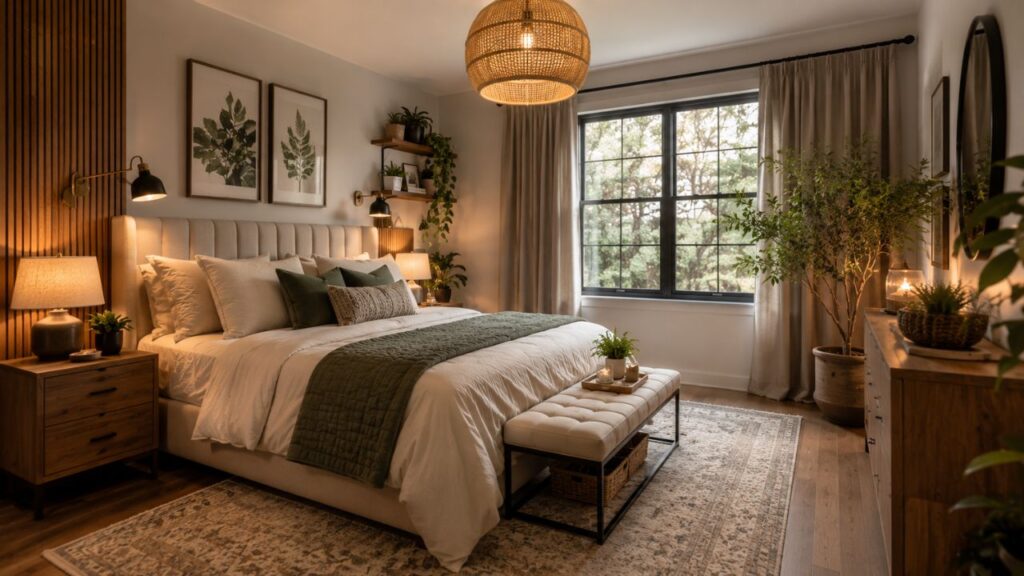
Small Bedroom Ideas That Don’t Feel Like a Compromise
Most small bedroom ideas circulating online are just photos of small rooms with expensive furniture in them. That’s not a strategy — it’s a budget problem waiting to happen. Real small-space design is about geometry, not just picking dainty furniture.
Getting the Small Bedroom Layout Right
A workable small bedroom layout usually follows this order of priority:
- Bed against the wall that gives the most clearance for the door to swing and the closet to open.
- A single nightstand instead of two, if space is genuinely tight — a floating shelf works as well.
- Storage that goes vertical (tall, narrow) rather than wide, since floor space is the scarcest resource in a small room.
- Nothing placed directly in a walking path, even if it “fits” on paper.
A queen bed in a 9×10 room, for instance, usually only works pushed into a corner with one side against the wall. That’s not a stylistic choice — it’s the only geometry that leaves you room to actually walk around and open drawers.
Tiny Very Small Bedroom Ideas (Under 80 Square Feet)
For genuinely tight spaces — box rooms, converted closets, city apartments — the calculation changes again. Some tiny very small bedroom ideas that consistently work:
- A daybed or a bed on a low platform frame instead of a bulky bed frame with a footboard
- Wall-mounted sconces instead of table lamps, freeing up nightstand surface entirely
- A mirror positioned to reflect the window, not just for looks — it genuinely changes how the room reads in daylight
- Under-bed storage boxes instead of a dresser, if there’s truly no floor space for both
Small Bedroom Decor Ideas That Add Without Cluttering
Decor in a small room needs to earn its place twice as hard as decor in a large one. A few small bedroom decor ideas that hold up over time rather than just looking good in a listing photo:
- One statement item (a headboard, a rug, or a piece of art) rather than five small accents competing for attention
- Curtains hung close to the ceiling rather than at window height, which tricks the eye into reading the room as taller
- A pale, warm wall color, since dark walls in a small windowless room can read as cave-like rather than cozy
Small Master Bedroom Ideas When the “Master” Isn’t That Big
Not every primary bedroom is spacious, and a lot of small master bedroom ideas ignore that reality. If your primary bedroom is under 150 square feet, treat it like any other small bedroom — don’t force in a bench, a full sitting area, and a king bed just because it’s labeled “master.” Pick two priorities (usually: bed comfort and closet function) and let the rest go.
Bedroom Ideas by Style
Style should come after layout, not before. Once the bones of the room are solved, here’s how different directions tend to play out in practice.
Luxury Bedroom Interior Design
Luxury bedroom interior design isn’t really about price tags — it’s about restraint and material quality. The rooms that read as genuinely luxurious tend to share a few habits:
- A limited color palette (often two to three tones total)
- Layered, matte-finish lighting instead of one bright overhead fixture
- Natural materials — real wood, linen, wool — over synthetic substitutes
- Hardware and fixtures that match in finish across the whole room
You can apply the same logic on a modest budget. A well-made linen duvet and a single well-placed lamp will outperform a room full of mismatched “premium” pieces bought separately.
Minimalist and IKEA Bedroom Ideas
For anyone furnishing on a real budget, ikea bedroom ideas get recommended constantly for a reason — the MALM, HEMNES, and NORDLI lines cover most basic layout needs at a price point that lets you spend more on the mattress and bedding, which matter far more to comfort than the frame does. The trick with flat-pack furniture is choosing pieces with simple lines, since ornate details rarely survive the manufacturing process well. Pair basic IKEA pieces with one higher-quality textile item — a rug or curtains — and the room stops looking like a showroom display.
Boho and Eclectic Bedrooms
If your bedroom inspo leans toward layered textiles, mixed patterns, and plants, the one rule that keeps boho rooms from looking chaotic is a consistent color family. Mix patterns freely, but keep them within the same two or three base tones, or the room starts to feel more like storage than a retreat.
Traditional and Transitional Bedrooms
Traditional bedrooms lean on symmetry — matching nightstands, matching lamps, a centered headboard — which is part of why they photograph so consistently well. Transitional design softens that symmetry slightly with more casual textiles and mixed wood tones, giving a room that feels lived-in rather than staged.
Color, Light, and Texture — The Real Mood Drivers
Paint color gets disproportionate attention online. Light and texture usually matter more.
Color
Warm neutrals (soft taupe, warm white, muted clay tones) tend to read as restful in most lighting conditions. Cool grays, while popular for years, can look flat or even slightly cold in rooms with limited natural light — worth testing with an actual paint sample on the wall for a full day before committing.
Natural and Artificial Light
North-facing rooms get cooler, flatter light all day. South-facing rooms get warmer, more direct light. This single fact should influence your paint choice more than any trend does — a cool gray that looks elegant in a bright south-facing room can look grim in a north-facing one.
Texture
A room built entirely from smooth, hard surfaces — laminate furniture, a thin flat-weave rug, cotton bedding — tends to feel colder than the temperature suggests. Mixing in a few soft, uneven textures (a chunky knit throw, a real wool rug, linen sheets) does more to warm a room up than an extra degree on the thermostat.
Good bedroom design ideas almost always combine at least three textures in the room, even in minimalist spaces. Good bedroom decor ideas build on top of that texture base rather than trying to substitute for it with more objects.
Furniture Layout Rules That Actually Matter
Here’s a quick reference for clearance, since this is the single most common thing people get wrong when placing furniture.
| Element | Minimum Clearance Needed | Notes |
|---|---|---|
| Space to walk around bed | 24–30 inches per side | Less than 24″ makes bed-making and cleaning difficult |
| Closet or wardrobe door swing | Full door width + 6 inches | Sliding doors solve this in tight rooms |
| Dresser drawer pull-out | 36 inches in front | Needed to fully open bottom drawers |
| Path from door to bed | 30 inches wide | Should never be blocked by furniture |
| Nightstand height vs mattress | Within 2–4 inches of mattress top | Keeps reach comfortable from a lying position |
If a layout fails more than one of these, it’s worth reconsidering before buying anything, not after.
Storage Solutions for Every Bedroom Size
Storage is where most bedrooms quietly fall apart six months after the “reveal” photo. A few approaches that hold up over time:
- Under-bed storage — flat boxes or bed frames with built-in drawers, especially useful in any small bedroom layout
- Vertical wardrobes over wide dressers, when floor space is limited
- Closet systems with adjustable shelving rather than a single hanging rod and one shelf
- Nightstands with drawers, not open shelves, if you want the surface to actually stay clear
- A designated “landing spot” near the door for bags, keys, and everyday items — without one, these items migrate onto the bed or floor within a week
Lighting Layers Nobody Talks About
Most bedrooms rely on a single ceiling fixture, which is the least flattering way to light a room meant for relaxing. Three layers work better:
- Ambient light — the general ceiling or overhead source, ideally on a dimmer
- Task light — a reading lamp or wall sconce positioned at shoulder height when seated in bed
- Accent light — a small lamp, LED strip, or uplight that stays on after the main light goes off, useful for winding down before sleep
Warm white bulbs (2700K–3000K) suit bedrooms far better than the cooler, bluer bulbs (4000K+) often used in kitchens and offices — the color temperature genuinely affects how easily your body relaxes into the room.
Budget Tiers: Where to Spend and Where to Skip
| Budget Tier | Spend Here | Skip or Minimize |
|---|---|---|
| Under $500 | Mattress topper, bedding, one good lamp | Statement furniture, custom curtains |
| $500–$2,000 | Bed frame, rug, curtains, paint | High-end nightstands, designer lighting |
| $2,000–$5,000 | Quality mattress, wardrobe, layered lighting | Full custom millwork |
| $5,000+ | Custom storage, premium textiles, professional lighting design | — |
The mattress and pillow are almost always underfunded relative to their actual impact on daily life, while the headboard and decorative accents are almost always overfunded relative to theirs. If budget is tight, that ratio is worth flipping.
Common Bedroom Design Mistakes (and Realistic Fixes)
Mistake: Buying the bed before measuring the room. Fix: Measure first, always. A king bed in a room built for a queen leaves no functional walking space, regardless of how good it looks in the showroom.
Mistake: One overhead light and nothing else. Fix: Add at least one secondary light source — a lamp or sconce — before spending money on decor.
Mistake: Matching every piece of furniture from one collection. Fix: Mix at least one material or finish across the room. An all-matching set often reads as a hotel room rather than a personal space.
Mistake: Ignoring the closet until last. Fix: Plan closet or wardrobe storage at the same time as the bed placement — it affects walking paths just as much.
Mistake: Copying a large room’s layout into a small one. Fix: Scale the layout to the actual footprint, not the aspirational one. What works in a 200-square-foot room rarely survives in 90 square feet without adjustment.
A Real-World Case Study
A friend renting a one-bedroom apartment had a bedroom just under 100 square feet, one small window, and a closet with a door that swung directly into the only open floor space. The original layout had a queen bed centered under the window with two nightstands — which looked balanced on paper but left barely 18 inches of clearance on either side.
The fix: push the bed into the corner opposite the closet door’s swing, drop to a single nightstand on the accessible side, and replace the wide dresser with a narrow six-drawer unit against the remaining wall. Total furniture cost changed by less than $100, but the room went from feeling cramped to feeling intentional — because the geometry, not the decor, was the actual problem the whole time.
That’s the pattern worth remembering: most bedroom frustration is a layout problem wearing a decorating costume.
Materials and Fabrics That Change How a Room Feels
Fabric choice gets treated as an afterthought, usually decided in the last five minutes of a shopping trip. It shouldn’t be. The materials touching your skin and filling your field of view for eight hours a night have more influence on comfort than almost anything else in the room.
Bedding
Cotton percale is crisp and cool, which suits warmer climates or people who tend to sleep hot. Sateen weaves feel softer and slightly heavier, better suited to colder rooms. Linen sits in between — breathable, textured, and forgiving of wrinkles, which is part of why it shows up so often in relaxed, layered bedroom photos.
Rugs
A rug under the bed does more than soften the floor underfoot. It anchors the furniture visually and absorbs sound, which matters more than people expect in bedrooms with hard flooring. A rug should extend at least 18 inches beyond the sides of the bed to avoid looking like an afterthought.
Curtains
Blackout curtains matter more for sleep quality than most decorating advice acknowledges. Layering a sheer curtain underneath a blackout panel gives flexibility — privacy and softness during the day, full darkness at night.
Seasonal Adjustments Without a Full Redesign
Bedrooms don’t need a seasonal overhaul, but a few small swaps keep the room feeling current without much cost:
- Swap a heavy wool or velvet throw for a lighter cotton one between winter and summer
- Rotate lighter, breathable sheets in warmer months and flannel or brushed cotton in colder ones
- Add or remove one layered rug depending on floor temperature — cold tile in winter benefits from a rug that stays down all season
- Adjust bulb warmth slightly — a touch warmer in winter months tends to feel cozier
None of this requires new furniture. It’s the textile layer doing the work, which is also the cheapest layer to change.
Headboards, Walls, and the Focal Point Problem
Every bedroom needs one visual focal point, and in most layouts that’s the wall behind the bed. Skipping this decision is one of the more common reasons a finished room still feels unfinished.
A few reliable options:
- An upholstered headboard, which softens the room and gives a clear focal point without requiring wall art
- A single oversized piece of art or a small gallery grouping, centered above the bed frame
- A textured accent wall — wood paneling, a bold paint color, or wallpaper — used only on the one wall to avoid overwhelming a small room
- Wall-mounted sconces flanking the bed, which double as the focal point and the reading light layer
Whichever direction you choose, consistency matters more than the specific choice. A headboard paired with a busy gallery wall behind it usually competes with itself rather than reading as intentional.
How to Sequence a Bedroom Project Without Overspending
For anyone tackling this as an actual project rather than a single shopping trip, a rough order of operations avoids the most expensive mistakes:
- Measure the room and settle on bed placement.
- Choose and order the mattress — lead times can run several weeks.
- Paint before any new furniture arrives, since it’s far easier to paint an empty or half-empty room.
- Install or confirm lighting layers, including any electrical work, before furniture placement is finalized.
- Bring in furniture, largest pieces first.
- Add textiles — rug, curtains, bedding — last, once the room’s proportions are visible in real life rather than on paper.
- Finish with decor, art, and accessories.
Doing this out of order is the single biggest reason bedroom projects run over budget. Buying decor before the big pieces almost always means returning half of it later.
Frequently Asked Questions
What’s the most important thing to decide first in bedroom interior design? Bed placement. Every other decision — nightstands, lighting, walking paths — depends on where the bed sits, so it should be the first fixed point in the room.
What size bed fits in a small bedroom? A full or queen bed generally fits in rooms as small as 9×10 feet if it’s placed in a corner. Anything under that, a full-size bed or a daybed tends to work better than forcing in a queen.
Are IKEA bedroom pieces good quality for the price? For basic frames, nightstands, and wardrobes, yes — the simple designs hold up well over years of normal use. Where it’s worth spending more is the mattress and bedding, since those affect comfort directly.
How do I make a small bedroom look bigger without renovating? Hang curtains near the ceiling, use a light and warm wall color, add a mirror that reflects natural light, and keep floor space clear by choosing vertical storage over wide furniture.
What lighting is best for a bedroom? Warm white bulbs (2700K–3000K) across at least two light sources — an overhead or ambient light and a secondary lamp or sconce — work better than a single bright ceiling fixture.
How much should I budget for a full bedroom redesign? A functional refresh can be done for under $1,000 focused on mattress, bedding, and paint. A fuller redesign with new furniture and lighting typically runs $2,000–$5,000 depending on region and material choices.