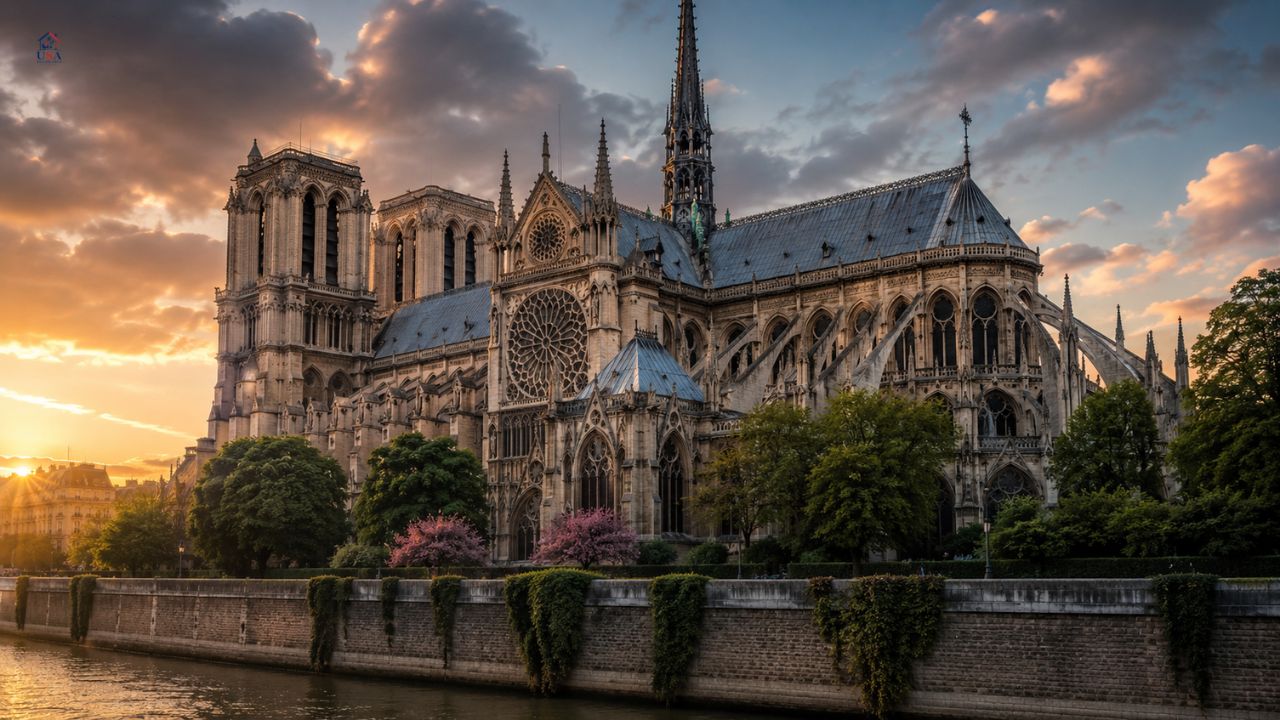
If you’ve ever stood at the base of a cathedral and felt genuinely small — almost unsettled by the sheer scale of stone rising above you — you already understand something essential about gothic cathedrals. They were built to create that feeling on purpose.
Gothic cathedrals are among the most ambitious architectural achievements in human history. Rising across Europe between the 12th and 16th centuries, these vast stone structures combined engineering innovation with religious devotion in ways that still astonish engineers, historians, and casual visitors alike. Whether you’re planning a trip to Europe, studying architectural history, or simply curious about why these buildings look the way they do, there’s far more to gothic cathedrals than pointed arches and dramatic silhouettes.
This guide covers everything — the defining features, the history, the most famous examples, what makes them remarkable, and what to look for when you visit one.
What Is a Gothic Cathedral?
A gothic cathedral is a large Christian church built primarily in the Gothic architectural style, which developed in medieval France and spread across Europe from roughly the 12th century through the 16th century. The word “cathedral” specifically refers to a church that houses the seat — or cathedra — of a bishop, making it the principal church of a diocese.
Not every Gothic-style church is technically a cathedral. There are countless gothic churches, gothic chapels, and abbey churches built in the same style that don’t carry the cathedral designation. That said, the terms are often used loosely in everyday conversation, and many of the most celebrated Gothic buildings in the world — including Westminster Abbey in London — are technically abbeys, not cathedrals at all.
What unifies the Gothic style, regardless of building type, is a recognizable set of architectural features: pointed arches, ribbed stone vaulting, flying buttresses, and enormous stained glass windows. Together, these elements made possible something that earlier Romanesque churches could not — buildings that felt impossibly tall, filled with light, and visually unlike anything that had come before.
A Brief History of Gothic Architecture
How It All Started in France
Gothic architecture didn’t appear overnight. It grew out of the Romanesque tradition — the heavy, thick-walled, round-arched churches that dominated European religious building in the 10th and 11th centuries. Those structures were solid and impressive, but they were also dark, low, and limited by the weight of their own stone.
The turning point came in the early 12th century in the Île-de-France region, particularly at the Basilica of Saint-Denis near Paris. Abbot Suger, the influential clergyman overseeing its reconstruction beginning around 1140, had a specific vision: he wanted a church flooded with light, believing that divine light was a vehicle for spiritual experience. To let more light in, he needed larger windows. To have larger windows, he needed thinner walls. To have thinner walls, he needed a new way to support the weight of the roof.
The solution — pointed arches combined with ribbed vaulting and external flying buttresses — transferred the structural load away from the walls themselves, making them more like a skeleton than a solid mass. Suddenly, walls could be opened up with vast windows filled with colored glass. The Gothic style was born.
The Spread Across Europe
From France, Gothic architecture spread rapidly. It reached England in the 1170s, where it developed a distinctive regional character — longer floor plans, broader nave windows, and eventually the extravagant Perpendicular Gothic style of the 14th and 15th centuries. Germany produced soaring, single-nave Hallenkirchen (hall churches) alongside the towering west fronts of Cologne and Ulm. Spain blended Gothic forms with Moorish influences. Italy adopted Gothic elements more selectively, producing buildings that feel quite different from their northern European counterparts.
By the 14th and 15th centuries, Gothic architecture had evolved into what historians call the High Gothic and Late Gothic periods, characterized by increasingly elaborate decoration, complex vaulting patterns, and increasingly daring feats of engineering height. Some of the most stunning cathedrals in the world — Chartres, Reims, Amiens, Cologne, Salisbury — were built or substantially completed during this era.
The Gothic Revival
Gothic architecture didn’t simply end. After a period of falling out of fashion during the Renaissance and Baroque eras, it experienced a massive revival in the 18th and 19th centuries, particularly in Britain and the United States. Architects like Augustus Pugin and George Gilbert Scott championed a return to medieval forms, producing neo-Gothic churches, universities, and civic buildings that still dominate many cityscapes. Some of the most recognizable “gothic” buildings in the world — including the Houses of Parliament in London and the Washington National Cathedral in the United States — are products of this revival, not the original medieval period.
The Defining Features of Gothic Architecture
Understanding what makes a gothic cathedral visually distinctive is easier than it might seem. A few key features appear in nearly every example.
Pointed Arches
The pointed arch is probably the single most recognizable element of Gothic architecture. Unlike the rounded arches of Romanesque churches, pointed arches can be made taller relative to their width, directing structural loads more efficiently downward. They also simply look dramatic — drawing the eye upward, toward the nave ceiling and beyond.
Ribbed Vaulting
Inside a gothic cathedral, look up. The ceiling — or vault — is typically divided into a web of stone ribs that rise from the piers and meet at the apex. This ribbed vaulting is both structural and decorative, distributing the weight of the stone ceiling across a network of supports rather than letting it press directly on the walls. In later Gothic periods, ribbed vaulting became extraordinarily intricate, producing the fan vaults and lierne vaults that make the ceilings of English cathedrals like Gloucester and Canterbury so spectacular.
Flying Buttresses
From outside, gothic cathedrals often look like they’re held up by a network of stone arms extending from the upper walls. These are flying buttresses — arched stone supports that carry the lateral thrust of the roof outward and downward to freestanding outer piers. They’re one of the great engineering innovations of the medieval world, and they’re also visually striking, giving gothic cathedrals their characteristic bristling, almost organic exterior profile.
Stained Glass Windows
Perhaps no feature defines the interior experience of a gothic cathedral more than stained glass. The structural innovations described above — pointed arches, ribbed vaulting, flying buttresses — existed largely to make possible larger and larger windows. The result was that the massive walls of earlier churches were effectively replaced by luminous fields of colored glass depicting biblical scenes, saints’ lives, and theological symbolism.
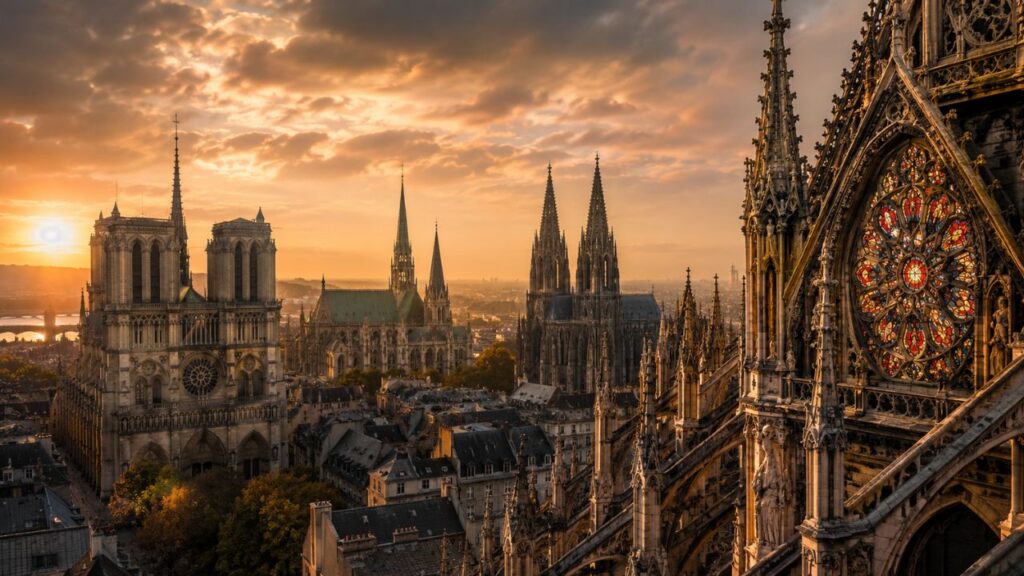
The rose window, a circular stained glass composition mounted in the west facade or at the ends of the transepts, became one of the most iconic elements of Gothic cathedral design. Chartres Cathedral in France preserves some of the finest medieval stained glass anywhere in the world.
Towering Spires and Facades
Gothic cathedrals announce themselves from a distance. Their vertical emphasis — expressed through spires, pinnacles, pointed gables, and soaring towers — was deliberately designed to be visible from miles away across the medieval European landscape. The west facade, the main public face of the cathedral, was typically the most elaborately decorated surface, featuring multiple portals carved with biblical figures, rows of saints, and layers of ornamental stonework.
The Most Famous Gothic Cathedrals in the World
Notre-Dame de Paris, France
Probably the most famous gothic cathedral in the world, Notre-Dame de Paris was begun in 1163 and largely completed by the mid-13th century. Its location on the Île de la Cité in the heart of Paris, its iconic twin towers, its three magnificent rose windows, and its elaborate flying buttresses have made it a global symbol of medieval architecture. The devastating fire of April 2019 severely damaged the cathedral’s spire and roof, but restoration efforts have been progressing, and the cathedral reopened in December 2024 after years of careful work.
Chartres Cathedral, France
Many architectural historians consider Chartres Cathedral, located about 50 miles southwest of Paris, to be the finest gothic cathedral in existence. Built primarily between 1194 and 1220 after a fire destroyed most of its predecessor, Chartres represents a pivotal moment in Gothic development — it’s one of the first cathedrals to use flying buttresses systematically. Its greatest treasures are its stained glass windows, of which more than 150 medieval panels survive largely intact, a rare and extraordinary preservation. The deep blue of the Chartres windows — sometimes called “Chartres blue” — is particularly celebrated.
Cologne Cathedral, Germany
Work began on the Cologne Cathedral in 1248, but it wasn’t completed until 1880 — a construction span of over 600 years. The result is one of the largest and most vertically dramatic gothic buildings in the world. Its twin spires, rising to 157 meters (515 feet), were the tallest structures in the world at the time of their completion. The cathedral holds the Shrine of the Three Kings, a golden reliquary said to contain the remains of the Biblical Magi, which made Cologne one of the most important pilgrimage destinations in medieval Europe.
Salisbury Cathedral, England
Salisbury Cathedral, in the English county of Wiltshire, contains the tallest church spire in the United Kingdom at 123 meters (404 feet). Its construction began in 1220 and proceeded rapidly, meaning the building has an unusual stylistic consistency compared to cathedrals built and rebuilt over many centuries. Salisbury also holds one of the four surviving copies of the Magna Carta, the 1215 document fundamental to English constitutional history.
Reims Cathedral, France
Reims Cathedral was the traditional coronation church of the kings of France — nearly every French monarch from the 10th century onward was crowned here. Built primarily in the 13th century, Reims represents French High Gothic at its most sophisticated, with a deeply sculpted west facade featuring over 2,300 carved figures. The cathedral suffered severe damage during World War I but was painstakingly restored. Its famous “smiling angel” sculpture, above the left portal of the west facade, has become one of the most reproduced images in medieval art.
Amiens Cathedral, France
Amiens Cathedral is the largest gothic cathedral in France by interior volume — its nave, at 42.5 meters (139 feet) high, is among the tallest of any medieval church. Built rapidly between 1220 and 1270, Amiens has a mathematical clarity and structural refinement that make it something of a Gothic ideal. The west facade features an extraordinary program of sculpted figures, and the interior gives an overwhelming impression of height and light. It has been a UNESCO World Heritage Site since 1981.
Burgos Cathedral, Spain
Begun in 1221 under Bishop Mauricio, Burgos Cathedral in northern Spain is often considered the finest Gothic building on the Iberian Peninsula. Its filigree-like spires and elaborate gold decoration in the interior Chapel of the Constables reflect a distinctly Spanish approach to Gothic ornament. The cathedral contains the tomb of El Cid, the legendary medieval warrior, making it both an architectural landmark and a site of national significance.
Seville Cathedral, Spain
Seville Cathedral, completed in the early 16th century, is the largest Gothic cathedral in the world by floor area and the third largest church of any kind. Its scale is extraordinary — at 135 meters long and 100 meters wide, the interior feels almost disorienting in its vastness. The cathedral was built on the site of a former mosque, and the Giralda — the former minaret, converted into a bell tower — remains one of the most recognizable landmarks in Spain.
Ulm Minster, Germany
Ulm Minster, a Lutheran parish church rather than a cathedral in the technical sense, holds the distinction of having the tallest church spire in the world at 161.5 meters (530 feet). Construction began in 1377, but the spire wasn’t completed until 1890. The building’s sheer vertical ambition — visible from across the surrounding Swabian landscape — makes it one of the most dramatic Gothic structures anywhere.
Canterbury Cathedral, England
Canterbury Cathedral is the seat of the Archbishop of Canterbury and the spiritual home of the Anglican Communion worldwide. Its history stretches back to 597 AD, though the building that stands today is primarily the product of construction and reconstruction between the 11th and 15th centuries. The cathedral became a major pilgrimage site after the murder of Archbishop Thomas Becket within its walls in 1170, and it was the destination of the pilgrims in Chaucer’s Canterbury Tales. Its fan-vaulted crypt and the elaborate Perpendicular Gothic fan vault of the nave ceiling are particularly remarkable.
Gothic Cathedrals in America: The Gothic Revival Tradition
While true medieval gothic cathedrals are naturally found in Europe, the Gothic Revival movement produced several extraordinary examples in the United States.
The Washington National Cathedral in Washington, D.C., is one of the most impressive neo-Gothic buildings in the world. Construction began in 1907 and continued until 1990, making it — like many medieval cathedrals — a multi-generational project. It was built using traditional gothic construction methods, including hand-carved limestone and genuine stained glass windows, rather than simply imitating the style in cheaper materials.
St. Patrick’s Cathedral in New York City, completed in 1878, is a prominent Gothic Revival church on Fifth Avenue, directly across from Rockefeller Center. Its twin 100-meter spires are a defining feature of the Midtown Manhattan skyline.
The Cathedral Basilica of Saints Peter and Paul in Philadelphia and Trinity Church in Boston are among many other significant Gothic and neo-Gothic religious buildings worth noting across the country.
What to Look For When You Visit a Gothic Cathedral
Visiting a gothic cathedral can be overwhelming — there’s simply so much to take in. A few focal points can help structure your experience.
Start outside. Walk around the entire exterior before entering. Look for the flying buttresses extending from the upper walls, the sculpted figures in the portal tympana (the curved surfaces above the main doors), the rose windows visible in the facade, and the way spires or towers announce the building from different angles.
Take time with the west facade. This is typically the most elaborately decorated surface. Gothic sculptural programs were essentially visual encyclopedias of Christian theology — the figures carved around the portals were intended to be read and understood by worshippers, many of whom were illiterate.
Look up inside. The ribbed vaulting overhead is one of the great visual experiences a gothic interior offers. In English cathedrals especially, the intricacy of fan vaulting and tierne vaulting can be extraordinary.
Spend time with the stained glass. Medieval stained glass was not just decorative — it was a narrative and theological medium, depicting biblical stories and saints’ lives in sequences meant to be followed from bottom to top. If possible, visit on a sunny day when the light actually passes through the glass.
Notice the scale deliberately. Many people rush through cathedrals without pausing to register how large they actually are. Find a spot near the center of the nave, stop, and simply look — at the length of the space, the height of the vault, the depth of the choir. This is what the builders intended.
Common Misconceptions About Gothic Cathedrals
“Gothic” originally meant barbaric. The term “Gothic” was actually coined during the Renaissance as an insult — Italian Renaissance critics used it to imply that medieval northern European architecture was as crude and uncivilized as the Goths (the Germanic tribes who had sacked Rome centuries earlier). The people who built these cathedrals never called their style “Gothic” — they simply called it modern, or the opus francigenum (“French work”).
They were built quickly. Most major gothic cathedrals took generations — sometimes centuries — to complete. Cologne Cathedral, as noted above, was under construction for over 600 years. This means most large cathedrals show evidence of multiple stylistic phases and changing construction priorities across their facades and interiors.
They’re all Catholic. While gothic cathedrals were originally built as Catholic churches, the Reformation in the 16th century transferred ownership of many to Protestant denominations. Canterbury and Salisbury cathedrals are Anglican. Ulm Minster is Lutheran. Several German Gothic churches serve Protestant congregations today.
Gothic architecture was primitive. The engineering behind Gothic cathedrals was extraordinarily sophisticated by the standards of its time — and remains impressive by modern standards. Medieval master builders developed the structural logic of pointed arches, ribbed vaults, and flying buttresses through trial, error, and accumulated expertise without calculus, structural engineering software, or modern construction equipment.
Frequently Asked Questions About Gothic Cathedrals
What is the difference between a gothic cathedral and a gothic church?
The word “cathedral” refers specifically to a church that is the seat of a bishop — it’s an administrative designation, not an architectural one. A gothic church simply refers to any church built in the Gothic style, regardless of its ecclesiastical status. All gothic cathedrals are gothic churches, but not all gothic churches are cathedrals.
What makes a building “gothic” in architectural terms?
Gothic architecture is typically defined by the combination of pointed arches, ribbed stone vaulting, and flying buttresses — the three structural innovations that together made possible the tall, light-filled interiors associated with the style. Large stained glass windows, sculptural decoration, and soaring spires are also characteristic, though not every gothic building includes all of these elements.
Where was gothic architecture invented?
Gothic architecture originated in the Île-de-France region of northern France in the early to mid-12th century. The reconstruction of the Basilica of Saint-Denis near Paris, overseen by Abbot Suger beginning around 1140, is generally considered the first major Gothic building.
What is the largest gothic cathedral in the world?
By floor area, Seville Cathedral in Spain is generally considered the largest gothic cathedral in the world. Cologne Cathedral and Amiens Cathedral are among the largest by height and interior volume, depending on the specific measurement used.
Why do gothic cathedrals have so many gargoyles?
Gargoyles on gothic cathedrals serve a practical purpose — they are carved stone spouts designed to carry rainwater away from the building’s walls, protecting the mortar and stonework from erosion. Their fantastical and often monstrous forms also carried symbolic meaning in medieval Christian culture, sometimes interpreted as representations of the spiritual threats from which the church offered protection.
Are gothic cathedrals still being built?
Yes, though rarely. The Washington National Cathedral in Washington, D.C., is perhaps the most notable example of a true Gothic-method cathedral completed in modern times — its construction ran from 1907 to 1990. Several smaller Gothic Revival churches have been built or are under construction in various countries in the 21st century.
What happened to gothic architecture after the Middle Ages?
Gothic architecture gradually gave way to Renaissance and Baroque styles in Europe from the 15th century onward. However, it experienced a major revival in the 18th and 19th centuries — known as the Gothic Revival — particularly in Britain, France, Germany, and the United States, where it influenced not just churches but also civic buildings, universities, and private homes.
Can you visit gothic cathedrals for free?
Many gothic cathedrals in Europe are free to enter, though some charge admission fees or request a suggested donation, particularly for access to specific areas like treasuries, towers, or crypt chapels. Visiting during an active service is typically free. It’s worth checking individual cathedral websites before visiting, as policies vary widely.
Conclusion
Gothic cathedrals remain among the most powerful architectural experiences available to anyone willing to seek them out. They are simultaneously monuments of religious faith, engineering ingenuity, artistic ambition, and communal effort — buildings that often took multiple human lifetimes to complete and were intended to endure forever.
Whether you’re standing inside Chartres watching centuries-old stained glass shift as clouds move across the sun, craning your neck at the impossible height of Amiens’ nave, or simply looking at a photograph and wondering how medieval builders managed it without modern tools, the answer is always the same: carefully, over a very long time, with an extraordinary commitment to something larger than any one person’s work.
If you’ve never visited a gothic cathedral in person, it’s worth making the effort. No photograph or description fully prepares you for the scale. And if you’ve visited one before, you already know — the experience doesn’t diminish on a second or third visit. If anything, knowing what to look for makes it richer.