Drive through any new subdivision in the country right now and count the black-framed windows, the board-and-batten siding, the wraparound porches. You won’t run out of fingers. There’s a reason this look refuses to go away, and it isn’t just because a home renovation show made it popular a decade ago.
I’ve spent years working alongside architects, builders, and homeowners who either grew up on real farms or just wanted their house to feel like it belonged somewhere. What I’ve noticed is that the people who end up happiest with their homes didn’t chase a trend. They understood what the style actually is, why certain choices work on paper but fall apart in real life, and how to adapt it to their own property instead of copying a photo from a magazine.
This guide walks through all of it: what the style really means, how to think about farmhouse plans before you ever call a builder, what belongs inside the house, and how to handle the ground around it. If you’re at the stage where you’re gathering ideas, or you already have a lot and need a plan for the dirt, this should save you from some expensive mistakes.
What Is Modern Farmhouse Style, Really?
If you ask ten people what is modern farmhouse style, you’ll get ten slightly different answers, and honestly, most of them aren’t wrong. It’s a blend, not a rulebook.
At its core, the look takes the honest, working-building bones of a real 19th-century farmhouse — simple gabled rooflines, generous porches, practical materials — and pairs them with the clean lines and open interiors people expect from a contemporary home. Where a Victorian farmhouse might have ornate trim and fussy detailing, a modern one strips that away in favor of flat panels, minimal ornamentation, and a lot of black or dark bronze metal accents.
To put it simply: what is farmhouse style in its original form was never about aesthetics at all. It was function first. Deep porches kept the sun off in summer. Metal roofs shed snow. Simple massing was cheap and quick to build. The modern version keeps that practicality but adds intention — every “simple” detail today is usually a deliberate design choice, not a budget shortcut.
You’ll also hear the term used loosely to describe anything with white siding and black windows, which is a little unfair to the style. A true modern farmhouse pays attention to proportion, roof pitch, window placement, and how the structure sits on its lot — not just the finish.
Modern Farmhouse Design: The Elements That Actually Define It
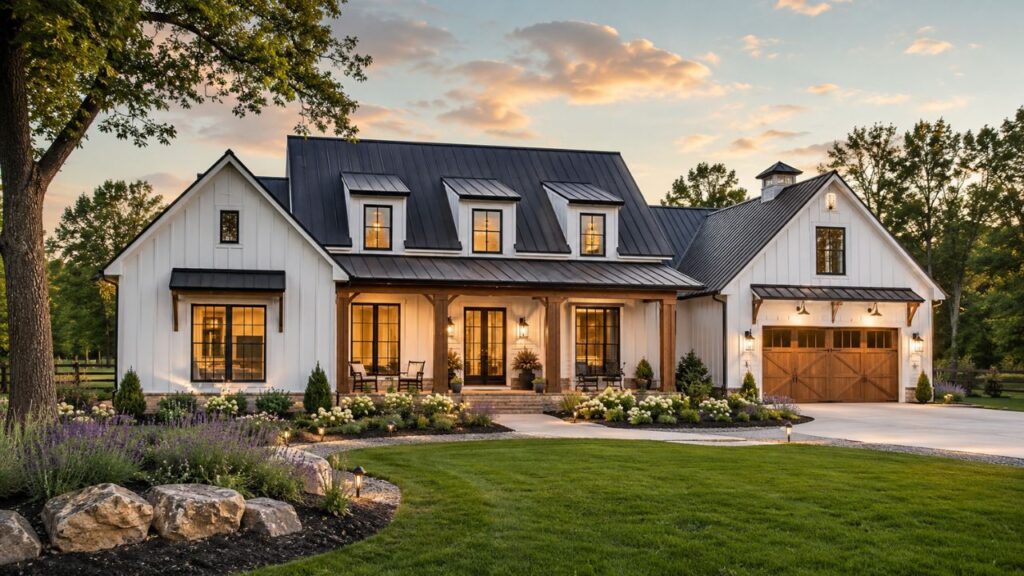
When people talk about modern farmhouse design, they’re usually pointing at a handful of recurring features. Here’s what separates a home that reads as authentic from one that just has the right paint color:
- Board-and-batten or lap siding, almost always in white, cream, or a muted warm gray
- Metal roofing, often standing seam, sometimes just as an accent over a porch or dormer
- Black-framed windows, which do more to define this look than almost anything else
- Gabled rooflines with steep pitches, sometimes mixed with a shed roof element for contrast
- A prominent front porch, usually with simple square or round columns rather than ornate ones
- Exposed structural elements, like wood beams or brackets, used decoratively but built to look load-bearing
What ties it together is restraint. A modern farmhouse aesthetic depends on a limited material palette used consistently, rather than a lot of competing textures. The homes that feel “off” almost always have too many finishes fighting for attention — stone, brick, siding, and shingles all crammed onto one facade.
There’s also a regional layer to this. A farmhouse designed for the Texas Hill Country handles heat and glare differently than one built in Vermont. Good design respects climate, not just style trends.
Farmhouse Plans: What to Actually Look For Before You Buy One
This is where a lot of people get into trouble. They fall in love with a photo, buy a set of farmhouse plans online, and only later realize the layout doesn’t fit their lot, their climate, or how they actually live.
A few things worth checking before committing to any of the many modern farmhouse plans floating around online:
- Porch orientation. A gorgeous wraparound porch facing west in a hot climate turns into an unusable oven by 4pm. Check which direction the porch faces relative to the sun path on your actual lot.
- Roof pitch and snow load. Plans drafted for the Southeast don’t always account for heavy snow. If you’re building somewhere with real winters, this needs engineering review, not just aesthetics.
- Mudroom placement. Farmhouses live and die by their mudrooms. If the plan puts the garage entry straight into a formal space instead of a drop zone, that’s a daily annoyance for the life of the house.
- Window-to-wall ratio. Big black windows look incredible in renderings but drive up both the build cost and the heating and cooling bill. Ask your builder for realistic numbers before you fall in love with a design.
For people building on a tighter footprint or a smaller budget, a simple farm house layout — rectangular footprint, gabled roof, minimal jogs in the exterior wall — is usually both cheaper to build and easier to heat and cool than a complex, multi-gable design. Simplicity in the massing doesn’t mean a boring interior; it just means the money goes into finishes instead of complicated framing.
It’s also worth noting that among all the farmhouse designs available through plan companies and architects, the ones that age well tend to avoid overly trendy details — think twice before committing to a finish or fixture that’s everywhere on social media this year, because “everywhere this year” often means “dated in five.”
Building Farmhouse Style Outside North America
Interest in this look isn’t limited to the U.S. and Canada. Search interest in farm house design in village settings and village farm house design has grown steadily across South Asia and the Middle East, where families are adapting the same white-siding, gabled-roof language to local climates and materials — often substituting locally available stone or concrete for the timber-heavy construction common in the West. If you’re building in a hot, dry region, look for plans that widen the porch overhangs and orient the main living spaces away from direct afternoon sun, rather than copying a Midwest U.S. plan wholesale.
Modern Farmhouse Interior Design: Making the Inside Match the Outside
A house can nail the exterior and still feel wrong the moment you walk in. Good modern farmhouse interior design carries the same restraint from the outside in, rather than treating the interior as a separate project.
The most common interior mistakes I see:
- Shiplap on every wall. It was fresh a decade ago. Now it reads as a costume rather than a material choice. Use it selectively — an accent wall, a fireplace surround — not as wallpaper.
- All-white everything. A truly good modern farmhouse interior uses white as a base, not the whole story. Warm wood tones, black metal fixtures, and at least one deep, saturated color somewhere in the home keep it from feeling sterile.
- Matching every light fixture. Real farmhouses were built and furnished over decades, with pieces added as needed. A little variation in your lighting and hardware actually looks more authentic than a matched catalog set.
For modern farmhouse decor, think in layers rather than a checklist. Vintage or vintage-inspired furniture pieces, natural fiber rugs, linen textiles, and a mix of open shelving with closed storage all read as lived-in rather than staged. Function matters here too — a farmhouse kitchen with a big working island and a deep apron-front sink isn’t decor, it’s a design decision that reflects how the space is meant to be used.
Kitchens and bathrooms are where most of the budget disappears, so prioritize there. A simple, well-proportioned kitchen with quality cabinetry will read as more expensive than a busy one with cheaper materials.
Farmhouse Landscaping: The Part Everyone Forgets Until It’s Too Late
Here’s something I tell every client: your modern farmhouse landscaping plan should be part of the design conversation from day one, not an afterthought once the house is framed. A beautiful house surrounded by builder-grade sod and three foundation shrubs doesn’t read as a farmhouse — it reads as a house that happens to be painted white.
Building a Layout Farmhouse Landscape Plan
A good layout farmhouse landscape plan starts with the bones, the same way the house design does. Before picking a single plant, map out:
- Where the driveway and walkways will sit, and what material fits the style (gravel, board-formed concrete, and reclaimed brick all read more authentic than plain poured concrete)
- Where you need privacy versus where you want an open view — farmhouses traditionally sat in open land, so overly dense foundation planting can actually work against the look
- Drainage, especially around porches and low points near the house
- Where outdoor living happens: a fire pit area, a vegetable garden, a place for the dog
Once the layout is set, the planting becomes a much easier decision.
Farmhouse Landscaping Ideas That Hold Up
Some of the most reliable farmhouse landscaping ideas lean into plants that look intentional but slightly untamed:
- Ornamental grasses along a fence line or driveway edge
- A mix of native perennials instead of a single repeated shrub
- Climbing roses or clematis on a trellis near the porch
- A working kitchen garden, even a small one, near the back door
For farmhouse front yard landscaping ideas, resist the urge to over-formalize. Symmetrical, clipped hedges read more colonial than farmhouse. A slightly asymmetrical planting bed with layered heights — tall grasses at the back, mid-height perennials, a low border — reads far more authentic.
If you’re working with a larger property, farm landscaping ideas should account for the transition between the maintained yard and the working or open land beyond it. That edge — sometimes called the “wild edge” — is often where a farmhouse property earns its character. A mowed lawn that abruptly meets untouched field looks unfinished; a graduated transition with taller native grasses closer to the field line looks planned.
Farmhouse Rustic Garden Design and Garden Beds
A farmhouse rustic garden design typically favors raised beds built from reclaimed or rough-cut lumber, mixed plantings of vegetables and flowers together (a classic cottage-meets-farm approach), and simple wire or wood fencing rather than anything ornamental. This isn’t about looking messy — it’s about looking productive. The best farmhouse garden design work I’ve seen treats the garden as a functioning part of the property, not a decorative feature.
For a broader farmhouse landscape design, think in zones radiating out from the house: a more refined, close-in planting near the porch and entry, transitioning to a more relaxed, practical landscape further out. This mirrors how real farms were laid out, with the most cultivated ground closest to the house.
Country Home Landscaping on a Larger Scale
If your property extends well beyond a typical suburban lot, country home landscaping and country farmhouse landscaping ideas need to account for scale differently. A small flower bed that looks perfect next to a suburban porch can disappear entirely against five acres. Larger properties benefit from mass plantings — big blocks of a single grass or shrub — rather than the fussier, plant-by-plant approach that works on a smaller lot.
This is also where farm landscape thinking comes in: consider sightlines from the road, where you want the eye to land first, and how the land itself (a slope, a pond, an old tree line) can be worked into the design instead of fought against.
Putting It All Together: Farmhouse Landscape and Farm Landscaping
Whether you call it a farmhouse landscape, a modern farmhouse landscape, or simply farm landscaping, the underlying goal is consistent: the ground around the house should feel like it belongs to the same story as the architecture. That means matching material choices (the same stone in a walkway that shows up on a chimney, for example), respecting the working, practical roots of the style, and resisting the urge to over-manicure a home whose whole appeal is that it looks like it grew out of the land rather than being dropped onto it.
Common Mistakes That Show Up After Move-In
A lot of design guides stop at the pretty pictures and skip the part where real people live in these houses for years and discover what actually holds up. A few patterns I’ve seen repeat across different builds, regardless of budget:
Overcommitting to black windows. They look sharp in photos, but they absorb more heat than white or bronze frames, and in a sunny climate that translates to a warmer house and a higher cooling bill. Some builders now suggest black on the street-facing elevation only, with a lighter frame color on windows that get heavy afternoon sun. It’s a compromise that keeps the curb appeal without the full energy penalty.
Underestimating porch maintenance. A big wraparound porch is gorgeous, but it’s also exposed wood or composite decking that needs regular upkeep, plus ceiling fans, lighting, and furniture that all sit outdoors year-round. Budget for the ongoing cost, not just the build cost.
Skipping the landscaping budget entirely. This is the one that surprises people most. After spending the full budget on the house itself, there’s often nothing left for the yard, and a farmhouse without any landscaping plan sits looking unfinished for years. Even a modest allocation set aside up front for grading, a walkway, and some foundation planting changes how the finished property reads.
Choosing trend-driven finishes over durable ones. A specific tile pattern or cabinet color that’s everywhere on social media right now often looks dated within a few years. Neutral, durable choices in the big-ticket items (flooring, countertops, siding) age better, and you can always bring in trend-driven pieces through furniture, textiles, or paint, which are far cheaper to change later.
Budgeting for a Modern Farmhouse Build
Nobody enjoys the budgeting conversation, but it’s the one that determines whether the finished house actually matches what was in the plans. A rough way to think about where the money goes on a typical build:
- Structure and framing — usually the largest single line item, and where roof complexity (multiple gables, dormers) adds cost quickly
- Exterior finishes — siding, roofing material, and window package; this is where the “modern farmhouse look” either gets funded properly or gets value-engineered away
- Interior finishes — kitchen and bathroom cabinetry, countertops, and flooring, which is where most people want to spend more than they initially planned
- Site work and landscaping — frequently underestimated, especially on a lot with grading challenges or a septic system to work around
A useful exercise before finalizing any farmhouse plans is to price out the exterior package (siding, roofing, windows, porch) separately from the interior finish package. That way, if the budget gets tight, the cuts come from a place of understanding trade-offs rather than a builder quietly swapping materials without a clear conversation about it.
A Quick Comparison: Traditional Farmhouse vs. Modern Farmhouse
| Feature | Traditional Farmhouse | Modern Farmhouse |
|---|---|---|
| Siding | Painted wood clapboard | Board-and-batten or engineered lap siding |
| Windows | Multi-pane, wood frame | Large black-framed, often minimal grid |
| Roof | Simple gable, wood or asphalt shingle | Steep gable, standing-seam metal accents |
| Interior layout | Compartmentalized rooms | Open-concept living, dining, kitchen |
| Porch style | Functional, often unadorned | Designed as a focal architectural feature |
| Color palette | Varied, regionally driven | Mostly white, black, warm wood tones |
| Landscaping | Practical, working land | Curated but intentionally relaxed |
Where to Find Real Inspiration (and What to Ignore)
There’s no shortage of a farmhouse gallery or a page of farmhouse photos online, and that’s both a gift and a trap. It’s easy to end up with fifty saved images that don’t actually agree with each other stylistically.
When you’re building your own farmhouse pics folder for a builder or designer meeting, try to be disciplined about it:
- Save images for specific reasons (this porch column style, this kitchen layout, this landscaping edge) rather than just “I like this house”
- Note what climate and region the photo is from — a look that works in coastal California may not translate to the Midwest
- Separate “aspirational” images from “realistic for my budget” images so your builder isn’t guessing which one you actually expect
An elegant farmhouse doesn’t need every trendy element at once. Some of the best examples I’ve toured in person were restrained almost to the point of being plain from the street, with all the character concentrated in a few well-chosen details — a single stone chimney, one really good door, a porch with generous proportions.
Contemporary Farmhouse Products Worth Knowing About
If you’re sourcing finishes yourself, a handful of categories of contemporary farmhouse products come up again and again in real builds:
- Matte black plumbing fixtures and cabinet hardware
- Engineered wood flooring with a wire-brushed or hand-scraped texture
- Fiber cement lap and board-and-batten siding, which holds up better than wood in most climates
- Standing-seam metal roofing panels, often in charcoal, matte black, or a weathered zinc tone
- Farmhouse (apron-front) sinks in fireclay or stainless steel
- Barn-style sliding doors, used sparingly rather than on every closet
None of these need to be expensive to look right — consistency across the choices matters more than any single premium product.
Modern Farm Living: Beyond Just the House
It’s worth stepping back from finishes for a second. A modern farm or modern farm house today often isn’t a working agricultural property at all — it’s a lifestyle choice, a way of signaling a slower, more grounded way of living even in a suburban or exurban setting. That’s not a criticism. It just means the design decisions carry symbolic weight beyond function.
This is part of why the modern day farmhouse and what people now call farmhouse modern design have such staying power compared to more purely decorative trends. The style is rooted in something real — actual working buildings, actual practical choices — even when it’s being used on a half-acre suburban lot. That authenticity is hard to fake with a purely decorative style, and it’s a big part of why the look has outlasted so many design trends that came after it.
Frequently Asked Questions
What is modern farmhouse style in simple terms? It’s a design approach that combines the simple, practical architecture of a traditional working farmhouse with cleaner, more contemporary interior layouts and finishes — think classic gabled rooflines and porches paired with open floor plans and a restrained material palette.
How much does it cost to build from modern farmhouse plans? Costs vary heavily by region, but the biggest cost drivers are usually the amount of black-framed glazing, metal roofing accents, and porch square footage — not the “farmhouse” label itself. A simple farm house layout with a straightforward roofline will always cost less per square foot than a design with multiple gables and dormers.
Do I need a lot of land to do farmhouse landscaping well? No. Farmhouse landscaping ideas scale down fine for a standard suburban lot — the key is choosing a few well-placed elements (a working garden bed, layered plantings, a natural material walkway) rather than trying to replicate acreage-scale landscaping on a small footprint.
What’s the difference between farmhouse style and modern farmhouse style? Traditional farmhouse style grew out of actual agricultural buildings and is regionally varied. Modern farmhouse style is a more recent design movement that borrows that visual language — white siding, gabled roofs, porches — but applies it with contemporary interior layouts, a more limited color palette, and often significantly larger window openings.
Can modern farmhouse design work in a hot climate? Yes, but it needs adjustment. Deeper porch overhangs, smaller west-facing window openings, and lighter roof colors all help. A plan drafted for a cooler climate often needs these tweaks before it makes sense somewhere hot and sunny.
What plants work best for modern farmhouse landscaping? Ornamental grasses, native perennials, and simple structured plantings near the entry tend to look the most authentic. Overly formal, clipped hedges usually read as a different style entirely.
A Few Places to Go From Here
If this guide covered the big picture, a few related topics are worth digging into separately once you’re further along in planning:
- A dedicated piece on farmhouse kitchen layouts for anyone deep into the interior planning stage
- A guide to choosing exterior paint colors for board-and-batten siding, since this decision affects the whole house’s character
- A resource on budgeting for a custom home build, which pairs well with anyone comparing farmhouse plans against cost
- A focused article on native plant selection by region, useful for anyone working through their own farmhouse landscape design
- A piece on porch design and proportion, since this single element does more visual work than almost anything else on a farmhouse exterior
Those make natural next reads for anyone who found this guide useful and is ready to get into the details.