Walk through an old-growth forest in Northern California and you’ll eventually spot one: a lumpy, misshapen swelling on the trunk of a redwood, sometimes the size of a beach ball, sometimes bigger than a car. Most hikers walk right past it. Woodworkers stop dead in their tracks.
That growth is a burl, and it’s one of the strangest things a tree can produce. It looks like a tumor. In a way, it kind of is one. But slice it open, sand it down, and rub in a little oil, and you’ll find some of the most jaw-dropping grain patterns in the entire natural world — swirling, knotted, almost hypnotic. Furniture makers pay thousands of dollars for a single slab. Collectors hunt for them the way some people hunt for rare coins.
So what is burl wood, exactly? Where does it come from, why is it worth so much, and how do you tell the real thing from a cheap imitation? I’ve spent years around sawmills, wood suppliers, and furniture shops, and I’m going to walk you through everything you actually need to know — not the recycled Wikipedia summary you’ll find on every other page.
By the end of this guide, you’ll understand what burl wood is, how a burl forms, which species produce the best burl, what burl wood is used for, and what to look for (and look out for) if you’re planning to buy some.
What Is Burl Wood? A Straightforward Definition
Burl wood — sometimes spelled burlwood or called burled wood — is timber cut from a burl, an abnormal, rounded growth that forms on a tree’s trunk, branches, or roots. Instead of growing in neat, parallel lines the way normal wood grain does, the wood cells inside a burl twist, curl, and knot around each other in every direction imaginable.
If you’ve ever wondered what is a burl in the first place, think of it this way: a burl is basically a tree’s version of a scar tissue lump. The tree keeps growing normally everywhere else, but at one spot, something has gone haywire, and the growth pattern turns chaotic.
Here’s the short version people usually search for:
- Burl = the growth itself, while it’s still on the tree
- Burl wood / burlwood = the lumber or slab cut from that growth once harvested
- Tree burl = another common way people refer to the growth in general conversation
All three terms point to the same underlying thing, and you’ll see them used more or less interchangeably across the woodworking world.
What Causes a Burl to Form?
This is where things get genuinely interesting, and honestly, a little mysterious. Even forestry scientists don’t have a fully settled answer.
According to research from the U.S. Forest Service, a burl is technically the result of hyperplasia — an abnormal overproduction of xylem cells by the tree’s vascular cambium, the thin growing layer just under the bark. In plain English: something triggers the tree to pump out way more wood cells than normal in one concentrated spot, and those cells grow in a tangled, disorganized way instead of the usual straight lines.
What triggers it? Most foresters point to some combination of:
- Insect infestation — bugs boring into the bark and disrupting normal cell growth
- Fungal or bacterial infection — a pathogen that irritates the cambium layer
- Viral infection — yes, trees can catch viruses too
- Physical injury — a broken branch, lightning strike, or wound that never fully healed
- Environmental stress — freeze damage, drought, or repeated mechanical damage
- Genetic predisposition — some groves seem to produce far more burls than others, which hints at a hereditary component nobody has fully mapped out yet
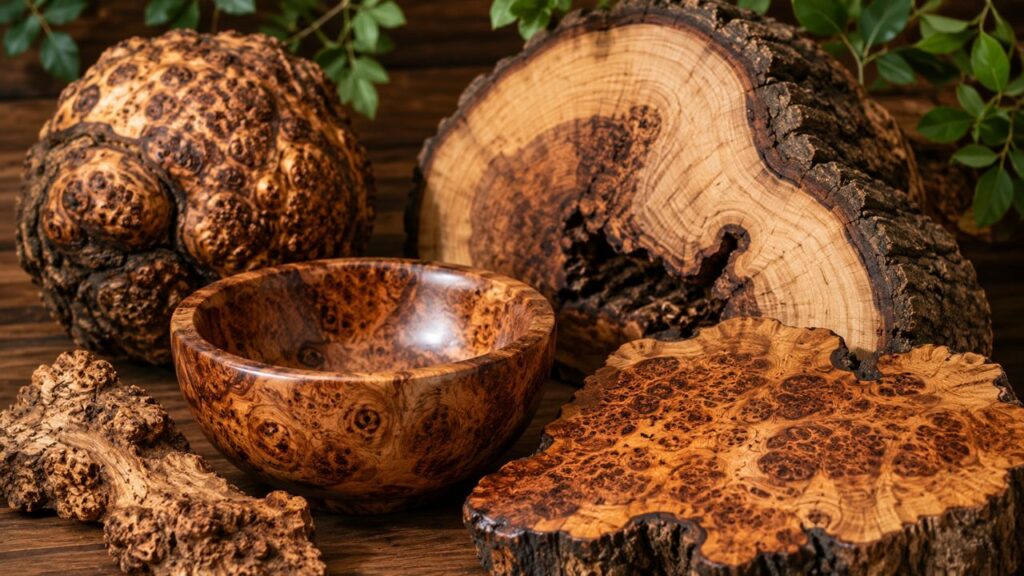
The honest answer is that no single cause explains every burl. Extension foresters at places like the University of Maryland openly admit the cause of most individual burls can’t be pinned down with certainty. What we do know is that the tree responds to whatever the irritant is by throwing a fit of disorganized growth, and dormant buds inside the burl multiply in tight little knots, which is exactly what creates that famous “eye” pattern collectors love.
One thing worth clearing up: a burl does not appear to shorten a tree’s life. The tree keeps functioning normally around it. What actually harms the tree is careless removal — cutting a burl off a living tree creates a large open wound that invites decay and disease, which is a big part of why illegal burl poaching in protected forests is such a serious problem (more on that shortly).
Where Burls Grow on a Tree
People assume burls only show up on the trunk, but that’s just where they’re easiest to spot. In reality, burls form in three main locations:
- Trunk burls — the classic, visible lump on the main stem, usually near the base
- Branch burls — smaller growths where a limb meets the trunk or along the branch itself
- Root burls — often the largest and most spectacular, growing entirely underground and connected to the root system, sometimes appearing as clusters of bulbous growths linked by rope-like roots
Root burls tend to be the real prize for serious collectors because they can grow undisturbed for decades without competing for light or space the way above-ground growths do.
Redwood Burl: The King of Burl Wood
If you search “burl wood” long enough, you’ll run into redwood burl constantly, and there’s a good reason for that. Coastal redwoods (Sequoia sempervirens) are practically burl machines. They’re one of the few tree species that regularly produce massive burls, sometimes called “goiter” growths, at the base of the trunk.
A few things make redwood burl special:
- Size — redwood burls can reach enormous dimensions, sometimes several feet across, because the trees themselves live for centuries and the burls have that much more time to grow
- Color — redwood burl slabs often show a warm reddish-amber tone with dramatic dark swirls running through the eyes
- Regeneration — a redwood burl left in the ground can actually sprout new growth even after the parent tree dies, which is part of what makes redwoods such resilient trees
- Legal protection — because so much redwood burl comes from old-growth trees inside national and state parks, harvesting it without authorization is illegal, and poaching has become a serious enforcement problem for park rangers in places like Redwood National and State Parks
If a supplier is selling you “genuine redwood burl,” ask where it was sourced. Reputable dealers get their material from sustainably managed private timberland, salvage logging operations, or fallen trees — never from live trees inside protected parkland.
Other Popular Species for Wood Burl
Redwood gets most of the spotlight, but plenty of other species produce excellent burl. Here’s a rundown of the ones you’ll most commonly find on the market:
| Species | Typical Color | Grain Character | Common Uses |
|---|---|---|---|
| Redwood | Reddish-amber, dark swirls | Bold, dramatic eyes | Slabs, tables, clocks |
| Maple | Cream to golden tan | Tight, fine eyes (“burr maple”) | Veneer, gunstocks, musical instruments |
| Walnut | Deep brown, chocolate tones | Dense, feathery swirl | High-end furniture, boxes |
| Oak | Light tan to honey | Coarse, open grain | Rustic furniture, bowls |
| Buckeye | Cream with pink or blue-gray hues | Soft, marbled swirl | Pens, jewelry, small turned items |
| Cherry | Reddish-brown, deepens with age | Fine, subtle figure | Cabinetry, decorative boxes |
| Elm | Light brown, olive undertones | Interlocked, wild grain | Bowls, live-edge pieces |
Technically, any species can produce a burl. Some are simply more prone to it than others because of how their bark and cambium layer respond to stress. Buckeye burl, for example, is famous among pen turners and small-object woodworkers specifically because of its soft, colorful marbling, while maple burl (often called burr maple in furniture circles) has been prized in fine cabinetry for centuries.
What Does Burl Wood Look Like Compared to Regular Lumber?
Regular lumber is cut with the grain running in a fairly predictable, straight direction. That’s what gives standard boards their strength and their relatively plain, linear appearance.
Burled wood throws all of that out the window. Instead of straight lines, you get:
- Swirls and curls that wrap around dormant bud clusters
- “Eyes” — small dark circular marks where a bud was trying (and failing) to sprout into a branch
- Irregular color banding, sometimes several shades within a single slab
- Unpredictable density, with some areas harder and some softer than the surrounding wood
This chaotic structure is exactly why burl wood is so difficult to work with hand tools or on a lathe — the interlocked grain chips and tears unpredictably instead of cutting cleanly. Experienced woodworkers usually stabilize burl blanks with resin before turning them, especially smaller pieces like pen blanks or bowl stock, because raw burl can crack or blow apart under the pressure of a lathe.
That same wild grain, though, is what makes burl wood so dense and split-resistant once it’s stabilized and finished. Historically, that toughness made it a practical choice — not just a decorative one — for mallets, wooden mauls, and the wooden pegs called “beetles” or “beadles” that carpenters once used to drive joinery together.
What Is Burl Wood Used For?
This is probably the question people care about most once they understand what a burl actually is. In practice, burl wood shows up in a surprising range of products:
- Live edge tables — dining tables, coffee tables, and console tables that keep the natural, irregular outer edge of the slab
- Furniture accents — drawer fronts, tabletops, headboards, and cabinet doors
- Veneer — thin sheets of burl glued onto plainer wood substrates, common in luxury car interiors, high-end pianos, and antique furniture restoration
- Bowls and turned objects — burl is a favorite among lathe turners because no two bowls ever look alike
- Clocks and wall art — cross-sections of burl are often finished as standalone decorative pieces
- Gun stocks — walnut burl in particular has a long history in high-end firearm crafting
- Pens, knife handles, and jewelry — smaller offcuts get turned into pocket-sized keepsakes
- Musical instruments — figured maple burl occasionally appears on guitar tops and other instrument bodies where visual character matters as much as tone
Because every burl is genuinely one of a kind, pieces made from it carry a certain bragging-rights quality that standard lumber just doesn’t have. No two burl slabs will ever match, which is part of the appeal for interior designers building a statement piece around a single table.
Why Is Burl Wood So Expensive?
If you’ve priced out burl wood for sale online, you’ve probably noticed the sticker shock. A few honest reasons explain the cost:
- Scarcity — not every tree produces a usable burl, and large, well-figured burls are genuinely rare
- Unpredictable yield — a supplier won’t know exactly how a burl will look, or how much usable wood is inside it, until it’s cut open
- Difficult processing — burl is harder to dry without cracking, harder to mill, and often requires resin stabilization before it can be worked
- High waste rate — cracks, voids, and bark inclusions mean a significant percentage of raw burl weight never becomes usable slab
- Labor-intensive finishing — sanding and finishing burl’s wild grain takes far more time than flat-sawn lumber
- One-of-a-kind appeal — buyers are paying partly for exclusivity; no other table in the world will look exactly like theirs
Small burl offcuts for pen blanks might run you $10 to $30. A finished, book-matched dining table slab cut from a large redwood burl can run into the tens of thousands of dollars, especially if it’s been kiln-dried, stabilized, and finished by a skilled shop.
How to Identify Real Burl Wood
Because burl commands premium prices, it’s worth knowing how to spot the real thing versus wood that’s simply been figured, dyed, or printed to imitate the look.
Look for:
- Concentric eye patterns that appear to have actual depth, not just a printed surface texture
- Grain that changes direction unpredictably across the piece rather than in one consistent sweep
- Slight color variation across the same board, since burl rarely dries to one perfectly uniform shade
- Weight — burl is typically denser than plain-sawn lumber of the same species
- Bark inclusions near the edges, which are common and actually considered a feature in live-edge pieces, not a defect
If a “burl” tabletop has a perfectly uniform, repeating pattern, you’re probably looking at a photo-printed laminate or a veneer applied over a cheaper substrate rather than solid burl.
Buying Burl Wood: What to Know Before You Purchase
If you’re in the market for a slab, here’s a practical checklist based on what experienced buyers and suppliers recommend:
- Ask about moisture content. Green, unseasoned burl is prone to cracking as it dries. Kiln-dried or properly air-dried slabs are far more stable.
- Ask for the species and origin. A reputable seller will tell you exactly what tree the burl came from and where it was harvested.
- Inspect for structural cracks, not just surface checking. Small surface cracks are normal in burl; deep structural splits are a bigger concern.
- Check if it’s already been stabilized with resin, particularly for smaller decorative pieces.
- Compare price per board foot across a few sellers before committing, since pricing on burl varies enormously depending on figure quality, not just size.
- Confirm sustainable sourcing, especially for redwood burl, given the ongoing poaching problems in protected forests.
A Quick Word on Burl Poaching
This part doesn’t get enough attention. Because a well-figured redwood burl can be worth thousands of dollars, illegal poaching inside national and state parks has become a real problem over the past couple of decades. Thieves have been known to chainsaw burls directly off living, centuries-old trees under cover of darkness, which exposes the tree to infection and can eventually kill it. Some rangers have gone as far as installing DNA tracking systems on vulnerable redwoods to help prosecute poachers who try to sell stolen burl material.
If you’re buying burl wood, this is exactly why sourcing matters. Ethical suppliers get their material from private land, salvage operations, or naturally fallen trees, not from someone with a chainsaw and a truck at 2 a.m. in a national park.
Caring for Burl Wood Furniture
Once you’ve got a piece of burl furniture in your home, keeping it looking good isn’t complicated, but it does need a bit more attention than standard furniture:
- Keep it away from direct sunlight for long stretches, since UV exposure can fade the natural color contrast that makes burl distinctive
- Maintain a stable humidity level in the room; burl’s wild grain makes it more reactive to swings in moisture than straight-grained wood
- Use furniture wax or oil finishes recommended for the specific topcoat your piece has, and reapply periodically
- Wipe up spills quickly, especially on unsealed or lightly finished pieces
- Avoid placing very hot or very cold items directly on an unprotected burl surface, since rapid temperature changes can stress the wood
A Brief History of Burled Wood in Craftsmanship
Burl wood isn’t some trendy discovery from the last decade of Instagram-friendly interior design. Woodworkers have prized it for centuries. Colonial and Native American craftspeople in North America turned burl into bowls, cups, and utensils long before power tools existed, valuing it precisely because its interlocked grain made it tough and split-resistant — a practical choice as much as a beautiful one. Root burl, in particular, was sought after for turned treen (small wooden household objects) because its density held up to daily use far better than straight-grained wood.
In Europe, burr walnut became a signature material in fine cabinetry and clockmaking during the 17th and 18th centuries, showing up in everything from writing desks to violin backs. Later, as automobile interiors became a status symbol in the early 20th century, walnut and maple burl veneer found its way onto dashboards and trim in luxury cars, a tradition some high-end manufacturers still carry on today.
What’s changed in recent decades isn’t really the appeal of burl — it’s access. Better kilns, stabilizing resins, and CNC milling have made it far easier for small shops and hobbyist woodworkers to work with burl material that once required serious specialized skill to process without it cracking apart. That’s part of why you’ll now see burl show up everywhere from Etsy shops to high-end architectural design firms.
Burl Wood vs. Spalted Wood: A Common Mix-Up
People often lump burl wood in with spalted wood, and while both produce dramatic, one-of-a-kind figure, they’re not the same thing at all. Spalting happens after a tree is cut down, when fungi begin colonizing the dead wood and leave behind dark zone lines and streaks of discoloration as they spread. Burl, on the other hand, forms while the tree is still very much alive, and the figure comes from the physical structure of the grain itself rather than fungal staining.
You can actually get both in the same piece — a burl that’s been sitting in damp conditions can develop spalting on top of its natural burl figure, which some turners consider the ultimate combination for a truly unique bowl blank. If a seller describes a piece as “spalted burl,” that’s exactly what they mean: burl figure plus fungal staining layered together.
Frequently Asked Questions
What is burl wood? Burl wood, also written as burlwood, is lumber cut from a burl — an abnormal, rounded growth on a tree’s trunk, branch, or root system where the wood grain has grown in a twisted, disorganized pattern instead of the usual straight lines.
What is a burl exactly, and is it harmful to the tree? A burl is a localized area of highly disorganized wood growth, usually triggered by stress like insect damage, infection, or injury. It doesn’t appear to shorten a tree’s lifespan on its own. The tree is mainly put at risk when a burl is carelessly cut away, which leaves an open wound vulnerable to decay.
What is the difference between burl and regular wood grain? Regular wood grain runs in relatively straight, parallel lines along the trunk. Burl grain twists and swirls in every direction around clusters of dormant buds, which is what creates the eyes and figure that make burl wood so visually distinctive.
Why is redwood burl considered special compared to other types of burl? Redwood burl tends to grow larger than burls from most other species, partly because coastal redwoods live for such a long time. It also has a distinctive warm, reddish tone and is one of the most recognizable types of burled wood in the furniture and slab market.
Where can I find burl wood for sale? Specialty lumber yards, sawmills that handle figured wood, woodworking supply stores, and online slab retailers are the most reliable sources. Always ask about species, origin, and moisture content before buying, and be wary of unusually cheap “burl” that may actually be veneer or printed laminate.
Can any tree produce a burl? In theory, yes. Any species is capable of forming a burl under the right combination of stress and irritation. In practice, some species — redwood, maple, walnut, oak, and buckeye among them — are simply more prone to burl formation than others.
Is burl wood more expensive than regular lumber? Almost always, yes. Scarcity, unpredictable yield, difficult drying and milling, and the one-of-a-kind nature of every piece all push the price well above standard flat-sawn lumber of the same species.
How do I know if a piece of furniture is really made from burl? Look for genuine depth in the eye patterns, grain that shifts direction unpredictably, slight natural color variation, and noticeably heavier weight compared to plain lumber. Perfectly repeating patterns are usually a sign of printed laminate rather than solid burl.