
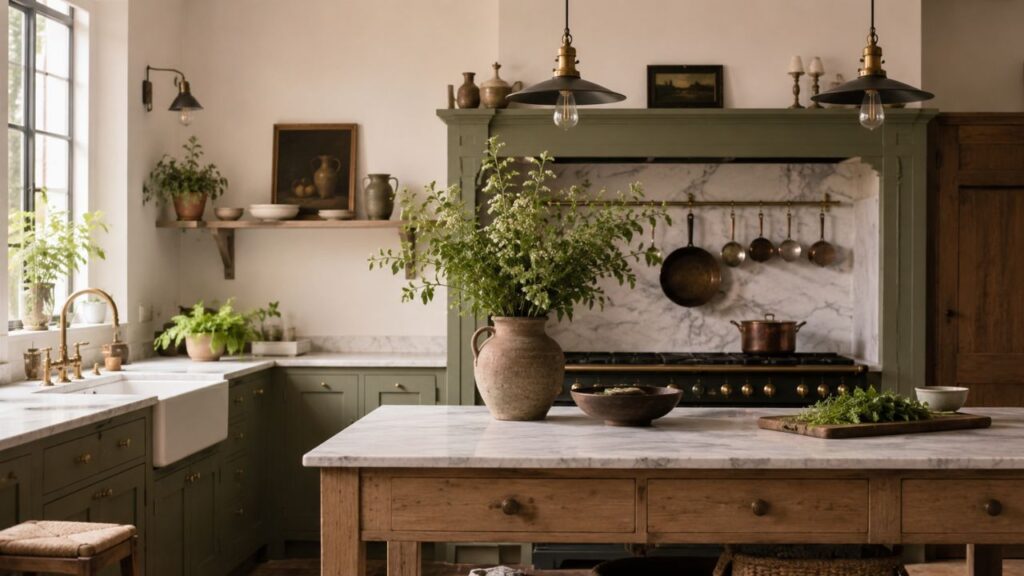
There’s a specific kind of kitchen photo that stops people mid-scroll. Muted green cupboards. A brass tap gone slightly cloudy with age. An open shelf holding three chipped jugs that somehow look intentional. Nine times out of ten, that photo traces back to one workshop in the middle of the English countryside: deVOL.
If you’ve landed here, you’re probably in one of three camps. You saw a kitchen on Pinterest or Instagram and went down a rabbit hole trying to find the source. You’re actually planning a renovation and someone mentioned the name. Or you typed “duval kitchens” into a search bar, got a “did you mean deVOL?” prompt, and now you’re wondering who these people even are.
Whichever camp you’re in, I’ve spent a fair amount of time researching British kitchen manufacturers, and deVOL is one of the few that genuinely earns the hype it gets. This isn’t a puff piece. I’ll cover what they actually make, what a devol kitchen costs, how the stools fit into the picture, why their Instagram account behaves more like a design magazine than a sales feed, and where the brand has real limitations you should know about before you fall in love with a cabinet colour.
What deVOL Actually Is (And Isn’t)
deVOL is a British kitchen and furniture manufacturer based at Cotes Mill, a 16th-century water mill on the River Soar just outside Loughborough, Leicestershire. It was started in 1989 by two design graduates from Loughborough University, Philip deVries and Paul O’Leary, who rented a small workshop to do custom furniture and antique restoration work. The name is simply an amalgamation of their surnames — de(Vries) + (O’Lea)ry, tidied up into “deVOL.”
deVries left after about a decade to run a property business, and O’Leary carried the company forward, eventually buying the company’s first proper shop in the village of Quorn. In 2012, deVOL purchased Cotes Mill and moved its headquarters and showrooms there the following year. It’s worth pausing on that building for a second, because it’s not just a backdrop for pretty photos — the mill appears in the Domesday Book from 1086, and the site has a genuinely strange history that includes a Civil War skirmish at the adjoining bridge and, according to deVOL’s own account, an ancestor of comedian Spike Milligan who died in an accident involving the old waterwheel.
Today, deVOL employs several hundred staff, many of whom are local craftspeople or design graduates recruited straight out of Loughborough University — the same pipeline that produced the founders. Helen Parker has served as Creative Director since 2011, and Robin McLellan, who joined as a placement student, became Managing Director the same year. That kind of internal promotion pattern tends to signal a company that’s stable rather than one chasing quick growth, and it shows in how slowly and deliberately deVOL adds new products.
One thing worth clearing up early: deVOL is not the same thing as “duval kitchens,” a common misspelling that search engines auto-correct. There isn’t a separate, well-known kitchen brand called Duval Kitchens — people typing that phrase are almost always looking for deVOL, just spelling it phonetically.
The Kitchen Collections: Shaker, Classic English, Sebastian Cox, Haberdasher’s and Heirloom
A devol kitchen isn’t one single style — it’s a family of ranges, and picking the right one matters more than most buyers realize before they start.
The Shaker Kitchen is the range most people picture when they hear the brand name. Simple flat-panel doors, painted in muted, slightly chalky colours (think sage greens, dusty pinks, soft blues), paired with brass or unlacquered metal hardware that’s meant to tarnish and age with the household rather than stay showroom-perfect. It’s the closest thing deVOL has to a signature look.
The Classic English Kitchen leans more traditional, with panelled and detailed cabinetry that nods to older English country-house kitchens — more ornate mouldings, more of a “this has always been here” feeling.
The Sebastian Cox Kitchen, added in 2015, came out of a collaboration with British furniture designer Sebastian Cox, known for green woodworking and sustainable timber sourcing. It’s a bit more textural and rustic than the core Shaker range.
The Haberdasher’s Kitchen, designed a few years later by Paul O’Leary, pulls in mid-century references — think slightly bolder colour blocking and cleaner lines than the Shaker range.
The Heirloom Collection is the newest addition and is described by deVOL itself as less of a full cabinet system and more a set of individual, characterful pieces reminiscent of the “below-stairs” service kitchens found in old English country estates — free-standing dressers, larders, and one-off furniture rather than a fitted run of cupboards.
Here’s a quick side-by-side to make the differences easier to scan:
| Collection | Style Direction | Best For |
|---|---|---|
| Shaker | Simple, flat-panel, painted | Buyers wanting the classic deVOL look |
| Classic English | Traditional, panelled, ornate | Period properties, country homes |
| Sebastian Cox | Textural, sustainable timber, rustic | Buyers wanting a designer collaboration |
| Haberdasher’s | Mid-century inspired | Modern homes wanting warmth without going full-traditional |
| Heirloom | Free-standing, characterful pieces | Mixing furniture-style pieces into an existing kitchen |
Every one of these ranges is made using solid timber construction rather than the MDF-and-veneer approach most mass-market kitchen brands rely on, which is part of why the pricing sits where it does — more on that shortly.
What Does a devol Kitchen Actually Cost?
This is the question nobody wants to answer directly, and deVOL doesn’t publish a price list, which is fairly standard for bespoke furniture makers. From industry reporting and customer accounts, a realistic entry point for a small Shaker kitchen in the UK tends to start somewhere in the £15,000–£20,000 range for cabinetry alone, with larger or more elaborate kitchens — especially anything from the Classic English or Sebastian Cox ranges — climbing well past £40,000–£60,000 before you factor in worktops, appliances, flooring, and installation.
That’s not a criticism — bespoke, handmade solid-wood furniture built in a UK workshop is never going to compete on price with flat-pack cabinetry from a big-box retailer, and deVOL has never pretended otherwise. If budget is the primary concern, it’s worth being upfront with yourself early: deVOL sells a specific aesthetic and a specific level of craftsmanship, not an affordable alternative to IKEA.
The devol Stool: A Small Product With an Outsized Following
If you’ve spent any time on the deVOL website or social accounts, you’ve probably noticed the stools get almost as much attention as the kitchens themselves. That’s not an accident — deVOL treats furniture accessories as seriously as cabinetry, and the stool range is a genuinely interesting case study in product design.
The Bum Stool is the one people talk about most. Development started in late 2016, led by Paul O’Leary alongside deVOL’s in-house product designers, with the goal of offering customers a comfortable, well-priced, England-made stool to go with their new kitchen island or breakfast bar. The seat shape wasn’t sketched on paper first — it was formed by sitting on slabs of wet clay and letting the impression of the body dictate the contour, which is a genuinely unusual (and slightly funny) origin story for a piece of furniture. It’s built with an ash or elm seat and oak legs, available at both table and counter height, and it picked up a Design Guild Mark in 2017 for excellence in British design.
Helen’s Stool, named for Creative Director Helen Parker, has a much simpler backstory — Parker found an old stool at an antiques fair, liked the bones of it, and had the design team tweak the proportions and add a solid brass footrest that develops a patina over time. It comes in a full-size version for breakfast bars and a petite version suited to bedside tables or extra dining seating.
The Creedy Stool is the most contemporary of the range — a thin, powder-coated steel frame paired with an oak or walnut seat top, with a distinctive 40mm cut-out hole in the seat that doubles as a handle for moving it around. It comes in colourways like “Plasterer’s Pink,” “Handyman Green,” and “Charcoal Black,” which gives some sense of deVOL’s slightly playful naming conventions.
There’s also a Woven Top Bentwood Café Stool, manufactured in Poland in one of the original factories that produced the classic Thonet bentwood chair, showing that not every product in the deVOL catalogue is made on-site — some pieces are carefully sourced rather than manufactured in-house.
The takeaway for anyone shopping specifically for a devol floor stool for a kitchen island: think about height (table vs. counter), material (wood tends to feel warmer against Shaker cabinetry; steel pairs better with the Haberdasher’s range), and whether you want something that visually disappears (Helen’s Stool, Creedy Stool) or something that becomes a feature in its own right (the Bum Stool, with its distinctive silhouette).
Where the “Floor” in deVOL Kitchens Actually Comes From
A lot of people search some version of “devol kitchen floor” expecting to find flooring products under the deVOL name directly. What they usually find is Floors of Stone — deVOL’s sister company, founded in 2007 specifically to supply natural stone tiles to deVOL’s kitchen customers. Both businesses operate under the same roof at Cotes Mill and share a founder in Paul O’Leary.
Floors of Stone has grown into a standalone supplier of natural stone, porcelain, terracotta, reclaimed tiles, and wood flooring — you don’t need to be buying a devol kitchen to order from them, and plenty of customers use their tiles in bathrooms, hallways, and utility rooms that have nothing to do with a deVOL cabinet. Their reclaimed and burned-oak plank options in particular show up constantly in deVOL’s own project photography, because the aged, slightly imperfect look of Floors of Stone flooring pairs so naturally with the brand’s worn brass and painted-timber aesthetic.
If you’re planning both a kitchen and its flooring at the same time, it’s genuinely useful that these two businesses share a showroom — you can walk the same four floors of Cotes Mill and see cabinetry, worktops, tiling, and lighting all styled together rather than trying to imagine how separately sourced products will look side by side.
deVOL Instagram: Why the Feed Works Like a Design Magazine
The deVOL Instagram account is worth discussing on its own, because it’s a genuinely instructive example of how a manufacturing business can use social media without it feeling like advertising. Rather than product shots against white backgrounds, the account is built almost entirely around real customer kitchens — messy counters, half-finished renovations, dogs on the floor, the occasional wonky angle. It reads more like a design magazine’s reader-submission column than a retailer’s feed.
That approach has clearly worked. deVOL has built one of the more engaged followings in the interiors space, and the brand’s aesthetic — worn brass, muted paint, imperfect vintage styling — has arguably shaped how an entire generation of UK and US homeowners think a “nice kitchen” should look. You’ll see the deVOL influence in countless kitchens that were never actually made by deVOL, simply because the look has become so widely copied.
The Instagram presence also fed directly into deVOL’s television deal. An unexpected introduction to Chip and Joanna Gaines — the American design duo behind Fixer Upper — led to deVOL producing its own show, For The Love of Kitchens, for the Gaines’ Magnolia Network. The first series aired in August 2021, a second followed in 2023, and the show picked up two Emmy nominations along the way. It’s a rare example of a mid-sized British manufacturer landing genuine mainstream US television exposure, and it happened largely because the visual identity built on Instagram translated so well to a wider audience.
Showrooms: Where You Can Actually See a devol Kitchen
deVOL’s flagship showroom remains Cotes Mill itself, with four floors of kitchen displays spread across the historic building alongside Floors of Stone’s flooring showroom, antiques, and homeware. Beyond Leicestershire, deVOL has expanded steadily rather than rapidly:
- London showrooms in Clerkenwell (the first opened in 2014, a second nearby location followed in 2017)
- A Manhattan, New York showroom, opened in 2019 — the brand’s first outside the UK
- A Bath showroom, opened in a converted corner shop on George Street in October 2023
- A West Hollywood showroom in Los Angeles’s Design District, opened in late 2025 — deVOL’s second US location
That geographic spread — Leicestershire, London, Bath, New York, LA — tells you something about where the brand’s customer base actually sits: design-conscious buyers in both the UK and US who are willing to travel or ship internationally for a specific aesthetic rather than the most convenient local option.
Real Talk: Where deVOL Isn’t the Right Fit
No brand deserves an uncritical write-up, so here’s the honest counterpoint. deVOL kitchens are expensive, and lead times for bespoke, handmade furniture are genuinely long — plan for months, not weeks, between ordering and installation. The aesthetic, while broad across five collections, is still recognizably “deVOL” — if you want a kitchen that reads as sleek, ultra-modern, or high-gloss, this isn’t your brand. And because the company doesn’t publish pricing, getting an accurate quote requires a showroom visit or a design consultation, which can feel like a bigger commitment than browsing a catalogue online.
On the flooring side, it’s also fair to note that not every customer experience with sister company Floors of Stone has been flawless — like most natural stone suppliers, there are occasional complaints about the maintenance requirements (sealing, filling natural holes in the stone) not being made clear enough at the point of sale. Natural materials come with natural quirks, and it’s worth asking detailed questions before ordering.
Frequently Asked Questions
Is deVOL the same as Duval Kitchens? No — “Duval Kitchens” isn’t a recognized, established kitchen brand. It’s a common misspelling of deVOL, the British kitchen manufacturer based at Cotes Mill in Leicestershire.
How much does a devol kitchen cost? deVOL doesn’t publish set prices since every kitchen is bespoke, but smaller Shaker kitchens realistically start in the tens of thousands of pounds, with larger or more elaborate designs costing considerably more once worktops, flooring, and installation are included.
What is the deVOL Bum Stool made from? It’s built with an ash or elm seat and oak legs, with the seat shape originally formed by pressing into wet clay to create a naturally comfortable, body-shaped contour.
Does deVOL sell flooring directly? Not under the deVOL name — flooring is handled by its sister company, Floors of Stone, which shares a showroom with deVOL at Cotes Mill and sells natural stone, porcelain, terracotta, and wood flooring.
Where can I see a devol kitchen in person? Showrooms are located at Cotes Mill in Leicestershire, two locations in Clerkenwell, London, in Bath, and in the US in Manhattan, New York and West Hollywood, Los Angeles.
Who founded deVOL Kitchens? Philip deVries and Paul O’Leary, two design graduates from Loughborough University, founded the company in 1989. The name combines their surnames.