
I’ve bought three couches in the last decade. The first one, I picked because it was on sale and fit through my apartment door. Eighteen months later, the cushions had gone flat, the arms were peeling, and I finally understood why the salesperson kept asking “what’s it for, exactly?” I didn’t have an answer. Now I do, and it’s the question I ask everyone who tells me they’re couch shopping.
A couch isn’t just a couch. There’s a real difference between a chesterfield and a Lawson, between a sectional built for a family room and a loveseat meant for a reading nook. Get the type wrong and you’ll spend years annoyed by an armrest that’s too high, a seat that’s too deep, or a silhouette that just never quite fit the room. Get it right and the thing practically disappears into your life in the best way.
This is the guide I wish someone had handed me before that first purchase. We’re going to walk through the major types of couches, the couch styles that actually show up in real homes (not just showroom fantasies), how IKEA fits into all this, what a tuxedo sofa even is, and which sofa trends are worth paying attention to heading into 2026.
Quick Answer: What Type of Couch Should You Buy?
If you want the short version before we go deep: for small spaces, a loveseat or apartment-size sofa; for families and movie nights, a sectional; for a classic living room anchor, a Lawson or English roll arm; for a formal or moody space, a chesterfield or tuxedo sofa; for renters on a budget, an IKEA couch. Keep reading for the reasoning behind each pick.
Why the Type of Couch You Choose Actually Matters
Most people shop for a couch the way they shop for a phone case, they eyeball the color and the price tag and call it done. But a couch is one of the few pieces of furniture your body interacts with for hours every single day. The seat depth affects your posture. The arm height determines whether you can actually rest your elbow or your head. The frame construction decides whether it’s still holding up in five years or sagging in eighteen months.
Interior designers talk about “scale” for a reason. A couch that’s proportioned wrong for your room makes the whole space feel off, even if you can’t name why. So before we get into the different types of couches, it helps to understand the handful of variables that separate one from another:
- Arm style — rolled, track, tuxedo (flush with the back), or flared
- Back style — tight back (no loose cushions), loose pillow back, tufted, or channel-tufted
- Seat depth — shallow (great for upright sitting) versus deep (great for lounging)
- Leg style — exposed wood, tapered metal, skirted, or hidden
- Frame material — kiln-dried hardwood is the gold standard; softwood or particleboard frames wear out faster
Once you know these building blocks, every couch style on the showroom floor starts to make a lot more sense.
The Main Types of Couches (And What Each One Is Actually Good For)
Let’s get into the different kinds of couches you’ll run into, whether you’re browsing a furniture showroom, scrolling a retailer’s site, or standing in an IKEA warehouse trying to remember which model your friend recommended.
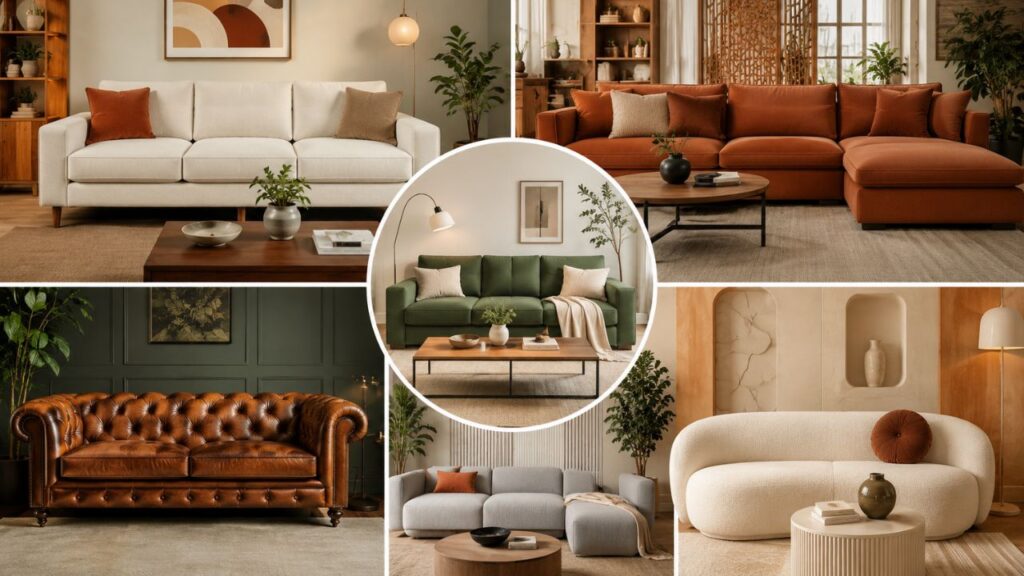
1. The Sofa (Standard Three-Seater)
This is the baseline everyone pictures: roughly 72 to 84 inches wide, seats two to three people comfortably. Most of the couch styles below are really variations on this basic shape, differentiated by arm, back, and leg details. If your living room is a standard size and you want a piece that plays well with almost any decor, a classic sofa is your safest bet.
2. The Loveseat
A loveseat is essentially a sofa cut down to seat two. It typically runs 52 to 72 inches wide. Loveseats get overlooked, but they’re genuinely one of the smartest picks for small apartments, home offices, or as a secondary seating piece paired with a larger sofa. Among the different types of couches, this is the one most likely to solve a genuine space problem rather than just a style preference.
3. The Sectional
Built from modular pieces (a chaise, corner unit, and one or more armless seats), a sectional is designed to wrap around a room. Families gravitate toward these because they maximize seating without needing a second couch, and many modern versions can be reconfigured or split apart if you move. The tradeoff: sectionals are heavy commitments in terms of both floor space and price, so measure your room twice before you buy once.
4. The Loose Pillow Back Sofa
Instead of one fixed cushion running the length of the back, this style uses individual loose pillows. It reads as more casual and gives you the flexibility to fluff, rearrange, or eventually replace cushions without buying a whole new sofa. This is one of the more forgiving sofa styles for households with kids or pets, since worn cushions are cheaper to swap than reupholstering an entire tight-back frame.
5. The Tight Back Sofa
The opposite approach: the back cushion is sewn permanently into the frame, creating a cleaner, more tailored silhouette. Tight back sofas tend to look more formal and structured. They’re lower maintenance day to day (no fluffing required) but harder to refresh later since the upholstery is fixed.
6. The Camelback Sofa
Named for the distinctive hump in the middle of the backrest, camelback sofas usually pair with exposed wood legs and rolled arms. This is a more traditional, almost antique-adjacent look. If your home leans toward classic or English country style, this is one of the more distinctive types of sofas you can bring into the room.
7. The Lawson Sofa
Probably the most common couch shape in American living rooms today, even if nobody calls it by name. A Lawson has a separate back cushion set against the frame (rather than sewn in) and low, simple arms, often lower than the back. It’s comfortable, casual, and pairs with nearly any decor style, which is exactly why furniture brands keep producing endless variations of it.
8. The English Roll Arm Sofa
Slightly tighter and more tailored than a Lawson, with arms that roll outward and are usually a bit lower than the back cushions. It’s a favorite among interior designers for its “quietly expensive” look. This is one of those couch styles that photographs beautifully but is worth sitting on in person first, since the roll can affect how much you can actually lean on the arm.
9. The Chesterfield
Deep button tufting, rolled arms that match the height of the back, and typically a leather or leather-look upholstery. Chesterfields carry a formal, clubby energy and work best as a statement piece rather than a blend-into-the-background couch. Among all the types of couches on this list, it’s the one most likely to become the focal point of the room whether you plan for that or not.
10. The Tuxedo Sofa
We got a specific question about this one, so let’s answer it directly.
What is a tuxedo sofa? A tuxedo sofa is defined by arms and a back that are the exact same height, creating a clean, squared-off silhouette, almost like the couch is wearing a tailored jacket (hence the name). There’s no rolled or curved arm here; everything is straight lines and sharp corners. Tuxedo sofas tend to look modern or Art Deco depending on the fabric and legs, and they’re popular in spaces that want a more architectural, less fussy feel. If you’ve seen a couch in a design magazine that looked almost geometric, more like a piece of sculpture than a place to nap, there’s a good chance it was a tuxedo sofa.
11. The Chaise Lounge / Convertible Sofa
Technically its own category, a chaise lounge is a single elongated seat, often used alone or paired with a sofa. Convertible versions (sofa beds, futons, pull-out sleepers) fall into this bucket too. If you regularly host overnight guests but don’t have a spare bedroom, this is worth serious consideration over a standard sofa.
Couch Styles vs. Sofa Types: Is There Actually a Difference?
Here’s something that trips people up during research: “couch” and “sofa” are functionally the same piece of furniture. The word “sofa” has roots tracing back to Arabic and Turkish terms for a raised, cushioned platform, while “couch” comes through French from a word meaning “to lie down.” Americans use both words fairly interchangeably today, though “sofa” tends to sound slightly more formal in casual conversation, and “couch” tends to sound more relaxed.
So when someone searches for sofa styles versus couch styles, they’re looking at the same list. The types of sofas we covered above (Lawson, Chesterfield, tuxedo, camelback, and so on) are identical to what you’d find under “styles of couches.” Don’t let the terminology slow down your research; focus on the actual construction details instead.
Comparison Table: Types of Couches at a Glance
| Style | Best For | Formality | Maintenance | Typical Price Range |
|---|---|---|---|---|
| Standard Sofa | Everyday living rooms | Medium | Low | $600–$2,000 |
| Loveseat | Small spaces, offices | Medium | Low | $400–$1,200 |
| Sectional | Families, media rooms | Casual | Medium | $1,000–$4,000+ |
| Loose Pillow Back | Casual, kid/pet homes | Casual | Medium | $700–$2,200 |
| Tight Back | Clean, tailored rooms | Formal | Low | $800–$2,500 |
| Camelback | Traditional interiors | Formal | Medium | $900–$3,000 |
| Lawson | Nearly any room | Casual-Medium | Low | $600–$2,200 |
| English Roll Arm | Designer, layered spaces | Medium-Formal | Medium | $1,000–$3,500 |
| Chesterfield | Statement piece, studies | Formal | Medium-High | $1,200–$4,000+ |
| Tuxedo | Modern, architectural spaces | Formal | Low | $900–$3,200 |
| Chaise/Convertible | Guest rooms, small homes | Casual | Low-Medium | $500–$2,000 |
Prices vary widely by fabric, frame quality, and retailer, so treat this as a general orientation rather than a quote.
What About IKEA Couches?
I’d be doing you a disservice if I skipped this, because so many people searching for couch information end up there anyway. An IKEA couch occupies a specific and honestly useful niche: modular, budget-conscious, and designed for people who move apartments every couple of years.
The KIVIK and SÖDERHAMN lines function like build-your-own sectionals, so you can start with a loveseat-sized configuration and add sections later as your space or budget grows. That flexibility is genuinely rare outside of custom furniture makers. The tradeoff with an IKEA sofa is frame material; many models use particleboard or engineered wood rather than solid kiln-dried hardwood, which means they’re not built for a 20-year lifespan the way a higher-end sectional might be.
That said, dismissing IKEA couches as “cheap” misses the point. For renters, first apartments, or anyone who wants low-commitment furniture while they figure out their long-term style, an IKEA sofa is a genuinely smart choice. Just budget for replacing the cushion foam or the cover fabric (both are sold separately, which is one of IKEA’s underrated advantages) every few years rather than expecting heirloom-level durability.
Sofa Trends and Couch Trends Heading Into 2026
Trend forecasting in furniture moves slower than fashion, but a few directions are showing up consistently across designer showrooms and retailer catalogs right now.
Curved and rounded silhouettes. After a decade of hard right angles, curved backs and rounded arms are showing up everywhere, from budget retailers to high-end design houses. This is one of the more visible sofa trends of the last two years and it doesn’t show signs of slowing down.
Bouclé and textured boucle-adjacent fabrics. The nubby, tactile look that took over Pinterest boards a few seasons back has settled into the mainstream. It’s not going away; it’s becoming a standard fabric option rather than a niche one.
Warm, saturated color. Beige and gray dominated for years. Now terracotta, olive, deep burgundy, and warm browns are showing up as standard options rather than special orders, a shift that’s reshaping couch trends across nearly every price tier.
Modular, reconfigurable pieces. This one’s practical rather than purely aesthetic. As more people rent, move, or downsize, sectionals and sofas that break into separate modules (rather than one fixed shape) are becoming the default rather than the exception.
Low-profile, wide-arm designs. A softer, lower-slung silhouette with wide, almost table-like arms is showing up in a lot of what furniture editors are calling the best couches 2026 has to offer so far. It’s a direct reaction against the very deep, cloud-like sofas that were everywhere a few years ago; people are asking for pieces that still look intentional and structured, not just soft.
If you’re shopping with resale or longevity in mind, note that trend-driven pieces (bold curves, saturated color) tend to date faster than a classic Lawson or tight-back sofa in a neutral fabric. That’s not a reason to avoid them, just something worth weighing if you don’t plan on redecorating again soon.
How to Actually Pick the Right Couch for Your Space
Knowing the types of couches is only half the job. Here’s how I’d actually walk through a decision if a friend asked me for help.
- Measure your space before you fall in love with anything. Include doorways, hallways, and stairwells, not just the room itself. More returns happen because a couch couldn’t physically get inside than for any style reason.
- Think about how you actually sit, not how you imagine sitting. If you’re someone who curls up sideways, a deep seat with a loose pillow back will serve you better than a tight, formal English roll arm.
- Match the arm height to your habits. Rest your head or elbow on the arm at the store. If you can’t picture doing that for two hours during a movie, keep looking.
- Ask about the frame material specifically. Kiln-dried hardwood outlasts pine or particleboard by years. Salespeople will tell you this if you ask directly; they rarely volunteer it.
- Consider your household. Kids, pets, or heavy daily use point you toward performance fabrics and loose cushion covers you can remove and wash, not delicate velvets or fixed tight-back upholstery.
- Decide your formality level honestly. A chesterfield in a house with toddlers is asking for trouble. A Lawson or sectional in a formal sitting room can feel underdressed. Match the couch style to how the room actually gets used, not how you photograph it for one holiday a year.
Common Mistakes People Make Buying a Couch
- Buying based on the showroom photo instead of sitting on it for at least five full minutes
- Ignoring seat depth, which affects comfort more than almost any other single spec
- Choosing white or very light fabric without checking whether it’s actually cleanable performance fabric
- Skipping the doorway and stairwell measurement (this is the single most common return reason furniture retailers report)
- Assuming all types of sofas need matching end tables and coffee tables in the same wood tone; mixed materials read as more intentional today than perfectly matched sets
Fabric and Material Choices That Change Everything
Style gets most of the attention, but fabric is what determines whether your couch still looks good in three years or starts pilling and staining within months. A few categories worth knowing:
Performance fabrics. Originally developed for outdoor furniture, these woven synthetics (often polyester or a poly-blend) now dominate the mid-range indoor market because they resist stains, fading, and pet claws far better than traditional upholstery. If you have kids, dogs, or you just eat dinner on the couch more often than you’d admit, this is worth prioritizing over a fabric that merely looks nice in the showroom.
Velvet. Gorgeous, and one of the reasons certain couch styles like the Chesterfield and tuxedo sofa photograph so well. Velvet also shows crushing and watermarks easily, so it suits low-traffic formal rooms better than a family den.
Leather and leather-look. Durable, easy to wipe down, and ages into a nice patina over time on genuine leather. It can feel cold in winter and sticky in summer, and it’s less forgiving of claw marks than a woven fabric.
Linen and cotton blends. Breathable and casual, common on Lawson and English roll arm sofas. Natural fibers wrinkle and can stain more easily than synthetic blends, so they’re a better fit for lower-mess households.
Boucle. The textured, looped fabric behind a lot of current sofa trends. It’s cozy and visually distinct, but the loops can snag on pet claws or jewelry, worth testing in person if that’s a concern in your home.
Whatever fabric you land on, ask the retailer directly about abrasion rating (measured in “double rubs” on a scale most furniture stores can show you). Anything above 15,000 double rubs is considered suitable for heavy daily use; anything under 10,000 is better reserved for occasional-use rooms.
Sizing a Couch to Your Actual Room
A common mistake among first-time buyers is choosing a couch that looks proportionate in a photo but overwhelms the room in person. A few sizing rules of thumb that hold up across most of the different types of couches we’ve covered:
- Leave at least 30 to 36 inches of walking space in front of the couch for a coffee table and traffic flow
- For an open-concept living room, a couch should generally take up no more than two-thirds of one wall’s length
- If you’re combining a sofa with a loveseat or accent chairs, keep seat heights within an inch or two of each other so the grouping reads as intentional rather than mismatched
- In small apartments, an armless or track-arm sofa can save four to six inches of width compared to a rolled-arm equivalent, which matters more than it sounds like it would
None of this is about rules for their own sake. It’s about making sure whichever style of couch you choose, from a compact loveseat to a full sectional, actually functions the way you need it to once it’s home and not just admired in a catalog photo.
FAQ: Couches and Sofa Styles
What’s the difference between a couch and a sofa? Functionally, nothing. Both terms describe the same upholstered seating piece meant for two or more people. “Sofa” tends to sound slightly more formal in everyday conversation, but retailers and designers use the words interchangeably.
What is a tuxedo sofa? A tuxedo sofa has arms and a back set at the exact same height, creating a squared-off, tailored silhouette without rolled or curved arms. It’s a favorite in modern and Art Deco-leaning interiors.
What are the most common types of couches for small apartments? Loveseats, apartment-size sofas (usually under 72 inches wide), and modular IKEA couches like the KIVIK or SÖDERHAMN lines tend to work best in tight spaces, since you can scale seating up or down as needed.
Are IKEA couches actually good quality? An IKEA sofa is built for flexibility and affordability rather than decades-long durability. Frames are often engineered wood rather than solid hardwood, but the modular design, replaceable covers, and low price point make them a smart choice for renters or first apartments.
What couch style is most timeless? The Lawson sofa is generally considered the safest, most enduring of all the couch styles because its clean lines pair with nearly any decor era, from mid-century to modern farmhouse.
How do I know what type of sofa fits my living room? Start with your room’s formality level and your household’s daily habits (kids, pets, guests), then match that to arm height, seat depth, and fabric durability before worrying about color or trend.
What are the biggest sofa trends for 2026? Curved silhouettes, textured boucle-style fabrics, warm saturated colors like terracotta and olive, and low-profile wide-arm frames are the couch trends showing up most consistently across both budget and high-end retailers right now.