
I repainted my own staircase three times before I got it right. The first attempt looked great for about six weeks, and then the paint on the third and fourth steps started chipping where feet actually land. The second attempt held up better, but I picked a stair paint colour that clashed with everything else in the hallway. By the third go, I’d learned enough about primers, sheen levels, and traffic patterns to get a result that’s still holding up four years later.
That’s really what this guide is about. Not just pretty pictures of painted stairs, though there will be plenty of ideas here too, but the practical groundwork that makes the difference between a staircase that looks good in photos and one that actually survives daily use, kids, pets, and the odd dropped suitcase.
If you’re searching for painted stairs ideas, wondering what color to paint stair railing, or trying to work out the best way to paint stairs so it doesn’t peel within a season, you’re in the right place. We’ll cover the whole process: planning, product choice, technique, and a long list of design directions, from a single bold colour to a full stair paint design with patterned risers.
Why So Many Homeowners Are Painting Their Stairs
Carpet runners wear out. Bare wood staircases can look tired, dated, or mismatched with newer flooring. And full staircase replacement is expensive — often running into thousands of pounds or dollars depending on where you live and how many steps you have. Painting stairs sits in a sweet spot: it’s a weekend-to-week-long project that costs a fraction of a replacement and can completely change how a hallway feels.
There’s also a design trend behind it. Interior design accounts on social media are full of colorful stairs, striped runners painted directly onto treads, and staircases used as a genuine design feature rather than something you just walk past. Painted staircase ideas have moved well beyond plain white risers — homeowners are now treating the staircase the way they’d treat a feature wall.
Search interest reflects this shift too. People aren’t just typing “paint stairs” anymore. They’re searching for stairs wall design painting, staircase colour ideas, and even quite specific queries like painted staircase ideas UK, which tend to favour muted, heritage-friendly palettes compared to the brighter, high-contrast looks popular in newer-build American homes.
Planning Before You Pick Up a Brush
Good results start before any paint touches wood. Rushing this stage is the single biggest reason painting stairs goes wrong.
Assess What You’re Working With
- Bare wood needs sanding and a bonding primer.
- Previously varnished stairs need the varnish sanded back or stripped, otherwise paint won’t grip.
- Carpeted stairs being uncovered often have staple holes, nails, and uneven boards that need filling first.
- Painted stairs being refreshed just need a light sand and a compatible primer, assuming the old finish isn’t flaking badly.
Tools and Materials Checklist
| Item | Purpose | Notes |
|---|---|---|
| 120–150 grit sandpaper | Smooths surface, keys the wood | Use 220 grit for a final light pass |
| Degreaser or sugar soap | Removes grime and foot oils | Skip this step and paint may peel within weeks |
| Stain-blocking primer | Stops tannin bleed-through | Essential on pine and older varnished wood |
| Floor and stair enamel paint | The main paint for stairs | Look for products rated for foot traffic |
| Painter’s tape | Clean lines between treads, risers, and railing | Low-tack tape avoids pulling up fresh paint |
| Small foam roller and angled brush | Application | Foam rollers leave fewer lines on flat treads |
| Polyurethane topcoat | Protects the finish | Water-based dries faster and doesn’t yellow |
Choosing the Right Paint for Stairs
This is where a lot of people go wrong, and it’s worth slowing down on. Regular wall paint or even standard trim paint isn’t built for the abrasion a staircase takes. You want a paint for stairs that’s specifically formulated for floors, decks, or stairs — these products contain harder resins designed to resist scuffing.
Benjamin Moore’s Advance line and Sherwin-Williams’ Porch and Floor Enamel are two products professional painters mention often in the US market. In the UK, Farrow & Ball’s Floor Paint and Little Greene’s Intelligent Floor Paint are popular choices, partly because they come in the same heritage colour ranges used elsewhere in the home, which makes matching a stair paint design to existing skirting boards or doors much easier.
Oil-based enamel used to be the default for durability, but low-VOC water-based floor paints have closed the gap significantly over the last decade, and they’re far more pleasant to work with indoors, especially if you don’t want the whole house smelling of solvent for three days.
How to Paint Stairs: A Step-by-Step Process
Here’s the sequence I’d recommend, based on both professional guidance and my own trial-and-error experience. This is genuinely the best way to paint stairs if you want a result that lasts rather than one that looks fine until the first birthday party.
- Clear the stairs completely. Remove carpet, staples, nails, and any existing hardware you don’t want painted over.
- Repair before you sand. Fill gaps, cracks, and old nail holes with wood filler. Let it cure fully.
- Sand every surface you plan to paint — treads, risers, stringers, and the railing if it’s being painted too. Vacuum thoroughly afterward; dust left behind shows up as texture under paint.
- Clean with a degreaser. Stairs collect hand oils and shoe residue that ordinary dusting won’t remove.
- Prime. Two thin coats beat one thick one. Let each coat dry fully rather than rushing to the next step.
- Paint every other step first. This is the trick most tutorials skip. Painting the stairs in an alternating pattern means you can still use the staircase (carefully, on the unpainted steps) while everything dries, which matters if it’s your only way upstairs.
- Apply two coats of your chosen colour, sanding lightly with fine paper between coats for the smoothest finish.
- Finish with a protective topcoat on the treads specifically — this is the layer that actually takes the daily wear, so don’t skip it to save time.
- Wait longer than you think before use. Paint can feel dry to the touch within hours but needs one to two weeks to properly cure and reach full hardness underfoot.
A quick note on stair painting technique: work in the direction of the wood grain, use light, even coats, and resist the temptation to load the brush heavily to finish faster. Thick coats are the number one cause of drips, uneven sheen, and paint that stays tacky for days.
What Color to Paint Stair Railing
The railing gets touched constantly, so it needs both a durable paint and a colour that won’t show every fingerprint within a week. A few directions that consistently work well:
- Matte black or charcoal — hides marks exceptionally well and pairs with almost any wall colour, which is why it’s become close to a default choice in newer homes.
- Crisp white — classic, brightens a dark hallway, but shows scuffs faster and needs more frequent touch-ups.
- Matching the wall trim — a safe, cohesive option if you’re not trying to make the railing a focal point.
- A contrasting accent tone — sage green, navy, or deep terracotta railings against neutral treads create a deliberate, designed look rather than an accidental one.
If you’re still deciding what color to paint stair railing, a useful trick is to hold sample boards against the railing at different times of day, since hallway lighting often shifts dramatically between morning and evening and a colour that looks warm at 9am can look muddy by 6pm.
Painted Stairs Ideas Worth Considering
There’s no single right way to do this, but a few approaches show up again and again in homes that get it right. When people search for painting stairs ideas, they’re usually choosing between two mindsets: play it safe with a neutral tone that ages well, or commit to something bolder that turns the staircase into a talking point. Both are valid, and the right painting stairs ideas depend more on how much natural light the stairwell gets and how long you plan to stay in the house than on any single trend.
Colourful Stairs and Bold Statements
Colorful stairs have become one of the more Instagrammed home projects of the last few years, and for good reason — a rainbow gradient up a staircase or a colorful staircase where every riser is a different shade turns a purely functional space into something people actually stop to look at. This works especially well in homes with children, in stairwells with good natural light, or in properties where the staircase is visible from the front door and sets the tone for the whole house. A colorful staircase doesn’t need every shade to clash on purpose either — many of the best-looking examples stick to one colour family and simply vary the tone from step to step, which reads as playful rather than chaotic.
Modern Painted Stairs
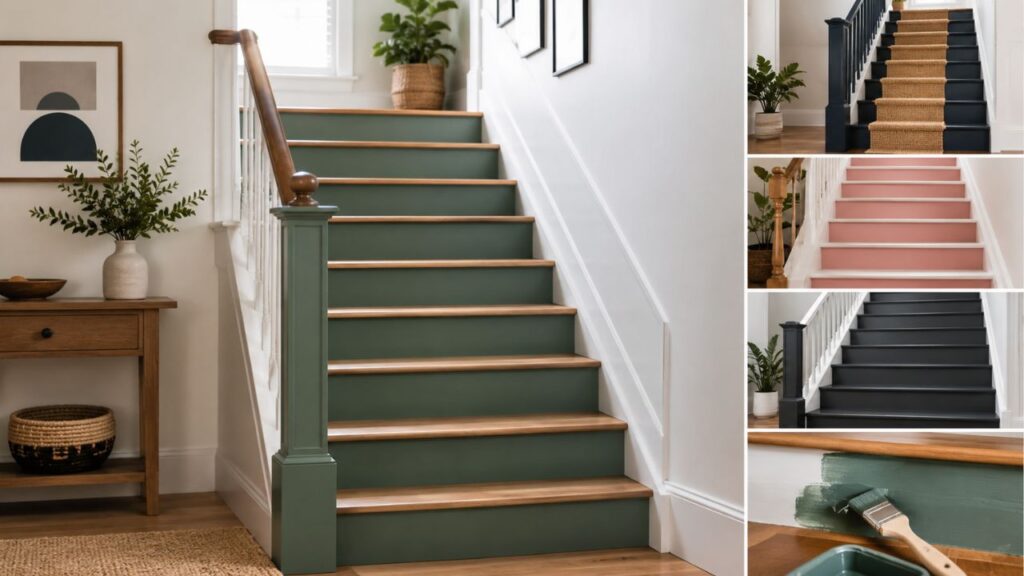
Modern painted stairs tend to favour restraint over riot of colour: a single deep tone like charcoal, forest green, or navy on the risers, paired with a lighter, natural or painted tread. The contrast reads as intentional and architectural rather than decorative, and it photographs particularly well against white walls and black metal balustrades.
Painted Staircase Ideas UK Homeowners Tend to Prefer
Painted staircase ideas UK searches skew toward heritage tones — sage, dusty pink, soft grey-blue, and off-white — which makes sense given how many UK homes are period properties with original wood staircases worth preserving rather than covering entirely. A common approach here is painting the risers a muted colour while leaving the treads in a natural wood stain or a durable clear finish, which respects the original joinery while still updating the look.
Painted Stair Cases as a Design Feature
Some of the most memorable painted stair cases treat the entire structure — stringers, risers, and even the underside — as one continuous design surface rather than treating each part separately. This full-commitment approach tends to work best when the staircase is a standalone feature, such as in an open-plan hallway or a loft conversion where the stairs are visible from multiple angles.
A staircase painted with even one confident colour decision tends to outshine one where every detail was agonised over but the final result stayed muted and forgettable. Whether the staircase painted ends up bold or restrained, the goal is the same: a finish that looks deliberate rather than accidental.
Stairs Wall Design and Painting: The Overlooked Half
People spend so much time thinking about the treads that the walls running alongside get ignored, which is a missed opportunity. Stairs wall design painting deserves just as much thought, because a staircase is usually one long, uninterrupted wall — often the biggest single wall in the house — and it’s rarely furnished or broken up the way a living room wall is.
A few directions worth trying:
- Gallery wall running up the incline, following the angle of the stairs rather than a straight horizontal line.
- A single accent colour on the stairwell wall only, distinct from the rest of the hallway, which visually frames the staircase as its own zone.
- Ombre or gradient painting, transitioning from a darker shade at the bottom to a lighter one near the top, which can make a narrow stairwell feel taller.
- Stripes or geometric patterning, either horizontal bands or a diagonal pattern that echoes the pitch of the stairs, is one of the simplest forms of stairs wall painting to execute yourself with painter’s tape and a steady hand.
Unique wall painting for stairs doesn’t have to mean elaborate murals, although hand-painted scenes and botanical designs do show up in higher-end interior projects. Even a well-chosen paint sheen — matte lower down where hands and bags brush against it, and a slightly higher sheen above head height — counts as thoughtful stairs wall painting. If you want unique wall painting for stairs without committing to a full mural, a stencilled border running alongside the stair wall painting gives a similar handmade feel with far less effort.
Staircase wall stair wall colour choices also affect how the whole hallway reads. A dark stairwell wall against light treads creates drama and makes the staircase itself the focal point; a light wall with a dark stair paint design does the reverse, letting the stairs recede while the architecture of the space takes over. These decisions are worth mapping out before buying any paint, since staircase colour ideas that look great on a sample chip can read completely differently once they’re spread across a full run of treads and risers under real hallway lighting. Getting the staircase wall stair wall colour pairing right is largely about contrast: too little, and the space feels flat; too much, and it feels busy rather than intentional.
Stair Paint Design Details That Change Everything
A stair paint design is really just a set of decisions about where colour changes happen: tread versus riser, wall versus railing, top versus bottom of the run. Small choices here have an outsized visual effect.
- Two-tone treads and risers — a neutral tread with a bold riser colour is one of the most forgiving combinations because the tread, which takes the most wear and shows the most scuffing, stays practical while the riser carries the personality.
- Stencilled or painted patterns on risers — Moroccan tile-style motifs, simple geometric shapes, or even painted numbers are a popular way to add detail without repainting the entire structure.
- Runner-effect painting — a painted stripe down the centre of each tread, mimicking a fabric stair runner, gives texture and visual interest without the maintenance of an actual textile runner.
Painting Stair Treads: What to Get Right
Painting stair treads is the part of the job that takes the most physical punishment, so it deserves the most attention to preparation and product choice.
Painted stair treads need:
- A floor-rated enamel, not a wall or trim paint, since ordinary paints simply aren’t built to withstand feet.
- A non-slip additive mixed into the final coat, or a textured additive product, particularly on stairs without a runner or on households with young children or older residents.
- A cured topcoat before regular use — this is the step people skip most often, and it’s the reason so many painted stair treads start looking worn within a month or two.
If durability is the priority, some homeowners paint the risers a decorative colour and leave the treads a stained natural wood or a simple, hard-wearing clear coat, sidestepping the wear issue on treads entirely while still getting the visual benefit of colour lower down.
Ideas for Painting Stairs and Landing Together
The landing at the top (or bottom) of a staircase often gets treated as an afterthought, but ideas for painting stairs and landing that treat the two as one continuous space tend to look far more finished. A colour or pattern that starts on the risers and continues onto the landing floor, rather than stopping abruptly at the top step, reads as planned rather than incidental.
A few approaches that work well together:
- Extending the same riser colour onto a painted landing floor as a border or full colour block.
- Using the landing as a transition zone — a lighter shade of the stair colour, rather than an identical match, which softens the change from stairwell to open room.
- Painting a simple geometric rug effect on the landing floor that echoes a pattern used on the stair risers below.
Comparison: Paint Types for Stairs
| Paint Type | Durability | Drying Time | Best For | Downsides |
|---|---|---|---|---|
| Oil-based enamel | Very high | Slow (24+ hrs between coats) | High-traffic stairs, rentals | Strong odour, longer cure time |
| Water-based floor enamel | High | Fast (4–6 hrs between coats) | Most family homes | Slightly less hard than oil-based |
| Chalk-style furniture paint | Low–medium | Fast | Decorative risers only, not treads | Needs heavy topcoating to survive foot traffic |
| Standard wall/trim paint | Low | Fast | Not recommended for stairs | Wears through quickly, not made for abrasion |
Common Mistakes When Painting the Stairs
- Skipping the primer. Paint applied straight onto varnished or previously sealed wood often peels within weeks.
- Using wall paint on treads. It simply isn’t engineered for the abrasion.
- Not allowing full cure time. A surface can look and feel dry long before it’s actually hardened enough for regular foot traffic.
- Ignoring ventilation. Stairwells are often narrow and poorly ventilated, which slows curing further and can trap fumes.
- Painting in one thick coat instead of two or three thin ones, leading to drips, tackiness, and an uneven sheen.
A Quick Word on Cost and Timeline
Most DIY stair painting projects, for an average 12–14 step staircase, run somewhere between a weekend and five days depending on drying time between coats, and typically cost a fraction of professional refinishing or full replacement — often in the range of the cost of paint, primer, sandpaper, and tape rather than the labour-heavy cost of hiring a contractor. Professional stair painting and refinishing services, if you’d rather not do it yourself, generally price by the step or by square footage, and it’s worth getting at least two quotes since pricing varies considerably by region and by whether structural repairs are needed first.
Frequently Asked Questions
What is the best way to paint stairs so they don’t chip quickly? Proper preparation matters more than the paint brand. Sand thoroughly, use a stain-blocking primer, apply a floor-rated enamel in thin coats, and finish with a durable polyurethane topcoat on the treads specifically. Skipping any one of these steps is usually where chipping starts.
How long should I wait before walking on painted stairs? Most floor enamels are dry to the touch within a few hours, but full cure — the point at which the paint reaches its maximum hardness — usually takes one to two weeks. Light, careful use is generally fine after 48–72 hours, but treat the surface gently until then.
Can I paint over varnished stairs without sanding? Not successfully, in most cases. Varnish creates a slick surface that paint doesn’t bond to well. A light sanding pass to dull the sheen, followed by a bonding primer, gives the new paint something to grip.
What color to paint stair railing if my walls are neutral? Matte black and charcoal are safe, durable choices that hide fingerprints well and work with almost any wall colour. If you’d rather add personality, a single accent tone like navy or deep green on the railing alone creates contrast without overwhelming the space.
Are painted stairs slippery? They can be if you skip a non-slip additive or textured finish, especially on treads without a runner. Adding a fine anti-slip additive to the final coat, or choosing a textured floor paint, addresses this without changing the look significantly.
Do painted stairs increase home value? There’s no formal data specifically isolating painted stairs, but real estate agents and home stagers generally agree that a well-maintained, visually cohesive staircase contributes positively to a buyer’s first impression, since the stairs are often one of the first things visible from the entryway.
Internal Linking Suggestions
For a site publishing this article as part of a broader home-renovation content hub, these supporting and pillar pages would strengthen topical authority:
- Pillar page: “Complete Guide to Interior Painting” (links out to this article as a specialised sub-topic)
- Cluster page: “How to Choose Interior Paint Sheen: Matte, Eggshell, Satin, and Gloss Explained”
- Cluster page: “Hallway Design Ideas: Making the Most of Narrow Spaces”
- Cluster page: “Wood Floor Refinishing vs Painting: Which Is Right for Your Home?”
- Cluster page: “Best Non-Slip Additives for Painted Floors and Stairs”
- Contextual anchor: link “stair-rated enamel paint” to a dedicated buying-guide page comparing specific brands
- Contextual anchor: link “painted stair treads” to a maintenance and touch-up guide for high-traffic painted surfaces
Final Thoughts
Painted stairs reward patience more than talent. Nearly all of the difference between a staircase that still looks sharp two years later and one that’s chipped and grubby within months comes down to preparation, product choice, and giving the paint the time it actually needs to cure — not artistic skill with a brush. Pick a stair paint design that fits how the space is actually used, choose paint for stairs rated for foot traffic rather than whatever’s left over from painting the walls, and the rest tends to fall into place.
Entity List Used
Benjamin Moore, Sherwin-Williams, Farrow & Ball, Little Greene, Advance (paint line), Porch and Floor Enamel, Floor Paint, Intelligent Floor Paint, polyurethane, wood filler, sugar soap, VOC (volatile organic compounds), Moroccan tile design, UK period properties
Semantic Keywords Used
stair-rated enamel, floor-rated paint, bonding primer, stain-blocking primer, non-slip additive, riser and tread, balustrade, stringers, wood grain, cure time, foot traffic durability, topcoat, sheen level, heritage colour palette, open-plan hallway, loft conversion, gradient/ombre painting, stencilled pattern, runner-effect painting
NLP Phrases Used
“what color to paint stair railing if my walls are neutral,” “how long should I wait before walking on painted stairs,” “can I paint over varnished stairs without sanding,” “are painted stairs slippery,” “do painted stairs increase home value,” “best way to paint stairs so they don’t chip quickly”